
Why the Distinction Matters
Walk into almost any kitchen and you'll find a knife block — but ask the owner when they last sharpened their knives versus honed them, and most will use the terms interchangeably. That confusion has real consequences: a cook who only hones will eventually find their knives unable to hold an edge, while one who only sharpens will wear their blades down faster than necessary.
Understanding the difference isn't just kitchen trivia. It directly affects how well your knives perform, how long they last, and how safely they cut. A dull knife requires more force, which increases the chance of slipping and injury.
2–4×
How often most home knives need sharpening per year
Kitchen equipment guides and culinary educators generally suggest sharpening home-use knives two to four times annually when honing is practiced regularly.
30 seconds
Time needed for a basic honing session
A standard pre-use honing routine of six to eight strokes per side typically takes under a minute, making it practical to do before most cooking sessions.
What Honing Actually Does
Every time a knife blade contacts a cutting board, the thin metal edge — which tapers to a near-microscopic point — flexes and bends slightly out of alignment. This doesn't remove metal; it simply displaces it. The knife isn't dull in the conventional sense, but it cuts less effectively because the edge is no longer straight.
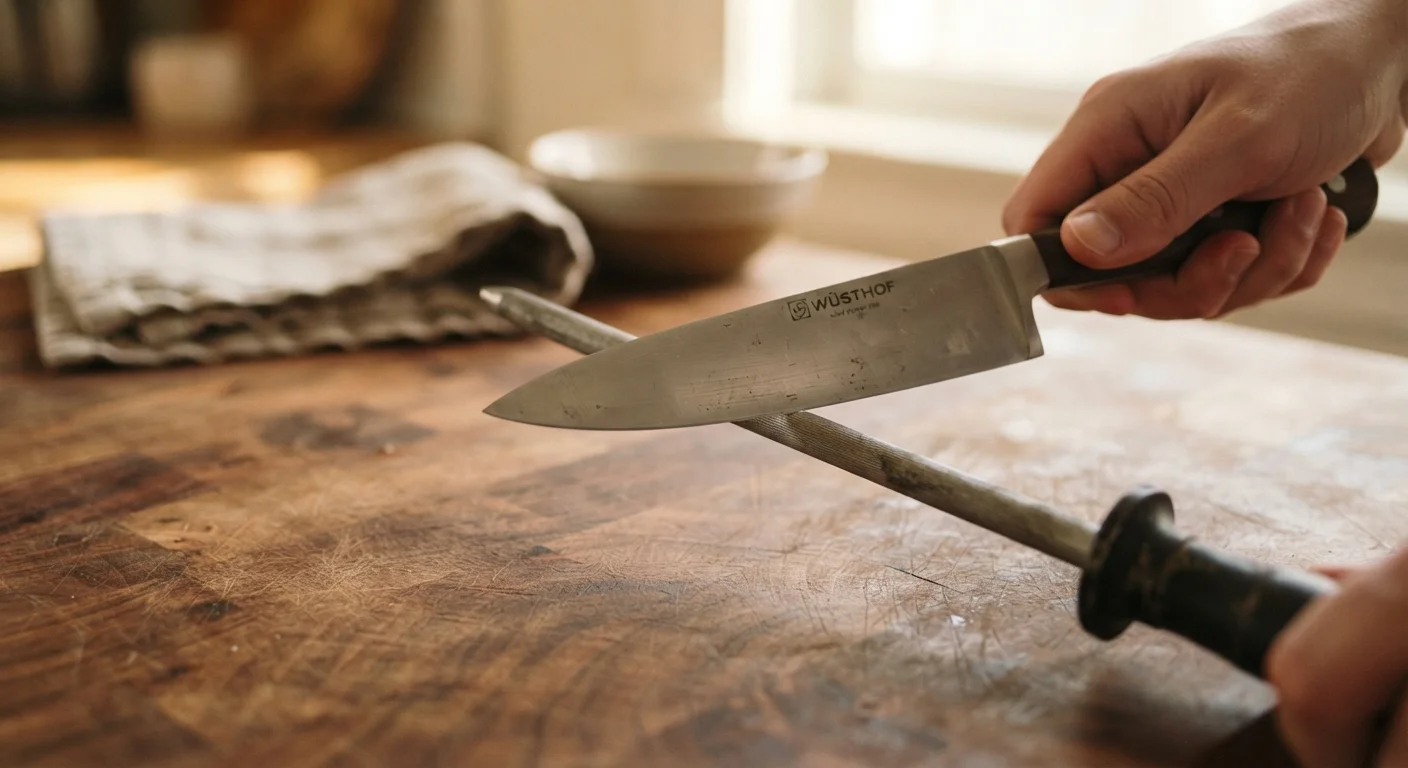
A honing steel corrects this by guiding the blade along a rod at a consistent angle, pressing the bent edge back into true. The result is immediate: a knife that felt sluggish will cut more crisply after just a few passes. Think of it like straightening a bent hair — the material is the same; it's just been repositioned.
Consistent Angle Is Key
When honing, maintaining a consistent blade angle — typically 15 to 20 degrees for most Western knives — is more important than speed. A few slow, deliberate passes produce better results than rushed strokes at an inconsistent angle. Many honing steels are marked or sold with angle guides to help beginners develop the feel.
What Sharpening Actually Does
When honing no longer restores performance, the edge has worn down beyond simple misalignment — it has become genuinely blunt or chipped. At that point, metal must be removed to expose a fresh, sharper edge. This is sharpening.
Sharpening is an abrasive process. Whether done with a whetstone, a pull-through sharpener, or a motorized grinder, the tool grinds away steel to reform the blade's geometry. Each method involves trade-offs in speed, control, and how much metal is removed per session. Because sharpening is irreversible — the steel is gone — using the most aggressive tool unnecessarily shortens a knife's working life.
Building a Simple Knife Maintenance Routine
Most home cooks don't need a complicated system. A practical approach combines frequent honing with occasional sharpening based on actual performance rather than a fixed calendar.
- Before significant cooking sessions: a few passes on a honing steel takes under a minute and maintains performance between sharpenings.
- When the paper test fails: if honing no longer restores a clean cut, sharpen — but choose the least aggressive method that does the job.
- Store knives properly: magnetic strips and blade guards prevent edge damage better than loose storage in a drawer.
- Choose appropriate cutting surfaces: wood and plastic boards are far gentler on edges than glass, ceramic, or stone.
Combining these habits means most quality kitchen knives need professional or at-home sharpening only two to four times per year, while staying consistently sharp the rest of the time.
“A sharp knife is a safe knife. The force required to push a dull blade through food is exactly what sends it off course and into your hand.”
— Culinary Institute of America, Culinary arts education institution, widely cited in professional kitchen training