
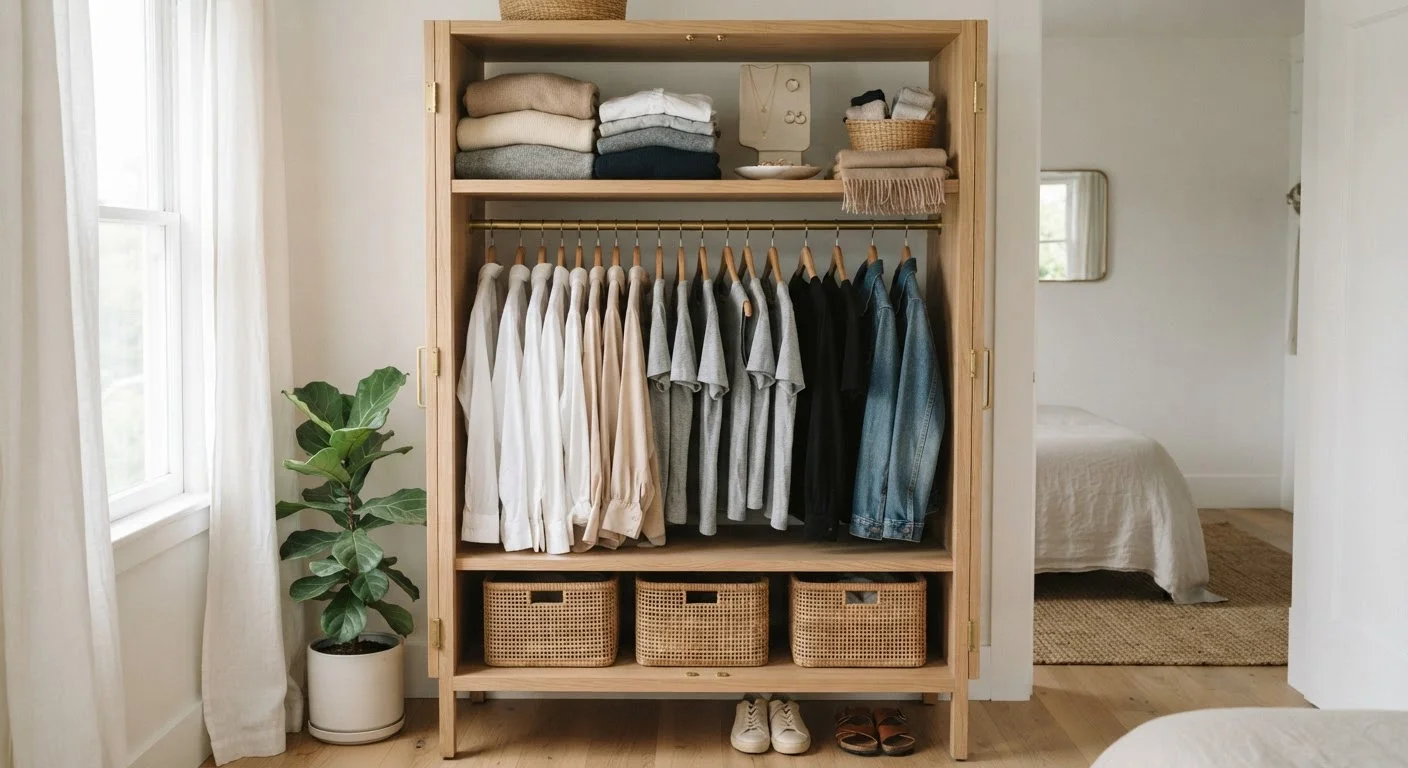
Why Starting from Scratch Is Actually an Advantage
There's a quiet freedom in having an empty or nearly empty closet. No inherited clutter, no decade-old pieces you keep out of guilt, no mystery items you don't remember buying. Starting from scratch means you get to build something that actually fits your current life — and that's genuinely valuable.
The overwhelm most people feel at this stage usually comes from trying to absorb too much advice at once: capsule wardrobes, color theory, investment pieces, seasonal transitions. This guide cuts through that noise. We'll help you build a working, confident wardrobe step by step — without making it more complicated than it needs to be.
Capsule wardrobe
A small, curated collection of clothing — typically 30–40 pieces — where every item works with the others, reducing decision fatigue and clutter.
Cost-per-wear
A way of thinking about clothing value: divide the price by the number of times you expect to wear it. A $60 item worn 60 times costs $1 per wear — often better value than a $20 item worn twice.
Wardrobe foundation
The core set of versatile, everyday pieces that cover the bulk of your real daily needs before adding anything more specialized or trend-driven.
Versatile piece
A clothing item that works across multiple contexts, occasions, or outfit combinations — making it pull more weight than a single-use or occasion-specific item.
One-in-one-out rule
A simple habit of donating or removing one existing item from your wardrobe every time a new piece comes in, keeping your closet from gradually growing unmanageable.
Clarify Your Life Before You Shop
The single most common wardrobe mistake is buying based on aspiration rather than reality. Before you add one item to your closet, take an honest inventory of how you actually spend your time. Think in rough percentages: What share of your week is work? Casual at home? Social outings? Exercise? Special occasions?
Someone who works from home and spends weekends outdoors needs an entirely different foundation than someone in a client-facing office role. Neither is wrong — but buying for the life you imagine rather than the one you live leads to pieces that just hang there unused.
Try the 'week in review' method
Spend five minutes writing down what you actually wore over the past two weeks — not what you wish you'd worn. This quick audit reveals your real wardrobe needs more accurately than any style quiz. It also shows you which categories are already covered and where the true gaps are.
Once you've mapped your week, you have a clear brief for what your wardrobe needs to do. That clarity is worth more than any shopping list someone else hands you. For deeper guidance on discovering your aesthetic alongside the practical stuff, see our end-to-end personal style guide.
The Foundation: What a Functional Wardrobe Actually Needs
Once you know your lifestyle breakdown, you can build a foundation that genuinely serves it. The categories below aren't rigid rules — treat them as starting prompts:
- Bottoms: Two to three pairs of well-fitting pants, jeans, or skirts that cover your most frequent contexts.
- Tops: Five to seven tops in colors and patterns that coordinate with your bottoms. Neutral tones — navy, white, grey, black, camel — mix the most easily.
- An outer layer: One or two pieces that bridge temperatures — a structured jacket, cardigan, or versatile coat depending on your climate.
- Footwear: Two to three pairs that cover your actual activities: a comfortable everyday shoe, something more polished, and something casual.
- One dress or smart outfit: A single, reliable option for occasions that call for a step up in formality.
Fit is everything here. A well-fitted basic in a modest fabric will always outperform a trendy piece that doesn't sit right on your body. Prioritize fit before price, label, or trend status.
For a deeper look at which specific clothing categories consistently earn their keep, our wardrobe staples guide is a natural next step.
How to Build Without Breaking the Budget
Building a wardrobe on a budget is very doable — it just requires sequencing your purchases instead of trying to do everything at once. Start with the pieces that cover the largest share of your week. Those earn the most cost-per-wear value and give you something functional immediately.
Resale and thrift shopping can stretch your dollars significantly, especially for basics and outer layers. Secondhand platforms have made quality pieces more accessible than ever across a range of styles and sizes.
Pacing your wardrobe investment
There's no rule that says you have to build everything at once. Many people find it useful to set a monthly clothing budget and stick to it, adding pieces deliberately over three to six months. This approach also gives you time to wear each new addition and confirm it actually works before buying more.
When you're thinking about what to spend, it helps to have a realistic budget framework in place. If spending limits and savings goals are still fuzzy for you, the Budgeting Basics hub offers practical strategies for building that financial foundation alongside any major purchase goal.
As your wardrobe grows, you'll also want to think about how pieces transition across seasons — adding a few strategic layers rather than buying an entirely new set of clothes each time. Our guide on dressing well across seasons covers exactly that.
Making It Work Long-Term
A wardrobe isn't a project you complete — it's a system you maintain. A few habits make that maintenance low-effort and sustainable:
- Do a brief quarterly check-in. Pull out anything you haven't worn in three months and ask honestly whether it serves you. Donate or resell items that don't.
- Apply the one-in-one-out principle. When something new comes in, something old goes out. This keeps volume manageable without requiring major purges.
- Buy to fill real gaps, not to browse. Shopping with a specific purpose — I need a second pair of work-appropriate pants — leads to better choices than shopping as entertainment.
- Take care of what you own. Following care label instructions, hanging or folding properly, and addressing small repairs promptly extends the life of every piece.
Getting dressed should feel like a low-stakes daily task, not an exhausting decision. When your wardrobe is aligned with your real life and deliberately built, that's exactly what it becomes.