
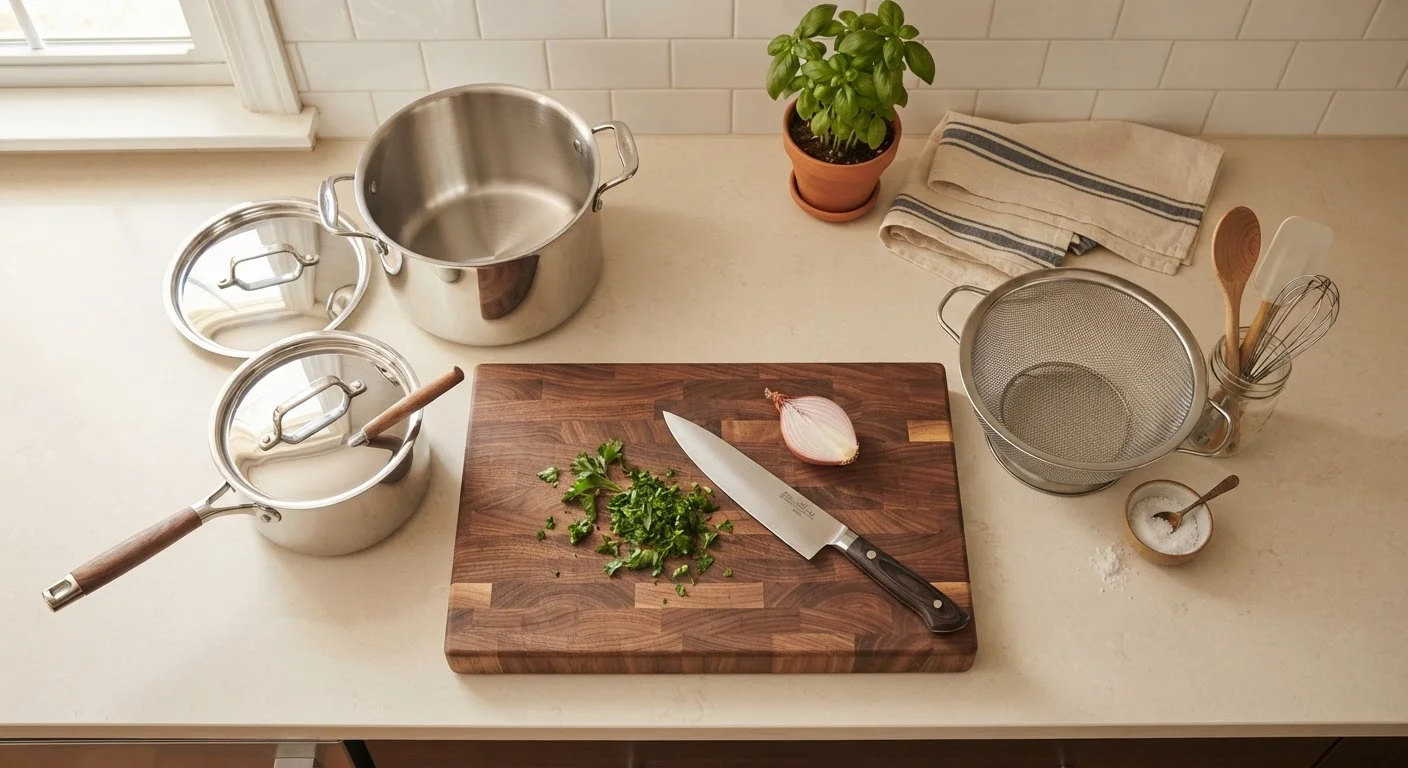
Start With Cookware, Not Gadgets
The first mistake most people make when setting up a new kitchen is buying too much at once — a full pot set, a gadget tower, and a spice rack all before cooking a single meal. A more practical approach: identify the core pieces that unlock the widest range of cooking, then fill gaps as real needs emerge.
For most beginners, four cookware items cover nearly everything:
- A 2- to 3-quart saucepan — for sauces, grains, reheating, and soups
- A large stockpot (6–8 quarts) — for pasta, boiling, and batch cooking
- A 10- or 12-inch skillet — for sautéing, frying, and one-pan meals
- A rimmed baking sheet — for roasting vegetables, sheet-pan dinners, and simple baking
This quartet handles breakfast through dinner without redundancy. If your budget allows, a Dutch oven or lidded braiser can replace both the stockpot and a casserole dish — a versatile investment worth considering as a second step.
Buy One Piece at a Time if Needed
There's no rule that says you need everything before you start cooking. Buying a single quality skillet and one pot first is a perfectly sound approach. Cooking with what you have reveals which gaps are real versus imagined, and prevents a cabinet full of items you'll never use.
The Knife Situation
Knives are where marketing pressure is highest and where beginners most often overspend. A full knife block looks professional, but most home cooks use only one or two blades regularly.
The only knife you truly need at the start is an 8-inch chef's knife. It can chop, slice, dice, and mince almost anything. Add a small paring knife (3–4 inches) for peeling, trimming, and detail work, and you have a genuinely complete cutting setup.
A few practical notes on knives:
- A sharp modest knife outperforms a dull expensive one — learn basic honing technique early.
- A simple honing steel or pull-through sharpener keeps edges functional between professional sharpenings.
- Avoid knives that come in large sets priced unusually low — the individual blade quality is often poor.
Handle Knives With Consistent Care
Never put knives in a dishwasher — heat and jostling dull blades and damage handles quickly. Hand-wash and dry knives immediately after use, and store them on a magnetic strip or in a knife guard rather than loose in a drawer. A sharp knife handled correctly is far safer than a dull one that requires excessive force.
Essential Small Tools and Prep Equipment
Once your cookware and knife situation is sorted, a handful of small tools makes the rest of cooking feel manageable rather than frustrating.
Honing
The process of straightening a knife blade's edge using a honing steel — not to be confused with sharpening, which actually removes metal to create a new edge.
Dutch oven
A heavy, deep pot with a tight-fitting lid that works on the stovetop and in the oven — useful for soups, stews, braising, and even bread baking.
Rimmed baking sheet
A flat metal pan with shallow edges on all sides that catches drips and keeps food in place — the standard tool for roasting and sheet-pan cooking.
Colander
A bowl with holes (usually metal or plastic) used to drain liquid from pasta, canned beans, or rinsed produce.
Prep and measuring:
- Two cutting boards (one for produce, one for raw proteins) — plastic boards are easy to sanitize; wood boards are gentler on knife edges
- Dry measuring cups and measuring spoons
- A liquid measuring cup (2-cup glass versions are especially durable)
Cooking tools:
- A wooden or silicone spoon for stirring
- A flat spatula for flipping
- A ladle for soups and sauces
- Tongs with locking mechanism
Finishing and storage:
- A colander for draining pasta and rinsing produce
- A vegetable peeler
- A box grater
- A set of mixing bowls in multiple sizes
This list fits comfortably in two drawers and one cabinet shelf — a realistic footprint for most apartment or starter kitchens.
Storage, Organization, and What to Skip
How you store things matters as much as what you own. Disorganized kitchens make cooking feel harder and lead to buying duplicates of things you already have.
A few organizational principles that hold up in practice:
- Keep frequently used items accessible. Everyday pots, knives, and prep tools should be within easy reach — not buried in back cabinets.
- Use vertical space. A simple wall-mounted magnetic knife strip or a hanging rack for utensils frees drawer space without requiring a large footprint.
- Standardize food storage containers. A set of containers that nest and stack efficiently takes up far less space than a mismatched collection.
On the skip list for now: electric can openers, single-use appliances (quesadilla makers, hot dog rollers), full sets of matching canisters, and decorative items that take up counter space without function. These are things to add — if ever — once you know your actual cooking patterns.
Setting up a kitchen is a project that benefits from the same incremental mindset as building your first budget — start with what you genuinely need, track what's missing in practice, and resist the pressure to have everything figured out on day one. Just as outfitting a functional wardrobe works best when you buy for real daily life rather than aspirational scenarios, the same principle applies to your kitchen.