
Two Numbers, Two Very Different Jobs
Most health insurance plans show at least two prominent cost figures in the summary of benefits: the deductible and the out-of-pocket maximum. Many people treat them as variations of the same idea. They aren't. Each figure does a distinct job, and confusing one for the other can leave you unprepared when a large bill arrives.
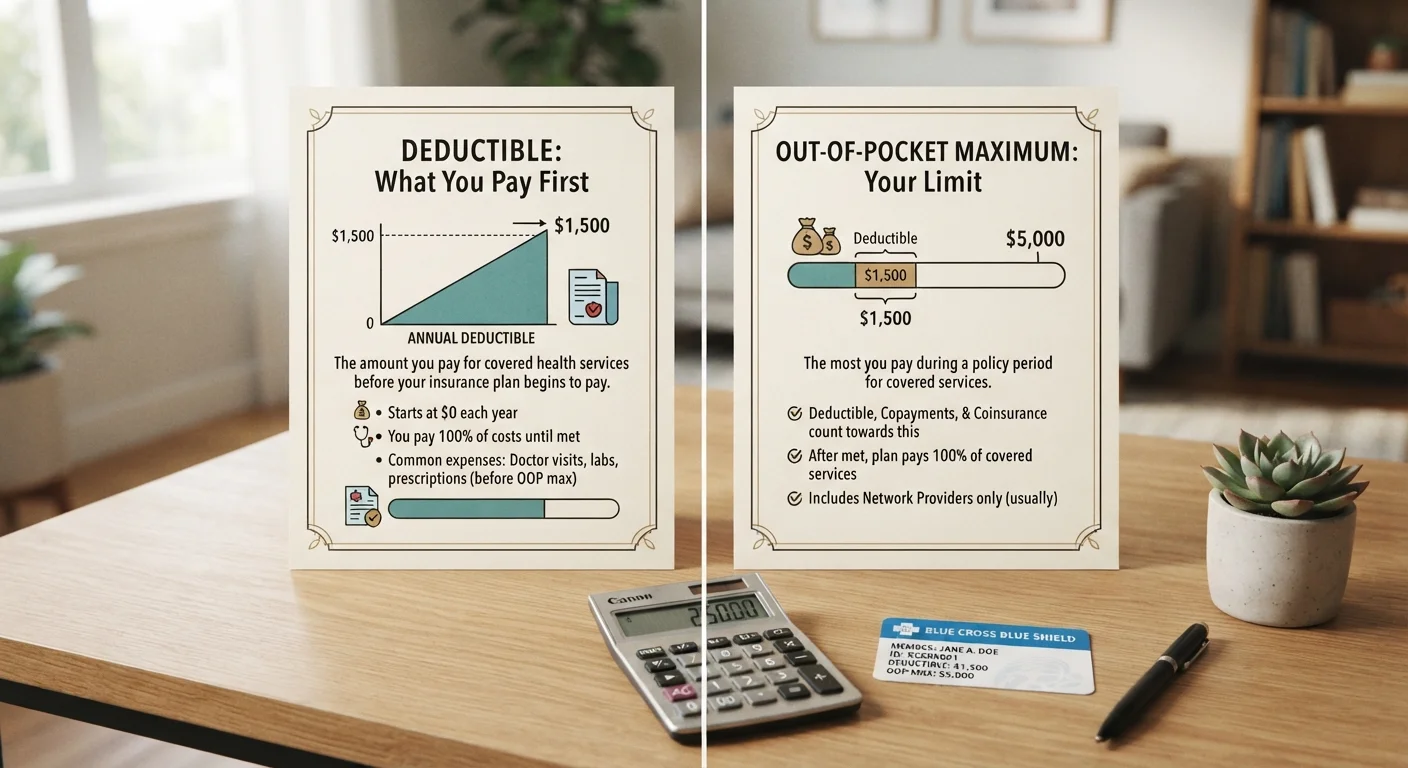
Your deductible is the amount you pay entirely on your own before your insurer begins sharing the cost of most covered services. If your deductible is $1,500, you cover the first $1,500 of eligible medical expenses each plan year — after that, cost-sharing features like coinsurance kick in. For more on how these three cost layers interact, see how deductibles, copays, and coinsurance work together.
Your out-of-pocket maximum is the ceiling on all your cost-sharing for the year — deductible payments, coinsurance, and copays combined. Once you reach it, your insurer covers 100% of covered in-network services for the remainder of the plan year. It's not a separate bucket; it's the total limit on everything you personally contribute.
| Criterion | Deductible | Out-of-Pocket Maximum |
|---|---|---|
| What it represents | Amount you pay before insurance shares costs | Total annual cap on all your cost-sharing |
| When it applies | At the start of each plan year | After deductible and coinsurance accumulate |
| What counts toward it | Eligible in-network covered expenses | Deductible + copays + coinsurance combined |
| Effect when reached | Cost-sharing (coinsurance/copays) begins | Insurer pays 100% of covered in-network care |
| Do premiums count? | No | No |
| Typical dollar range (health plans) | Often $500–$7,000 | Often $2,000–$9,100 (ACA individual cap) |
| Resets annually? | Yes | Yes |
How the Two Figures Work Together
Think of them as two stops along the same track. You pay toward your deductible first. Those payments also count toward your out-of-pocket maximum. After clearing the deductible, you typically share costs with your insurer through coinsurance — say, you pay 20% and the insurer covers 80%. Those 20% payments continue accumulating toward your out-of-pocket maximum. When the total hits that ceiling, your share drops to zero for the rest of the year.
$9,450
ACA out-of-pocket maximum limit (individual, 2024)
The Affordable Care Act sets an annual ceiling on out-of-pocket maximums for qualifying health plans; the 2024 limit for individual coverage is $9,450.
$1,500+
Typical individual deductible range starting point
Deductibles on employer-sponsored and marketplace plans commonly start around $1,500 for individual coverage, though they vary widely by plan design.
A concrete example makes this clearer. Suppose your plan has a $1,500 deductible and a $5,000 out-of-pocket maximum. You're responsible for the first $1,500 in full. Between $1,500 and $5,000 in total costs, you split expenses with your insurer at whatever coinsurance rate applies. Once your cumulative payments reach $5,000, you owe nothing more for covered in-network care until your plan year resets.
It's worth noting that not all costs count toward either figure. Premiums — the monthly amount you pay to maintain coverage — don't count toward your deductible or out-of-pocket maximum. Out-of-network charges and services your plan excludes may not count either. What counts and what doesn't toward your out-of-pocket maximum is a distinction worth reviewing carefully in your own policy documents.
Why the Difference Matters for Your Budget
If you focus only on the deductible, you might underestimate what a serious illness or accident could cost you. The deductible tells you the floor — the minimum before any coverage help arrives — but not the ceiling. For financial planning purposes, the out-of-pocket maximum is the figure that tells you the absolute most you'll pay in any given year, assuming you use in-network providers.
Conversely, if you focus only on the out-of-pocket maximum, you may not plan adequately for moderate expenses early in the year. Many people forget that every January (for calendar-year plans), both figures reset. Early in a new plan year, you're back to paying your full deductible again before cost-sharing resumes.
Family Plans Have Two Sets of Limits
If you're enrolled in family coverage, your plan likely has both individual and family deductibles and out-of-pocket maximums. An individual member can hit their individual limit independently, but the family maximum applies to the household's combined spending. Check your Summary of Benefits and Coverage carefully to see how your specific plan handles embedded versus aggregate structures.
When comparing two plans, a lower deductible might look appealing but often comes with a higher premium or a higher out-of-pocket maximum. A higher deductible paired with a lower out-of-pocket cap might serve someone with a serious chronic condition better than it appears at first glance. Strategies for managing out-of-pocket costs can help you apply this logic to real plan choices. For the broader budgeting picture, the concepts also connect to general budgeting fundamentals.
This article is for general informational purposes only and is not personalized insurance, financial, or legal advice. Coverage terms, cost-sharing structures, and what counts toward your deductible or out-of-pocket maximum vary by plan and provider. Read your actual policy documents and consult a licensed insurance professional for guidance specific to your situation.