
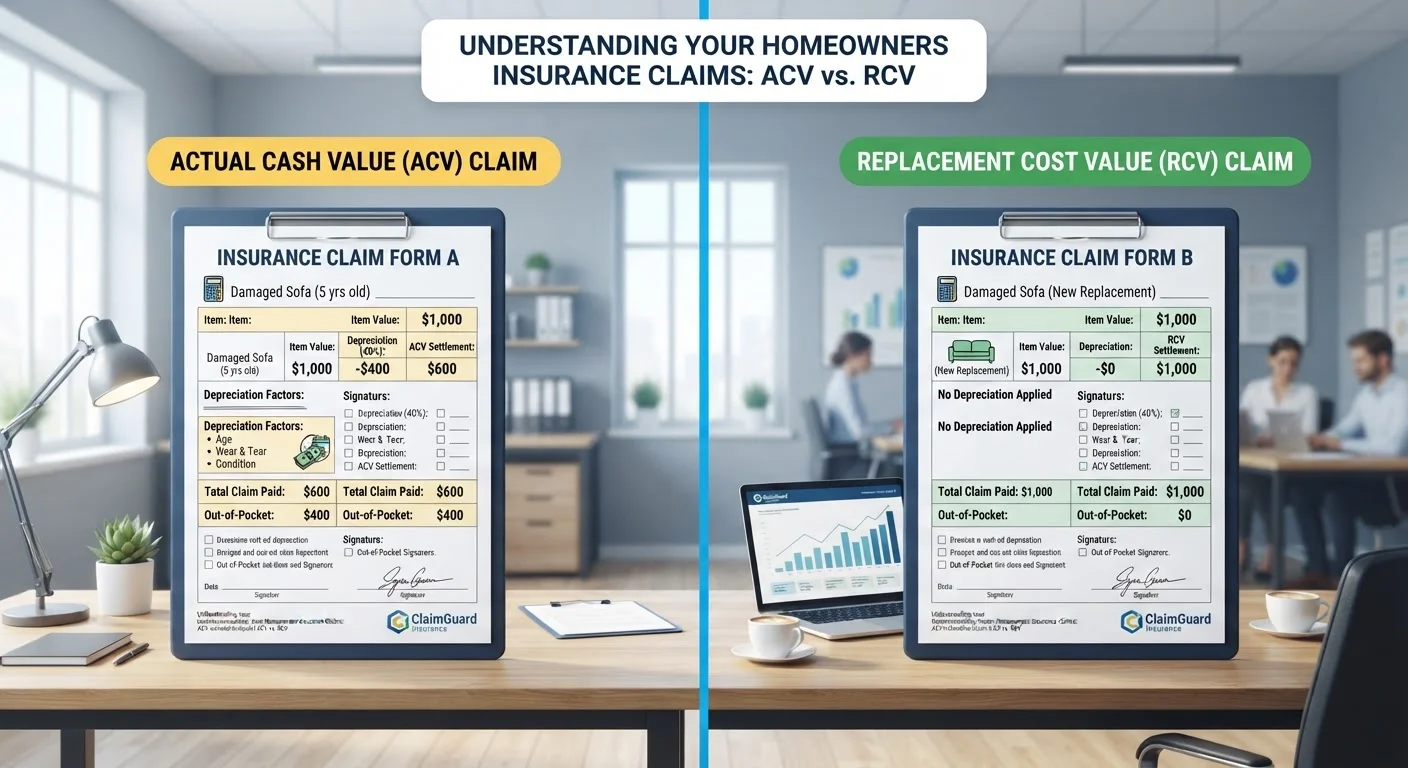
What These Two Terms Actually Mean
When you file an insurance claim, the dollar amount you receive depends heavily on one clause buried in your policy: the valuation method. Two policies covering the same house or the same belongings can produce very different claim checks — sometimes differing by thousands of dollars — based solely on whether they use Actual Cash Value (ACV) or Replacement Cost Value (RCV).
Actual Cash Value is calculated by taking the replacement cost of an item and subtracting depreciation — the loss in value due to age, wear, and obsolescence. If your five-year-old roof is damaged in a hailstorm, an ACV policy pays what that five-year-old roof was worth, not what a new one costs.
Replacement Cost Value skips the depreciation deduction. It pays the amount needed to repair or replace the damaged property with a comparable new item at today's prices. Using the same roof example, an RCV policy pays the current cost to install a new roof of similar quality.
For a deeper look at how these valuations interact with your specific coverage structure, see how ACV and RCV coverage types differ.
| Criterion | Actual Cash Value (ACV) | Replacement Cost Value (RCV) |
|---|---|---|
| Payout basis | Depreciated value at time of loss | Cost to replace with comparable new item |
| Depreciation deducted | Yes | No |
| Typical premium cost | Lower | Higher |
| Out-of-pocket gap risk | Higher — you cover the depreciation gap | Lower — insurer covers full replacement |
| Best suited for | Older property; budget-conscious buyers | Newer property; full-recovery priority |
| Payment structure | Single payment at settlement | Often two-step: ACV first, then recoverable depreciation |
How Depreciation Changes Your Payout
Depreciation is the engine behind the ACV calculation, and it can dramatically shrink a payout. Insurers use depreciation schedules — formulas that assign a useful life to each category of property — to determine how much value has already been used up.
Consider a practical example: A television purchased for $1,200 four years ago is destroyed in a covered event. If the insurer assigns that TV a ten-year useful life, it has depreciated 40%. An ACV policy would pay roughly $720 (minus your deductible). An RCV policy would pay whatever a comparable replacement television costs today — which might still be around $1,200 or more.
~20–40%
Typical depreciation on home contents after 5 years
General depreciation schedules used by insurers commonly reduce personal property values by 20–40% within five years, depending on the item category.
Thousands
Potential dollar gap between ACV and RCV on a major claim
On a significant structural or contents loss, the depreciation holdback between an ACV and RCV payout can easily reach several thousand dollars or more.
That gap — the difference between what the insurer pays and what you actually need to spend — is sometimes called the depreciation holdback. On a large loss involving multiple appliances, furniture, and structural repairs, these holdbacks add up fast.
Understanding how settlement figures are assembled can help you evaluate any offer you receive. Our guide on how insurers calculate a settlement offer walks through the math in detail.
Which Coverage Makes Sense for Your Situation
Neither valuation method is universally better — the right choice depends on your financial situation, the age and value of your property, and how much premium you're willing to pay.
ACV policies carry lower premiums because the insurer's maximum payout is capped by depreciation. That can make sense if your property is already older, if you have savings to cover a gap, or if the premium savings are meaningful to your budget.
RCV policies cost more upfront but provide a more complete financial recovery after a significant loss. For most homeowners with newer construction, recent renovations, or valuable personal property, that fuller protection tends to justify the higher premium.
One important nuance: many RCV policies are structured as two-payment systems. The insurer first pays the ACV amount. Once you complete the repairs or replacement and submit proof, the insurer releases the additional depreciation amount — called the recoverable depreciation. If you never complete the repairs, you typically keep only the ACV payment.
Before deciding, it's also worth understanding common misconceptions about how claims pay out. The insurance claims myths that cost people money article addresses several misunderstandings that affect how policyholders interpret their settlements.
Check Your Policy's Exact Language
The terms 'actual cash value' and 'replacement cost' appear in your policy's loss settlement or valuation section — not just on the declarations page. Some policies apply RCV to the structure but ACV to personal property, or vice versa. Read both sections carefully and ask your agent to clarify any part you don't understand before a loss occurs, not after.
This article is for general informational purposes only and does not constitute insurance, financial, or legal advice. Coverage terms, valuation methods, and depreciation schedules vary by insurer, policy, and state. Always review your actual policy documents and consult a licensed insurance agent or adviser for guidance specific to your circumstances.