
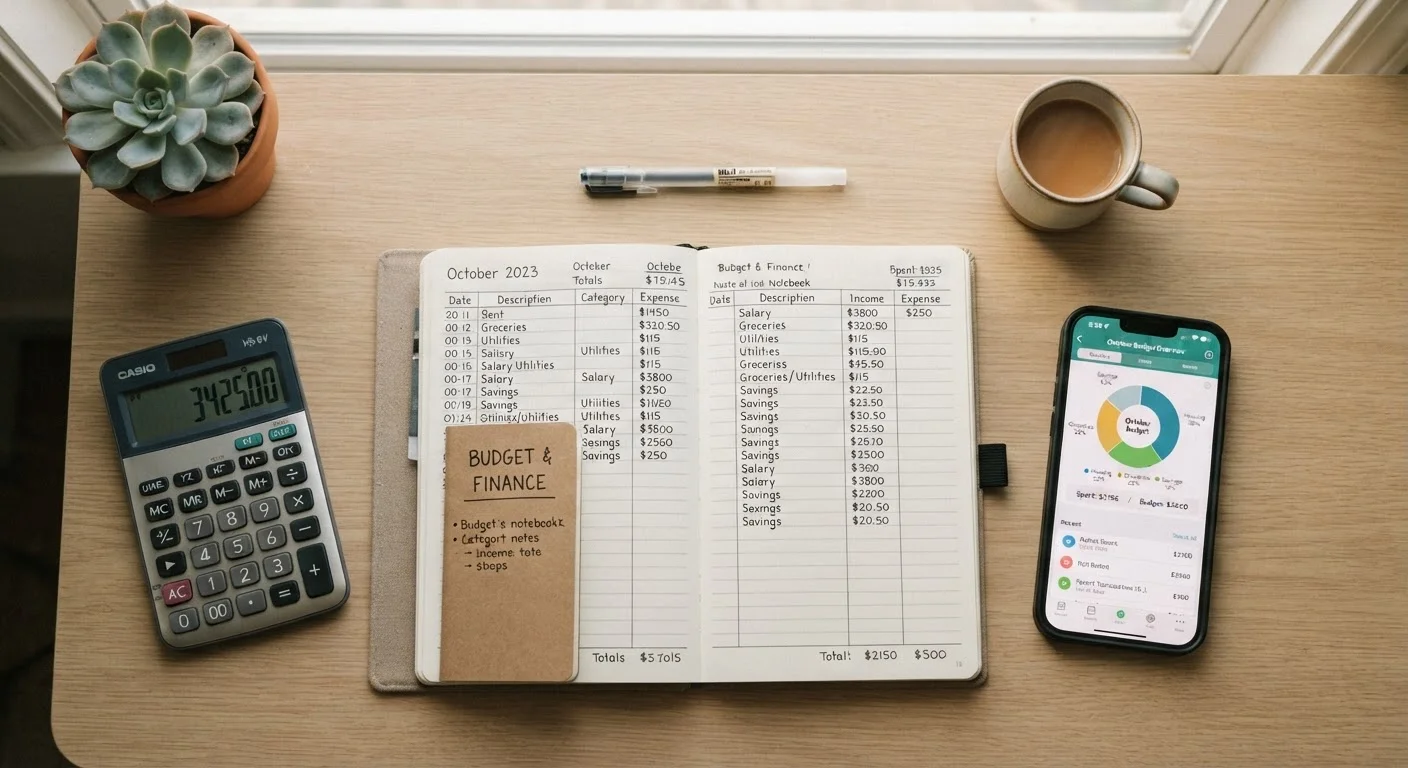
Why the Method You Choose Actually Matters
Budgeting only works if you do it consistently. That means the format — paper, spreadsheet, or app — is not a trivial decision. A beautifully designed app you rarely open is less effective than a modest notebook you check every morning. Research in behavioral finance suggests that friction points in a system cause people to abandon it, so choosing a method that fits your existing habits gives you a real advantage.
Before weighing the tradeoffs, it helps to understand what both approaches are trying to do. Both paper and digital budgeting aim to give you a clear picture of money coming in versus money going out. If you're new to the process, the step-by-step basics of building a first budget can ground you before you commit to any particular tool.
The Case for Paper Budgeting
Writing numbers by hand slows you down — and that's often the point. Studies on note-taking suggest that physical writing reinforces memory and comprehension more effectively than typing. Applied to budgeting, this translates into a heightened awareness of spending patterns that digital entry sometimes bypasses.
Increases mindful awareness of every spending decision
Physically writing down each transaction forces a moment of reflection that digital auto-sync skips. This friction can act as a natural spending brake for impulse-prone budgeters.
No technology dependencies or subscription costs
A notebook and pen cost nearly nothing and never require updates, password resets, or a working internet connection.
No third-party access to sensitive bank credentials
Paper budgeting keeps your account information entirely offline, eliminating concerns about data breaches through budgeting platforms.
Simpler to customize without technical skill
You can design any layout, category structure, or tracking system without needing to know formulas or navigate an app's interface.
Paper budgeting also has zero technology dependencies. There's no subscription fee, no risk of an app changing its pricing model, and no concern about a third-party service accessing your bank credentials. For people who are wary of linking financial accounts to external platforms, paper removes that concern entirely.
The envelope method — a cash-based system that pairs naturally with paper — is one structured framework worth considering. You can explore how it compares to percentage-based rules in our look at the 50/30/20 rule vs. the envelope method.
The Case for Digital Budgeting
Digital tools — whether spreadsheets or dedicated apps — offer capabilities paper simply cannot match. Automatic bank syncing, spending categorization, and real-time balance updates remove the manual data entry that many people cite as the main reason they abandon paper budgets.
Manual entry is time-consuming and error-prone
Every transaction must be logged by hand, which takes time and creates risk of arithmetic mistakes that can skew your picture of spending.
Real-time visibility requires constant manual updates
Unlike apps that sync automatically, paper budgets only reflect reality when you update them — gaps between entries can lead to overspending without warning.
Privacy tradeoffs when linking bank accounts
Most budgeting apps require read-access to financial accounts through third-party aggregators, which means your data is shared beyond your own device.
App features and pricing can change without notice
Free tiers of budgeting apps are frequently discontinued or restricted, meaning a system you rely on today could require payment or lose key features tomorrow.
Spreadsheets occupy a useful middle ground: they offer flexibility and customization without requiring you to share financial credentials with a third party. A well-structured spreadsheet can handle fixed and variable expenses side by side, making monthly adjustments straightforward.
Apps go further by aggregating data across accounts automatically, but this convenience comes with privacy tradeoffs. Most budgeting apps use read-only bank connections through secure third-party aggregators, though the specifics of data sharing vary widely by provider. Reading the privacy policy before linking accounts is a step worth taking.
~1 in 3
Americans who follow a formal written budget
Gallup polling has consistently found that fewer than one-third of U.S. adults maintain a detailed household budget, regardless of income level.
73%
People who say budgeting reduces financial stress
A National Foundation for Credit Counseling survey found that the large majority of people who budget report feeling more in control of their finances as a result.
Choosing Based on Your Situation
The best budgeting system is the one you'll sustain. A few questions can help clarify which direction makes more sense for you:
- How many accounts do you manage? One checking account and one credit card is manageable on paper. Five accounts across multiple institutions is far easier to track digitally.
- How variable is your income? Freelancers and gig workers with irregular earnings often benefit from digital tools that can recalculate projections quickly. If you want to explore broader frameworks for managing variable income, popular budget frameworks like 50/30/20 and zero-based budgeting may offer useful structure.
- Do you tend to overspend digitally? If tapping a card feels abstract, paper and cash may restore a sense of spending reality that digital tracking alone doesn't provide.
Hybrid Approaches Are Common and Effective
Many successful budgeters use both paper and digital tools together — for example, tracking daily spending in a notebook while using a spreadsheet for monthly summaries or long-term savings goals. There is no rule requiring you to commit exclusively to one format. Experimenting with a combined approach for 30 days can help you discover what actually sticks.
Whatever you choose, pairing it with a spending tracker — even a simple one — increases follow-through. Our guide on building a spending tracker you'll actually maintain walks through how to design a system that fits your life rather than fighting against it.
This article is for general informational purposes only and does not constitute personalized financial advice. Consider consulting a licensed financial professional for guidance specific to your situation.