
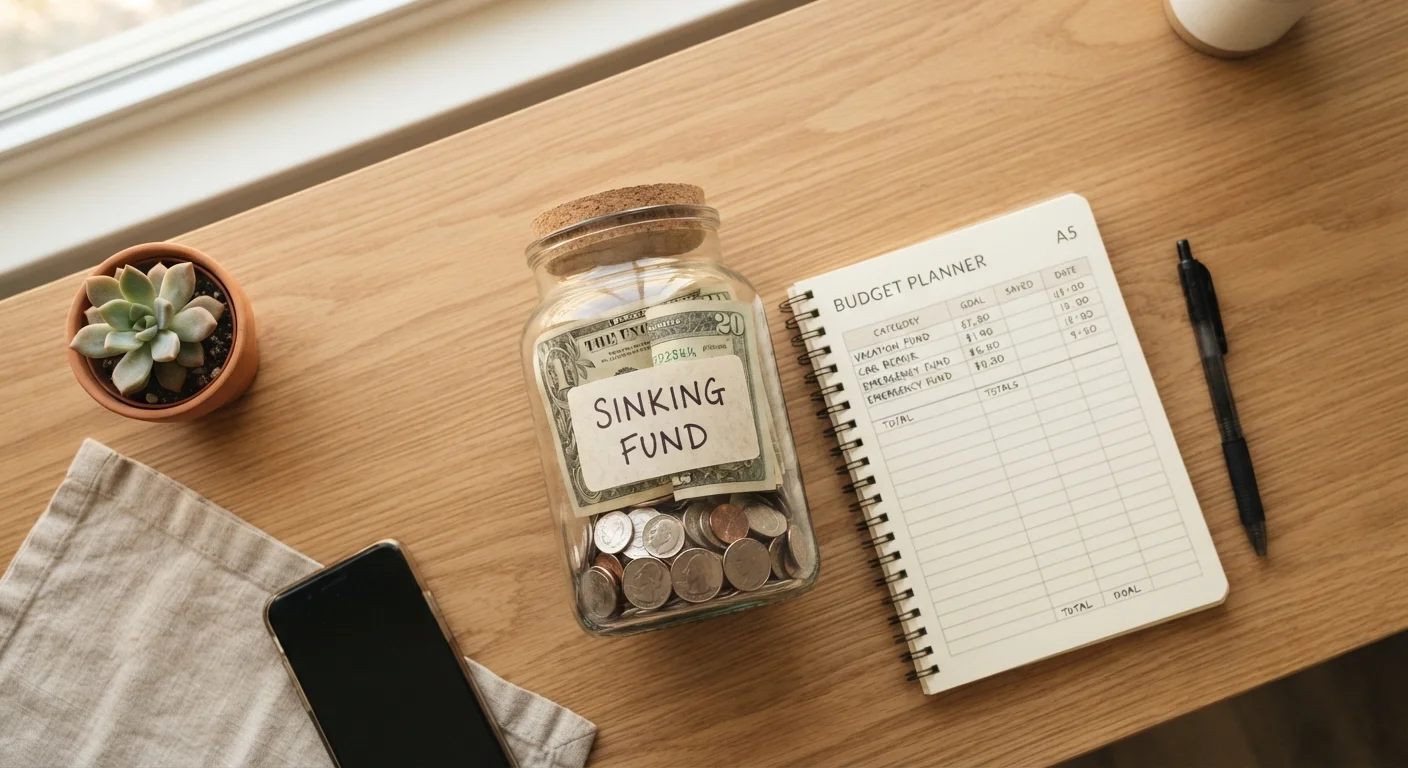
What a Sinking Fund Actually Does
Most budgets account for monthly expenses like rent, groceries, and utilities with ease. The expenses that derail budgets are rarely the monthly ones — they're the annual, semi-annual, or one-time costs that feel like surprises even when they were always on the calendar. A sinking fund solves this by converting a lump-sum future obligation into a predictable monthly savings habit.
The mechanics are straightforward: identify an upcoming expense, estimate its total cost, count the months until you need the money, and divide. That quotient becomes your monthly contribution. When the bill arrives, the money is already waiting.
This approach works equally well whether you're saving for a $200 car registration, a $1,500 vacation, or a $3,000 home appliance replacement. The expense type matters less than the discipline of contributing consistently each month.
“The goal of a budget is not to restrict your spending — it's to give every dollar a job before it arrives, so you're never caught unprepared.”
— Jesse Mecham, Personal finance author and founder of the zero-based budgeting method YNAB
Sinking Funds vs. Emergency Funds: An Important Distinction
These two savings tools are often confused, but they serve fundamentally different roles. An emergency fund exists for the unpredictable — a sudden medical bill, an unexpected job loss, or an urgent home repair you had no reason to anticipate. You don't know when you'll need it or exactly how much you'll draw. For more on structuring that safety net, see how emergency funds work.
A sinking fund, by contrast, is pre-planned. You know the expense exists; you simply haven't paid it yet. Conflating the two creates risk: if your holiday fund doubles as your emergency fund, a true financial crisis forces you to raid money you already mentally spent on gifts — and vice versa.
Keeping each fund in a separate, labeled account removes that ambiguity entirely. Many online banks let you create multiple sub-accounts at no cost, making it easy to maintain three to six sinking funds alongside a dedicated emergency reserve.
Sinking Funds Are Not Investment Accounts
Because sinking fund money will be spent within a defined timeframe — often 6 to 18 months — it belongs in a liquid, low-risk savings account rather than invested in stocks or other market-based assets. The priority is preservation and accessibility, not growth. A high-yield savings account offers a modest return while keeping funds fully accessible.
How to Build Sinking Funds Into Your Budget
Start by listing every irregular expense you faced in the past 12 months — registration fees, subscriptions billed annually, seasonal utility spikes, gift-giving occasions, and planned travel. Total each category and divide by 12. Those monthly figures become new line items in your spending plan.
If you're new to structured budgeting, building your first budget can help you establish the baseline before adding sinking fund categories on top. Sinking funds integrate cleanly into frameworks like zero-based budgeting or the 50/30/20 rule — for a comparison of how each approach handles saving, see popular budget frameworks.
Once your funds are running, treat each monthly contribution as a non-negotiable bill — paid to your future self. Automate the transfers on payday so the money moves before you have a chance to spend it elsewhere.
1 in 3
Americans who couldn't cover a $400 emergency without borrowing
According to the Federal Reserve's Report on the Economic Well-Being of U.S. Households, a significant share of adults lack the liquid savings to absorb even modest unexpected costs.
$5,000+
Average annual irregular household expenses
Consumer expenditure data from the U.S. Bureau of Labor Statistics suggests that vehicle fees, insurance premiums, subscriptions, and seasonal costs collectively represent thousands of dollars in non-monthly obligations each year.
Keeping Sinking Funds on Track Over Time
Sinking funds require occasional maintenance. Costs change — an insurance premium may increase, or a planned trip may become more expensive than estimated. Build in a monthly review where you verify that each fund's balance is on pace for its target date. This review fits naturally into a broader budget reset; a monthly budget reset checklist provides a useful structure for that habit.
If a fund is running behind, adjust either the monthly contribution or the target date. If a planned expense disappears entirely — say, a trip you canceled — redirect those contributions to another fund or your emergency savings rather than letting them dissolve into everyday spending.
Consistency is the engine behind sinking funds. The habits that keep budgets on track apply here too: automation, regular check-ins, and keeping goals visible all reinforce the behavior. Over time, the practice of funding future expenses in advance becomes second nature — and the financial surprises that once caused stress simply stop appearing.
Automate Contributions on Payday
Set up automatic transfers to each sinking fund on the day your paycheck clears. Treating these contributions like a bill — rather than something you do with 'leftover' money — dramatically increases follow-through. Most banks allow you to schedule recurring transfers to sub-accounts at no extra cost.
This article is for general informational purposes only and does not constitute personalized financial advice. Consult a qualified financial professional for guidance specific to your situation.