
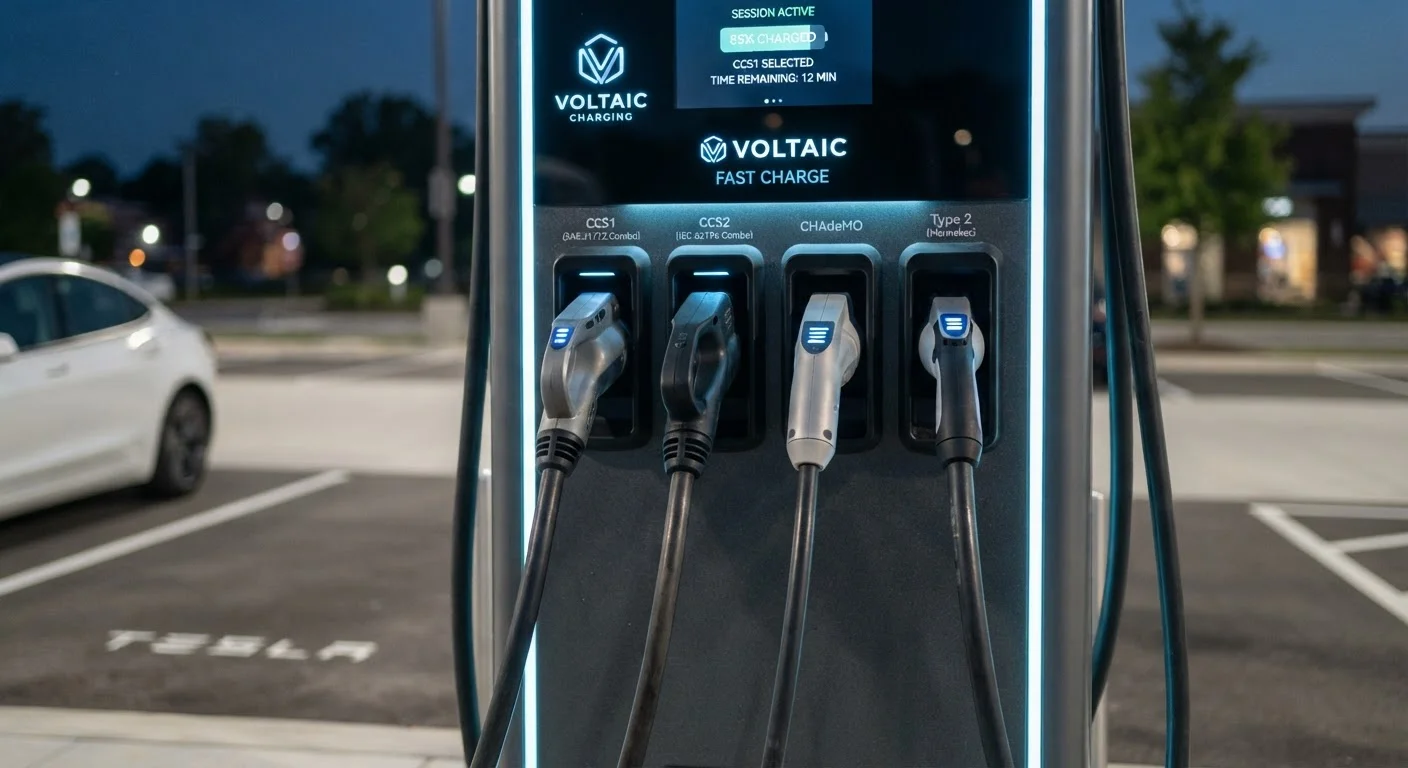
The Three Charging Levels at a Glance
EV charging isn't one-size-fits-all. The speed and equipment involved depend entirely on which of the three charging levels you're using - and picking the right one for a given situation can make a meaningful difference in your daily routine.
| Level 1 Voltage | 120V AC (standard US outlet) (U.S. Department of Energy) |
| Level 2 Voltage | 240V AC (U.S. Department of Energy) |
| DC Fast Charge Output | 50-350 kW depending on station (U.S. Department of Energy) |
| Typical Level 2 Home Charge Time (empty to full) | 6-12 hours (U.S. Department of Energy) |
| Public Charging Stations in the US | Over 60,000 stations (Alternative Fuels Station Locator, AFDC) |
| Most Common Home Charging Level | Level 2 (Edison Electric Institute) |
Think of the levels as a spectrum: Level 1 is the slowest but requires nothing beyond a standard wall outlet; Level 2 is the practical workhorse most homeowners rely on; and DC Fast Charging is built for when you need meaningful range added quickly on the road. Understanding the differences helps eliminate guesswork - and range anxiety. For a deeper dive into the voltage and wattage figures behind these numbers, see what the numbers on a power adapter actually mean.
Level 1: Convenient but Slow
Level 1 charging uses a standard 120-volt outlet - the same type found in virtually every American home. The main advantage is zero setup cost: plug the vehicle into a grounded outlet using the portable cord that comes with most EVs, and charging begins.
The tradeoff is speed. At roughly 3-5 miles of range per hour, Level 1 is best suited for drivers who cover fewer than 40 miles daily and can leave their vehicle plugged in overnight or for extended periods. It's also a useful backup option when no Level 2 equipment is available - at a vacation rental, for example.
80%
EV charging that happens at home
According to the U.S. Department of Energy, the vast majority of EV owners do most of their charging overnight at home.
~20 min
Typical DC Fast Charge to 80% SoC
Charge times vary widely by vehicle and station, but many modern EVs can reach 80% via DCFC in roughly 20-40 minutes.
3-5 mi
Range added per hour on Level 1
The U.S. Department of Energy reports Level 1 delivers approximately 3-5 miles of range per hour of charging.
For higher-mileage drivers or those with limited overnight parking time, Level 1 often can't keep pace with daily driving demands.
Level 2: The Home Charging Standard
Level 2 equipment operates on 240 volts - the same type of circuit used by electric dryers and ovens. A dedicated EVSE unit installed in the garage or carport typically delivers 10-30 miles of range per hour, meaning most EVs charge from nearly empty to full overnight.
Home installation requires a licensed electrician to run a 240-volt circuit and mount the unit. The cost varies by home wiring complexity, but the utility of waking up to a full charge every morning makes it the preferred choice for the majority of EV owners.
Level 2 stations are also widespread at workplaces, parking garages, hotels, and shopping centers, making top-ups easy during extended stops.
Not Every EV Supports Every Charging Level
Vehicle compatibility varies. While nearly all EVs support Level 1 and Level 2, DC Fast Charging acceptance depends on the vehicle's onboard hardware and connector type. Always check your vehicle's specifications before assuming DCFC access. Plug standards also differ - CHAdeMO, CCS, and NACS connectors are not universally interchangeable, though adapters are increasingly available.
DC Fast Charging: Speed for the Road
DC Fast Charging - sometimes called Level 3 - bypasses the vehicle's onboard charger and delivers direct current straight to the battery pack. Output ranges from roughly 50 kW at older stations to 350 kW at newer installations, enabling significant range gains in a short stop.
DCFC is primarily a public infrastructure technology, found along highway corridors and at travel plazas. It's engineered for intercity trips, not daily home use. One important nuance: charging speed intentionally tapers as the battery approaches 80% state of charge, a built-in protection that extends long-term battery health.
Level 1 Charging
The slowest form of EV charging, using a standard 120-volt household outlet. It typically adds 3-5 miles of range per hour and requires no special equipment.
Level 2 Charging
A 240-volt charging method used at home with a dedicated unit or at public charging stations. It adds roughly 10-30 miles of range per hour, making it the most practical option for daily home charging.
DC Fast Charging (DCFC)
Also called Level 3 charging, this method converts AC power to direct current before it reaches the battery, enabling very rapid energy transfer - often 100-350 miles of range in 20-40 minutes.
EVSE
Electric Vehicle Supply Equipment - the technical term for EV charging hardware, including the cord, connector, and control electronics that safely deliver power to a vehicle.
Kilowatt (kW)
A unit of power equal to 1,000 watts. Charging speed is measured in kilowatts; a higher kW rating means faster charging.
State of Charge (SoC)
The current battery level of an EV expressed as a percentage, similar to a fuel gauge. Charging speed, especially with DCFC, often slows as SoC approaches 80-100%.
Frequent reliance on DCFC as a primary charging source - rather than occasional road-trip use - is generally not recommended by most manufacturers. For more context on how charging behavior connects to real-world range, see common myths about EV range.
Choosing the Right Level for Your Situation
Most EV owners find that a Level 2 home charger handles the vast majority of charging needs, with occasional DCFC sessions during long trips. Level 1 remains a practical fallback. Matching charging level to context - rather than always seeking the fastest option - is generally the most battery-friendly and cost-effective approach.
Alternative Fuels Station Locator (AFDC)
A free, government-maintained tool from the U.S. Department of Energy that maps public EV charging stations by location, charging level, and connector type across the United States.
PlugShare Community Map
A crowd-sourced platform where EV drivers report real-world charger availability, reliability, and access details for stations across North America.
This article is for informational and educational purposes only. Charging speeds, connector compatibility, and station availability vary by vehicle, location, and equipment. Consult your vehicle owner's manual and a licensed electrician before installing home charging equipment.