
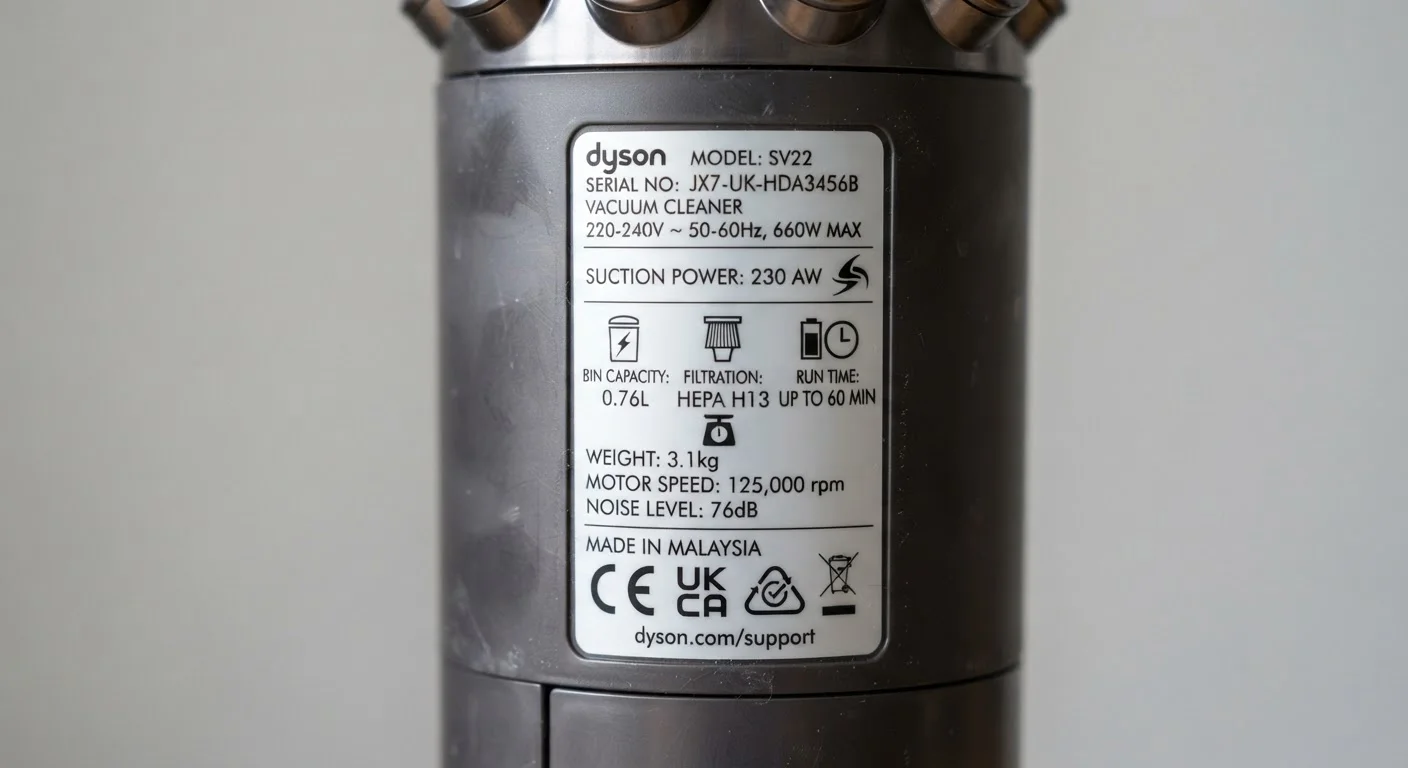
Why Vacuum Specs Are Harder to Read Than They Look
Walk down any vacuum aisle — physical or virtual — and you'll encounter a parade of numbers: watts, pascals, decibels, microns. Manufacturers don't always present these consistently, which makes side-by-side comparisons tricky. Understanding what each figure actually measures — and what it doesn't — is more useful than chasing the highest number on the box.
If you've wrestled with spec-sheet confusion on other appliances, the same logic applies here as with electronics generally. Our beginner's guide to everyday electronics lays out a helpful baseline for reading technical labels without getting overwhelmed.
| Standard HEPA efficiency | 99.97% at 0.3 microns (U.S. Department of Energy HEPA standard) |
| Typical vacuum noise range | 65–80 dB (General industry range) |
| Key suction pressure unit | Pascals (Pa) or water lift (in. H₂O) |
| Airflow measurement unit | CFM (cubic feet per minute) |
| Average dustbin capacity range | 0.5 to 3 liters (Varies by model type) |
Key Specs Decoded
Suction Power: Watts vs. Pascals
Wattage on a vacuum label typically refers to motor input power — how much electricity the motor draws. A higher wattage motor isn't automatically more effective; it just consumes more energy. What matters more is suction pressure, measured in pascals (Pa) or water lift (inches of H₂O). These figures describe the actual force pulling air and debris through the machine. A well-engineered lower-wattage motor can outperform a poorly designed higher-wattage one.
Airflow: CFM
CFM (cubic feet per minute) measures the volume of air moved through the vacuum. Higher CFM generally means better pickup across open surfaces like hard floors. Suction pressure and CFM work together — strong suction with weak airflow struggles on carpets, while strong airflow with low pressure may miss embedded debris.
Filtration: What HEPA Actually Means
A HEPA filter (High Efficiency Particulate Air) must capture at least 99.97% of particles 0.3 microns or larger under standardized testing. Look for filters described as sealed system HEPA — this means filtered air can't escape around the filter housing. Labels saying "HEPA-style" or "HEPA-like" do not meet the same standard and are not equivalent.
Noise Level: Decibels
Vacuum noise is rated in decibels (dB). For context, normal conversation sits around 60 dB; most vacuums fall between 65 and 80 dB. A 10 dB increase represents roughly a doubling in perceived loudness. Noise ratings are measured under controlled conditions, so real-world sound may vary based on flooring type and attachments in use.
Wattage (W)
A measure of electrical power consumed by the vacuum motor. Higher wattage indicates more energy draw, not necessarily stronger suction or better cleaning results.
Pascal (Pa)
A unit of pressure used to quantify suction force. Higher pascal ratings generally indicate greater ability to lift debris, particularly on carpeted surfaces.
CFM (Cubic Feet per Minute)
A measure of airflow volume moving through the vacuum. CFM and suction pressure together determine how effectively a vacuum picks up debris across different surface types.
HEPA Filter
A standardized filter type that must capture at least 99.97% of airborne particles at 0.3 microns under laboratory conditions. Only filters meeting this standard may be certified HEPA.
Sealed System
A vacuum design where all air passes through the filter before being exhausted. Prevents unfiltered air from bypassing the filter through gaps in the housing.
Decibel (dB)
A logarithmic unit measuring sound intensity. Vacuum noise ratings are typically taken under controlled lab conditions and may differ in real-world settings.
Dustbin or Bag Capacity
Capacity is listed in liters. Larger bins require less frequent emptying, which matters more in high-traffic homes or households with pets. Bagged models often have lower stated capacities but can hold more fine dust before suction drops noticeably.
99.97%
Minimum particle capture for certified HEPA filters
Per the U.S. Department of Energy's definition, applied at the 0.3-micron particle size threshold.
10 dB
Increase perceived as roughly twice as loud
Based on general acoustic principles; perceived loudness is logarithmic, not linear.
What the Spec Sheet Won't Tell You
No spec sheet captures how a vacuum feels to push across thick carpet, how tangled hair clears from a brush roll, or how long a cord actually reaches in a typical room. Build quality, brush roll design, and hose flexibility affect everyday usability in ways that wattage figures can't convey.
Filtration specs also only matter if filters are maintained. A sealed HEPA system gradually loses efficiency when filters are clogged and not replaced on schedule — the spec describes the filter's potential, not its ongoing performance.
Reading specs is one skill among several for evaluating household products. Similar challenges come up when interpreting bedding labels like thread count and fill power, where the headline number rarely tells the full story. Before committing to any home appliance purchase, it's also worth reviewing the return policy in detail so you understand your options if the product doesn't perform as expected.