
Why Nonstick Cookware Triggers So Much Anxiety
Few kitchen items generate as much online debate as the nonstick pan. Over the past two decades, reporting on industrial chemical contamination — particularly around PFAS compounds — has created a cloud of concern that hovers over the everyday skillet. Some of that concern is legitimate and grounded in real science. A good portion of it, however, is rooted in outdated information, misread studies, or confusion between industrial-scale exposure and kitchen-level use.
Understanding the actual risks requires separating what researchers found about manufacturing and environmental contamination from what a home cook reasonably encounters frying an egg. For a broader look at how cookware materials compare on practical grounds, see our cookware materials field guide.
Myth
All nonstick pans contain dangerous PFOA and should be avoided entirely.
Fact
PFOA was phased out of nonstick coating production in the U.S. by 2013 and is no longer used in pans sold domestically.
PFOA (perfluorooctanoic acid) was used as a processing aid during the manufacture of PTFE (polytetrafluoroethylene) coatings — it was not a deliberate ingredient in the finished coating itself. After regulatory pressure and voluntary industry commitments, major manufacturers eliminated PFOA from production. Pans sold in the U.S. today are not made with PFOA. The broader PFAS family of chemicals remains an active area of environmental and public health research, but equating current nonstick cookware with PFOA contamination studies is not scientifically accurate.
Myth
If a nonstick pan gets scratched, the flaking coating will poison you.
Fact
PTFE is chemically inert and does not absorb into the body; ingested particles pass through the digestive tract without being metabolized.
PTFE is one of the most chemically stable substances known. Studies and regulatory assessments have consistently found that if small particles of a PTFE coating are accidentally ingested, they are not absorbed or metabolized — they simply pass through. This does not mean a heavily damaged pan should be used indefinitely; practical replacement is sensible. But the scenario of acute poisoning from a scratched pan is not supported by toxicological evidence. The real concern with a deteriorating pan is diminished cooking performance, not a health crisis.
Myth
Ceramic-coated pans are completely safe and a perfect substitute for PTFE coatings.
Fact
Ceramic coatings vary significantly in composition and durability; they are not inherently safer, and their nonstick properties typically degrade faster than PTFE.
"Ceramic" is a marketing category, not a tightly regulated material specification. These coatings are generally sol-gel based and do not contain PTFE or PFAS — a genuine distinction. However, they are often less durable than PTFE, losing their nonstick properties more quickly with normal use. Some older ceramic formulations contained trace heavy metals, though current products sold in the U.S. must comply with FDA regulations on materials that contact food. Choosing ceramic over PTFE is a reasonable personal preference, but framing it as categorically safer overstates the evidence.
Myth
Nonstick pans are dangerous at any cooking temperature.
Fact
PTFE coatings begin to break down meaningfully only above approximately 500°F — temperatures rarely reached in normal home cooking.
Research, including work cited by the Environmental Working Group and reviewed by the EPA, indicates that PTFE begins to degrade and release fumes at temperatures generally above 500°F (260°C). A pan preheated empty on high heat can reach these temperatures relatively quickly, which is why the key precaution is to avoid overheating an unattended or empty pan. Standard stovetop cooking — sautéing vegetables, scrambling eggs, reheating leftovers — typically stays well below this threshold. Cooking with food in the pan, which absorbs heat, keeps temperatures lower still. The risk is real but bounded by ordinary cooking behavior.
Myth
Birds dying from nonstick fumes proves the pans are dangerous for humans too.
Fact
Birds have an exceptionally sensitive respiratory system that makes them uniquely vulnerable to airborne particles and fumes; human physiology is not equivalent.
Avian respiratory systems are fundamentally different from human lungs — birds are known to be acutely sensitive to many airborne substances that humans tolerate without measurable harm, including common cooking fumes and smoke. Reports of pet birds being harmed by overheated nonstick pans are documented and worth taking seriously if you keep birds at home (keep birds out of the kitchen and ensure strong ventilation). Extrapolating those outcomes to human health risk, however, misapplies the biology. Human exposure limits and avian exposure limits are not the same measure.
What Safe Use Actually Looks Like
Most nonstick safety guidance boils down to a few durable principles that protect both the pan and the cook.
Bird Owners: Extra Precaution Is Warranted
Pet birds are highly sensitive to airborne fumes of all kinds, including those produced by overheated cooking oil and standard oven cleaners — not just nonstick pans. If you keep birds at home, experts generally recommend keeping them out of the kitchen and ensuring strong ventilation regardless of cookware type. Consult an avian veterinarian if you have specific concerns.
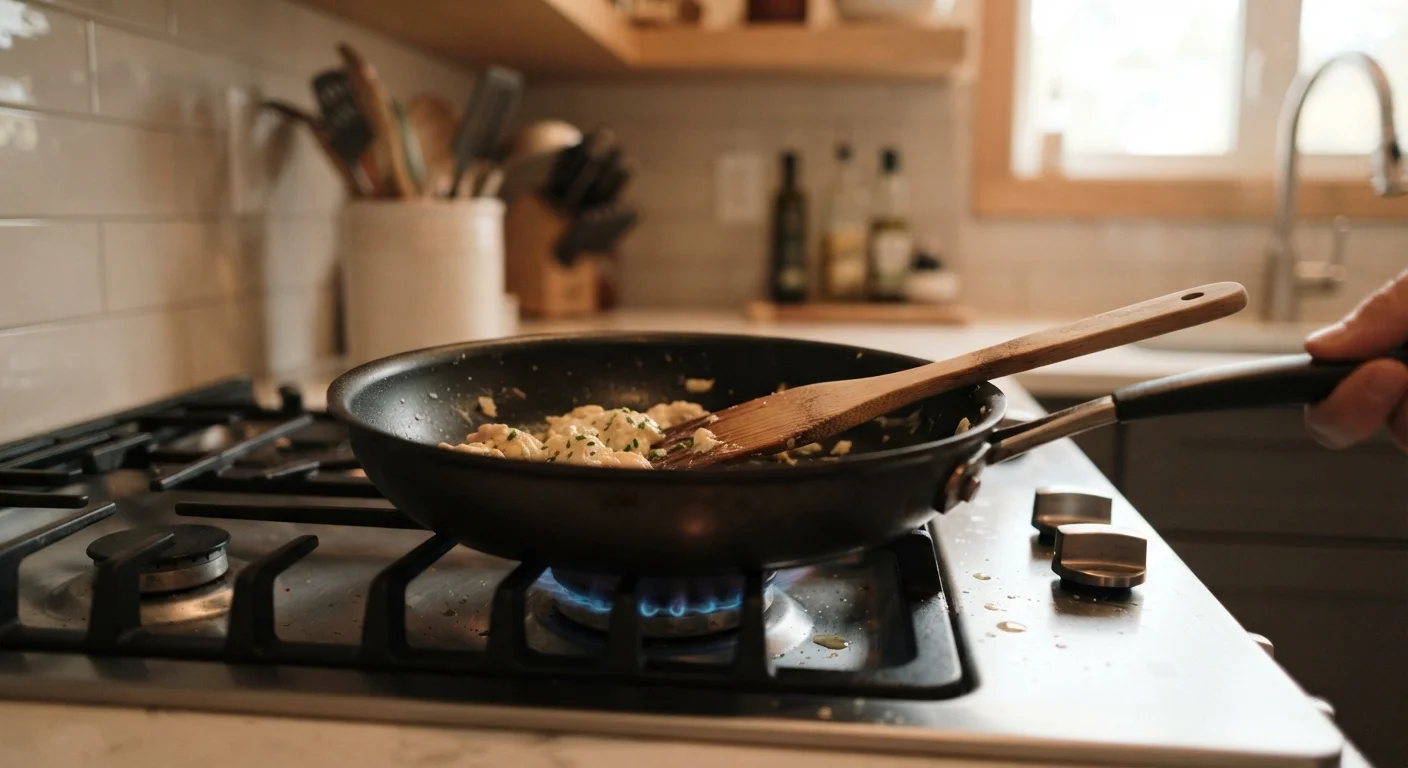
- Keep heat moderate. Medium or medium-low heat is sufficient for the vast majority of nonstick cooking tasks. High heat is rarely necessary and accelerates coating degradation.
- Use appropriate utensils. Silicone, wood, or nylon tools preserve the coating surface. Metal utensils accelerate scratching regardless of how durable a manufacturer claims the coating is.
- Ventilate your kitchen. Running a range hood or cracking a window is good practice for any cooking method, not just nonstick.
- Retire visibly degraded pans. If the coating is peeling in large sections or the pan has warped, replacement is the straightforward answer — not a health emergency, but a reasonable step.
Pattern-wise, the healthiest kitchen habits — cooking at appropriate temperatures, cleaning gently, and not relying on one pan for every task — apply regardless of which coating material you choose. If label-reading anxiety is familiar territory, the same evidence-based skepticism is worth applying elsewhere; our article on misleading beauty label claims shows how marketing language often outpaces regulatory meaning.
This article is for general informational purposes only and does not constitute medical or safety advice. If you have specific health concerns related to cookware or chemical exposure, consult a qualified healthcare professional.