
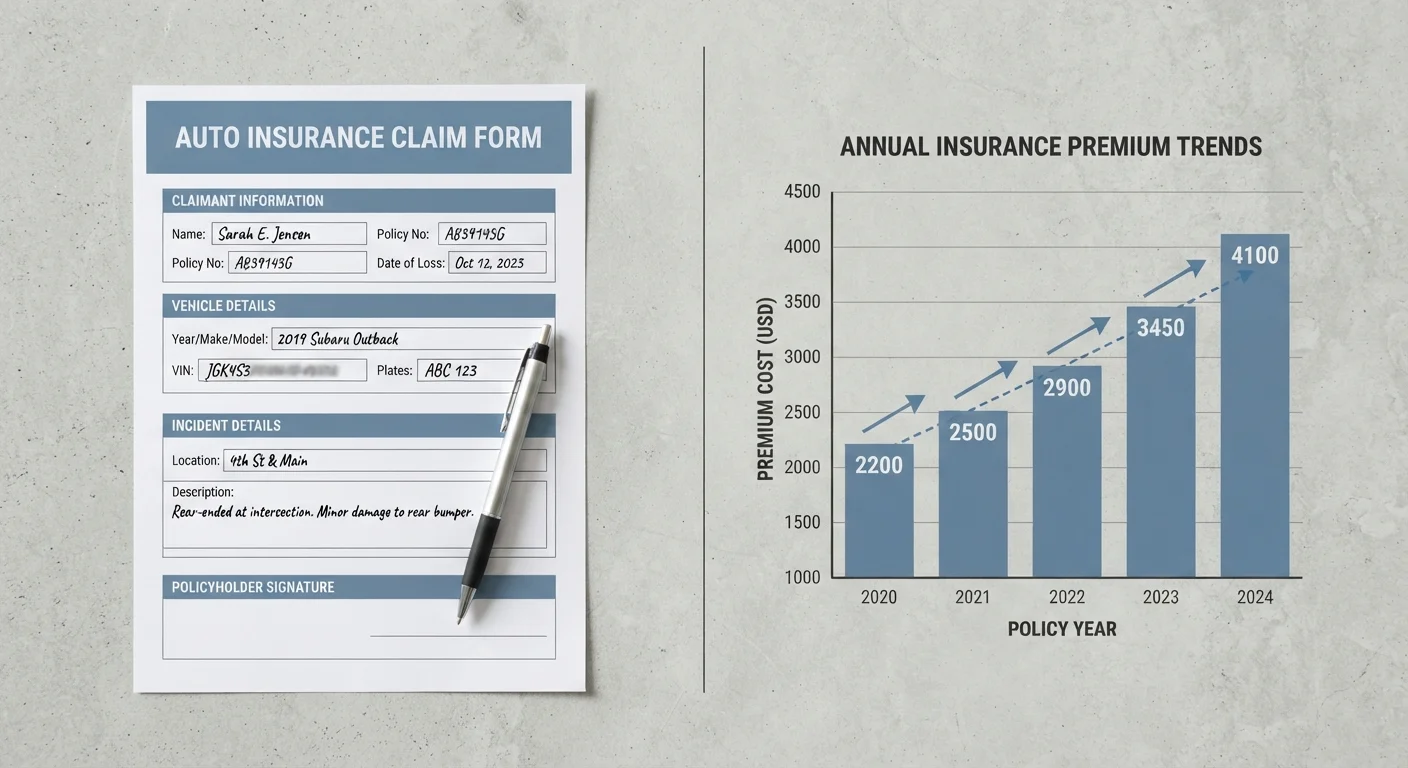
The Link Between Claims and Premium Changes
When you file an insurance claim, your insurer records it. That record becomes part of how they assess your risk going forward. If they decide you're more likely to file again, they may raise your premium at renewal — this is called a surcharge.
But the relationship isn't automatic. Insurers don't uniformly raise rates after every claim. Instead, they apply rating rules — filed with and approved by state regulators — that define which claims trigger a surcharge, how large it can be, and how long it lasts. Understanding those rules is the first step to making smarter decisions about when to file.
For a broader look at how the claims process works from start to finish, see what actually happens after you file an insurance claim.
~40%
Average premium increase after an at-fault claim
Industry analyses have found that a single at-fault claim can raise auto insurance premiums by roughly 40% on average at renewal, though the range varies significantly by insurer and state.
1–3 years
How long a surcharge typically remains on your record
Most insurers apply claims-related surcharges for one to three policy years, after which the incident typically stops affecting your rate.
~$1,300+
Estimated added annual cost from a major at-fault claim
Depending on the insurer and the severity of the claim, the cumulative cost of a surcharge over multiple renewal periods can significantly exceed the original claim payout.
Factors That Typically Influence Whether Your Rate Goes Up
Fault
This is usually the biggest factor. If you were responsible for a collision or liability claim, expect a meaningful surcharge in most cases. Not-at-fault claims — where another driver hit you, for example — are treated more leniently by most insurers and many state regulations.
Claim Type
Comprehensive claims (theft, weather, hitting an animal) are generally viewed differently than collision or liability claims. A hailstorm that damages your roof or car is a shared, regional risk — many insurers don't surcharge for it, or surcharge less. Liability claims, especially large ones, tend to produce the steepest increases.
Claim Size
Larger claims signal greater financial exposure and may produce larger surcharges. Small claims — particularly those close to your deductible — can sometimes be more expensive in the long run if the resulting surcharge compounds over two or three renewal periods.
Your Claims History
One claim after seven years of a clean record is viewed very differently from a third claim in three years. Frequency matters. A pattern of claims tells an insurer more about your risk profile than any single incident.
Ask Before You File
Before submitting a claim for a minor loss, call your insurer or agent and ask whether the claim would affect your premium. Many carriers can tell you in advance. This lets you make an informed choice rather than discovering the surcharge at renewal.
When Paying Out of Pocket May Be the Smarter Move
Not every loss worth reporting is worth claiming. If the damage estimate is only modestly above your deductible, consider whether filing makes financial sense. A $900 repair with a $750 deductible means a $150 insurance payout — but if that claim triggers a surcharge that adds $200 a year for two years, you've paid more in the long run.
This calculation isn't always straightforward, because you won't know the exact surcharge until renewal. Your insurer or agent can sometimes tell you in advance whether a hypothetical claim would affect your rate — it's worth asking before you file.
For guidance on weighing the decision to file on your own versus involving your agent, see filing a claim on your own vs. through an agent.
Accident Forgiveness and Other Rate Protections
Some insurers offer accident forgiveness — a feature that protects you from a surcharge after a first at-fault accident. It's typically available to long-standing customers with clean records, and it may be built into a policy automatically or added as an optional endorsement. Read your declarations page and policy documents to understand whether you have it and what conditions apply.
Beyond accident forgiveness, a strong prior record can work in your favor even without a formal program. Insurers often give informal consideration to loyalty and history when determining how aggressively to surcharge — though this varies widely and isn't guaranteed.
There are also common misconceptions about how claims work that can lead people to make costly decisions. See insurance claims myths that cost people money for a plain-language breakdown of what's true and what isn't.
This article is for general informational purposes only and does not constitute personalized insurance or financial advice. Coverage terms, rating rules, surcharge amounts, and claim outcomes vary by insurer, policy, and state. Always review your actual policy documents and consult a licensed insurance agent or adviser for guidance specific to your situation.