
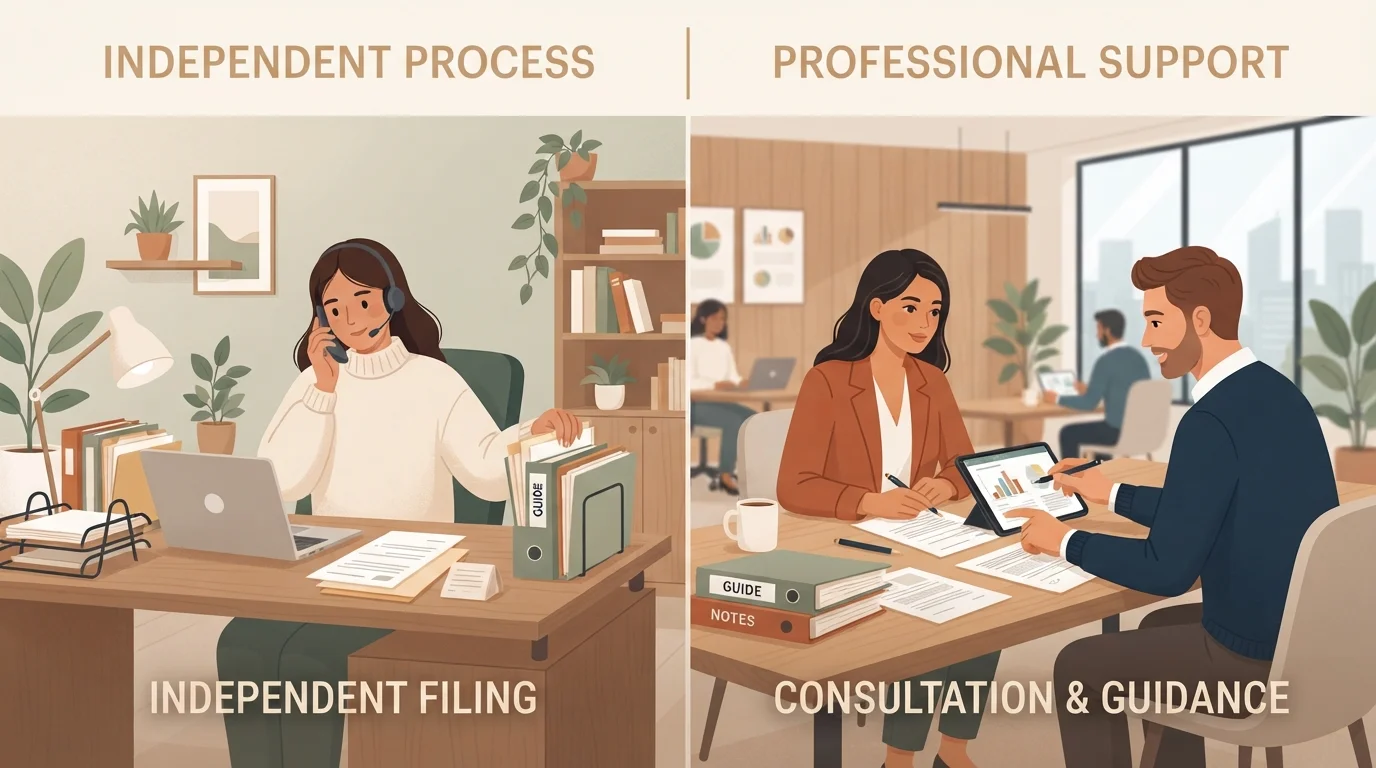
Two Valid Paths Through the Claims Process
When something goes wrong and you need to file an insurance claim, you typically have two options: contact your insurer directly or work through your agent. Both routes can lead to the same place — a processed claim — but the experience along the way is quite different depending on your situation.
Most insurers today make direct filing accessible through phone hotlines, websites, and mobile apps. At the same time, independent and captive agents remain a legitimate, and sometimes valuable, resource. Understanding the difference helps you choose with confidence rather than default to whichever feels most familiar.
For a fuller picture of what happens after you file, see the full lifecycle of an insurance claim.
How Each Approach Works in Practice
When you file on your own, you contact your insurer directly — typically by calling their claims department, submitting through their website, or using their mobile app. You provide your policy number, describe the loss, submit documentation, and work with a claims adjuster assigned by the insurer. The adjuster is an employee of the insurance company; their role is to evaluate the claim against your policy terms.
When you file through an agent, your agent acts as a conduit. They can help you complete the initial claim form accurately, communicate with the insurer on your behalf, flag policy provisions you might overlook, and follow up on the status of your claim. Importantly, your agent works for you (or at least alongside you), not for the insurer's claims department.
| Criterion | Filing on Your Own | Filing Through an Agent |
|---|---|---|
| Speed of filing | Often faster via app or online portal | May add a step, but agent handles coordination |
| Policy interpretation | You interpret terms yourself | Agent can clarify language and exclusions |
| Error risk | Higher if unfamiliar with policy details | Lower — agent reviews before submission |
| Best for claim complexity | Simple, clear-cut losses | Complex, high-value, or disputed claims |
| Adjuster interaction | Direct, one-on-one with insurer | Agent can mediate and follow up |
| Availability | 24/7 via insurer channels | Limited to agent's business hours typically |
| Outcome guarantee | None — depends on policy terms | None — depends on policy terms |
Regardless of which route you take, thorough documentation is non-negotiable. Documenting your claim properly — photos, receipts, written records, timestamps — is one of the most important steps you can take to protect yourself.
When Going Direct Makes Sense
Direct filing tends to work well when the claim is uncomplicated. Think: a clearly at-fault minor car accident, a stolen item with a purchase receipt, or a burst pipe with an obvious cause and documented repair estimate. In these cases, the coverage question is usually clear, the paperwork is manageable, and the insurer's online portal can move things along quickly.
Direct filing also makes sense when your agent isn't readily available — such as during off-hours after an emergency — and you need to get the process started right away. Most insurers allow you to open a claim and still loop in your agent later.
You Can Always Involve Your Agent Later
Starting a claim on your own doesn't lock you out of agent support. If the process becomes complicated — or if you're unsatisfied with the adjuster's initial assessment — you can contact your agent at any stage. It's generally better to loop them in early if you sense a claim might be contested, rather than waiting until there's a problem.
One thing to watch: even on what looks like a simple claim, be aware that filing can affect your premiums. Learn more about when a claim can raise your rates before you decide to file for smaller losses.
When an Agent's Involvement Adds Real Value
The more complex a claim, the more an agent's involvement can matter. If there's any ambiguity about what caused the loss, whether coverage applies, or how much the insurer is obligated to pay, having someone who understands policy language and insurer processes in your corner is worth considering.
Agents are also helpful when you're navigating unfamiliar policy terms — exclusions, sublimits, depreciation rules — that can quietly reduce a payout if you don't know to ask about them. They can advocate for accurate documentation of your loss and help you avoid statements that might be used to minimize a settlement.
If a claim has already been denied, an agent can sometimes help you understand why and whether an appeal is worth pursuing. For formal appeals, especially contested ones, you may also want independent legal guidance. Here's how the appeals process generally works.
~40%
Policyholders who use an agent to file
Industry surveys have generally found that a significant share of policyholders still rely on agents for initial claim guidance, particularly for home and life insurance claims.
1 in 7
Homeowners claims that involve a dispute
Estimates from insurance industry researchers suggest disputes over coverage or settlement amounts are not uncommon, underscoring the value of careful documentation and, in some cases, agent support.
What Neither Approach Can Guarantee
It's worth being direct: neither filing on your own nor going through an agent guarantees a particular outcome. Coverage depends on what your policy actually says — not on who submits the paperwork. An agent cannot override your policy terms, and filing directly doesn't put you at a disadvantage if your claim is valid and well-documented.
What both approaches share is a dependence on the same underlying factors: the strength of your documentation, the clarity of your loss, and what your policy covers. If you're ever uncertain about those factors before an event occurs, reviewing your coverage types and policy terms in advance is time well spent.
This article is for general informational purposes only and does not constitute insurance, legal, or financial advice. Policy terms, coverage, and processes vary by insurer and state. Consult a licensed insurance agent or adviser for guidance specific to your situation.