
Why Plan Structure Matters Before You Compare Costs
When you're choosing a health insurance plan, it's tempting to go straight to the premium — the monthly amount you pay to keep coverage active. But the plan's structure shapes how every dollar you spend on care actually works. Two plans can have identical premiums and wildly different out-of-pocket experiences depending on whether they're an HMO, PPO, EPO, or HDHP.
Understanding these structures is foundational. For a closer look at how premiums, deductibles, and copays interact once you're enrolled, see what each cost term actually means. This article focuses on what distinguishes the four main plan types from each other.
This article is for general informational purposes only and is not personalized insurance or financial advice. Coverage details, costs, and rules vary by plan and state. Always review your actual policy documents and consult a licensed insurance professional before making enrollment decisions.
The Four Plan Types at a Glance
Here's how HMO, PPO, EPO, and HDHP plans compare across the criteria that most affect your everyday experience as a patient.
| HMO | PPO | EPO | HDHP | |
|---|---|---|---|---|
| Requires primary care physician (PCP) | Yes | No | No | Varies by plan |
| Specialist referral needed | Yes | No | No | Varies by plan |
| Out-of-network coverage | Emergency only | Yes, at higher cost | Emergency only | Emergency only (unless PPO-based) |
| Typical premium level | Lower | Higher | Moderate | Lower |
| Typical deductible level | Low to moderate | Moderate | Low to moderate | High (IRS-defined minimum) |
| HSA eligible | Generally no | Generally no | Generally no | Yes |
| Best for | Cost-conscious, local care | Flexibility, multi-provider needs | No-referral simplicity, in-network | Healthy, savings-focused individuals |
Each row above reflects general design patterns. Your specific plan's details — including exact deductible amounts, network breadth, and cost-sharing rules — will be spelled out in its Summary of Benefits and Coverage document.
HMO and EPO: Network-Bound but Different Inside
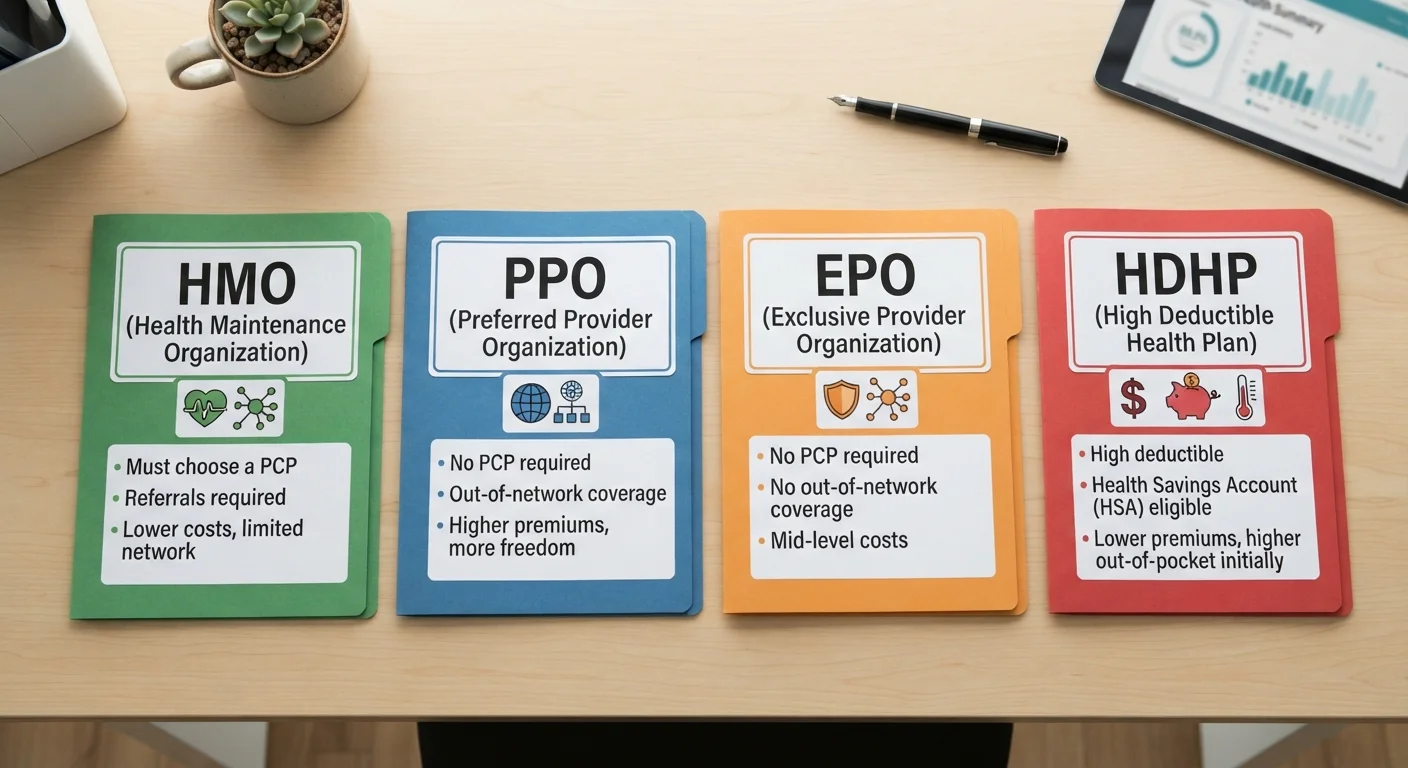
A Health Maintenance Organization (HMO) requires you to choose a primary care physician (PCP) who coordinates your care. Want to see a cardiologist or dermatologist? Your PCP must refer you first. In exchange for that structure, HMOs typically offer lower premiums and predictable copays. Care received outside the plan's network is generally not covered at all, except in a genuine emergency.
An Exclusive Provider Organization (EPO) is similar in that it only covers in-network care — go outside the network and you pay the full bill yourself. The key difference: EPOs usually don't require a PCP or referrals. You can book a specialist appointment directly. This makes EPOs a middle ground for people who want HMO-level cost predictability without the referral requirement.
Always Verify Your Providers Are In-Network
Before enrolling in an HMO or EPO, call your doctors' offices directly and ask if they accept the specific plan — not just the insurer. Provider directories are not always current. Confirming in advance can prevent unexpected out-of-network bills after enrollment.
Both plan types work best when you've confirmed that your current doctors and preferred hospitals are in-network before you enroll. Networks change, and an out-of-network surprise bill can be significant.
PPO: Flexibility at a Price
A Preferred Provider Organization (PPO) gives you the widest latitude. You can see any doctor — in-network or out-of-network — without a referral. In-network care costs less due to negotiated rates; out-of-network care is covered but at a lower reimbursement rate, meaning you pay more out of pocket.
That flexibility comes at a cost: PPOs typically carry higher premiums than HMOs or EPOs, and their cost-sharing structures can be more complex. You'll often encounter both copays and coinsurance depending on the service. Understanding how those two mechanisms differ is worth a few minutes — coinsurance and copays work very differently even though they appear on the same bill.
PPOs tend to fit people managing chronic conditions who see multiple specialists, patients who travel frequently, or anyone whose preferred providers are spread across different health systems.
HDHP: Lower Premiums, Higher Deductible, and the HSA Advantage
A High-Deductible Health Plan (HDHP) is defined by IRS thresholds: for a plan to qualify, the annual deductible must meet a minimum set each year (the IRS updates these figures annually). In return, premiums are lower. The trade-off is that you pay a larger share of costs out of pocket before coverage kicks in for most services.
The significant upside of a qualifying HDHP is eligibility for a Health Savings Account (HSA). An HSA lets you contribute pre-tax dollars that can be used for qualified medical expenses and roll over year to year — they don't expire. That triple tax advantage (pre-tax contributions, tax-free growth, tax-free withdrawals for qualified expenses) makes HDHPs genuinely attractive for people who are generally healthy and can afford to cover routine care out of pocket.
HDHPs Carry Real Financial Risk
If you experience a significant health event early in the plan year before your HSA has accumulated funds, you could face a large out-of-pocket expense. Carefully evaluate your expected healthcare use and financial cushion before selecting a high-deductible plan. This is general information — consult a licensed insurance professional for guidance tailored to your situation.
HDHPs carry real financial risk. If you have a major health event early in the year before your HSA has built up, you could face a large deductible with limited savings to offset it. Consider your realistic healthcare needs — not just last year's, but potential ones — before choosing this structure. See strategies for keeping out-of-pocket costs manageable for ways to prepare.
For a fuller breakdown of how deductibles, copays, and coinsurance layer together within any plan type, see how each cost-sharing term affects your wallet.