
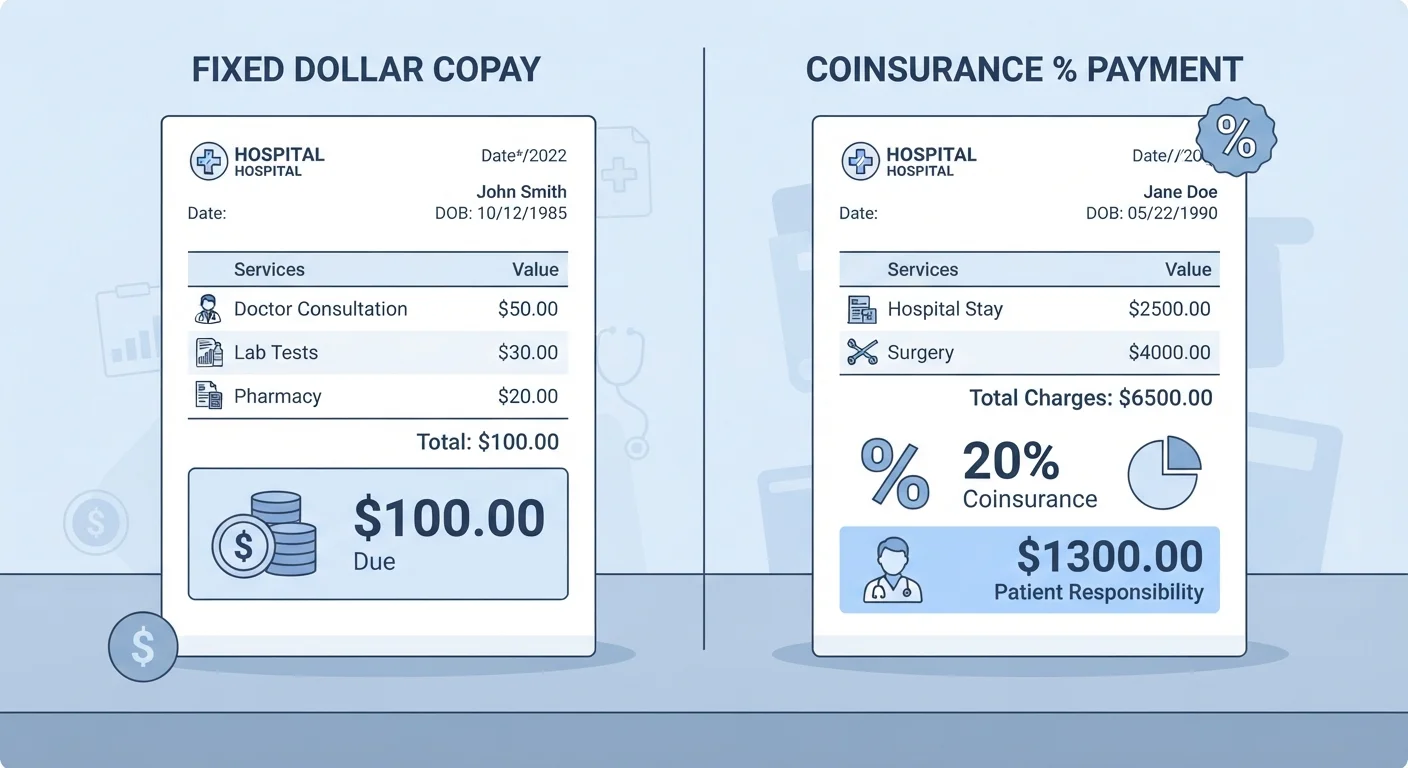
What Each Term Actually Means
Both copays and coinsurance are forms of cost-sharing — mechanisms that require you to pay a portion of your medical costs rather than the insurer covering 100%. But they're structured in fundamentally different ways, and mixing them up can lead to some unpleasant billing surprises.
A copay (short for copayment) is a flat, predetermined dollar amount you pay for a covered service. Your plan might require a $30 copay for a primary care visit or a $15 copay for a generic prescription. That number stays the same regardless of what the provider actually charges — you pay $30, the insurer handles the rest.
Coinsurance, on the other hand, is a percentage split between you and your insurer. A common arrangement is 80/20 — meaning the insurer pays 80% of the allowed amount for a service and you pay the remaining 20%. If an approved claim is $1,000, you owe $200. If it's $5,000, you owe $1,000. The dollar amount you pay scales with the size of the bill.
For a broader look at how these terms fit into the full picture of what you actually pay, see our breakdown of deductibles, copays, and coinsurance.
| Criterion | Copay | Coinsurance |
|---|---|---|
| How it's calculated | Fixed dollar amount | Percentage of allowed cost |
| Cost predictability | High — you know the amount in advance | Lower — depends on total bill |
| Typical timing | At time of service | After deductible is met |
| Common use cases | Office visits, prescriptions | Surgery, specialist care, hospitalization |
| Deductible required first? | Often not — varies by plan | Usually yes |
| Counts toward out-of-pocket max? | Yes (on most plans) | Yes |
When Each One Applies — and Why It Matters
Timing is one of the most important differences between these two cost-sharing methods. Copays are generally collected at the time of service, before any claims processing. You pay the copay when you check in, and that's typically the end of it for that visit.
Coinsurance usually comes into play after you've met your annual deductible. Until you've satisfied that deductible, you may be responsible for the full allowed cost of a service. Once you've crossed that threshold, your insurer steps in at the agreed percentage — and you pay your coinsurance share on remaining covered expenses.
This sequencing matters a lot. Early in a plan year, a patient with a high deductible might pay full cost for services even though their plan includes 20% coinsurance — because the deductible hasn't been met yet. Copays, by contrast, are often exempt from the deductible entirely. Many plans charge you a copay for primary care or urgent care visits regardless of where you are in your deductible cycle.
80/20
Most common coinsurance split
An 80/20 split — insurer pays 80%, enrollee pays 20% — is among the most frequently seen coinsurance arrangements in employer-sponsored health plans.
$30–$60
Typical primary care copay range
According to KFF (Kaiser Family Foundation) survey data, copays for primary care visits in employer-sponsored plans commonly fall in this range, though amounts vary widely by plan tier.
Your plan documents — specifically the Summary of Benefits and Coverage (SBC) — will spell out exactly which services are subject to copays, which trigger coinsurance, and whether a deductible applies first. It's worth reading that document carefully before you need care, not after.
To understand how your deductible and out-of-pocket maximum interact with both of these cost-sharing tools, see our explainer on out-of-pocket maximums vs. deductibles.
Both Count Toward Your Out-of-Pocket Maximum
Regardless of whether you're paying a copay or a coinsurance amount, both typically count toward your plan's annual out-of-pocket maximum. Once you hit that ceiling, your insurer generally covers 100% of additional covered costs for the rest of the plan year. Knowing this limit — and tracking your progress toward it — can be just as important as understanding how each individual cost-sharing term works. You can learn more in the out-of-pocket maximum vs. deductible guide.
This article is for general informational purposes only and does not constitute personalized insurance, financial, or legal advice. Coverage terms, costs, and rules vary by plan and insurer. Always review your actual policy documents and consult a licensed insurance professional for guidance specific to your situation.