
Why the Policy Type You Choose Matters
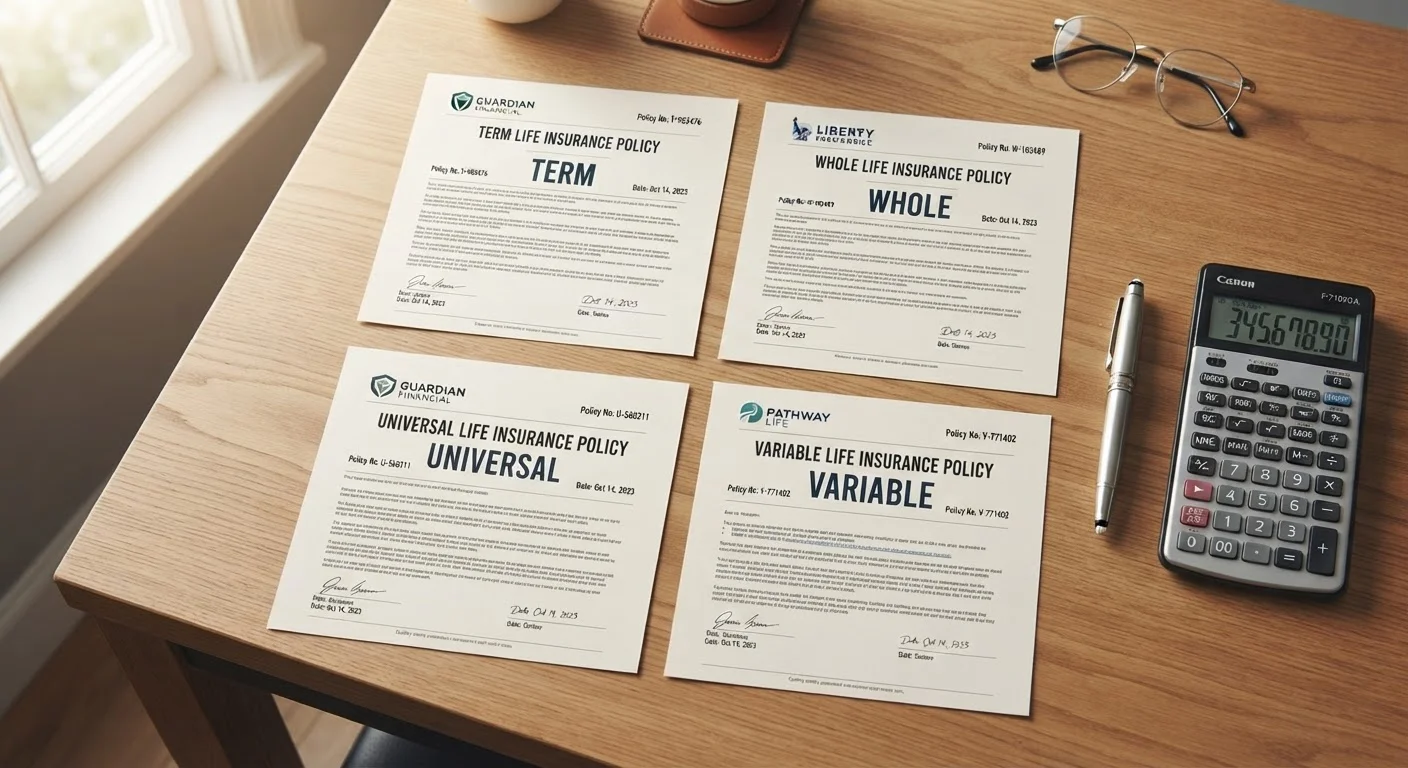
Life insurance is one of the few financial products where the structure of the policy itself — not just the coverage amount — determines what you pay, what you receive, and when. Two people can each hold a $500,000 policy and have wildly different experiences depending on whether that policy is term, whole, universal, or variable.
Understanding the differences isn't about picking the "best" product. It's about understanding what each type actually does so you can match it to your own circumstances. This guide unpacks each major structure in plain language. For a broader look at how life insurance fits alongside health, auto, and home coverage, see The Four Pillars of Personal Insurance.
52%
Americans with life insurance coverage
According to LIMRA's 2023 Insurance Barometer Study, roughly half of U.S. adults report having some form of life insurance.
54%
Life insurance owners who hold term policies
LIMRA research consistently shows term life is the most commonly owned individual life insurance product among American adults.
~10x
Typical cost difference: whole vs. term (same benefit)
Industry analyses generally show whole life premiums can run several times higher than equivalent-benefit term policies, depending on age and health class.
Term Life Insurance: Simple, Affordable, Time-Limited
Term life is the most straightforward type. You pay premiums for a defined period — typically 10, 20, or 30 years — and if you die during that term, your beneficiaries receive the death benefit. If the term ends and you're still living, coverage stops and no money is returned unless you added a return-of-premium rider.
What it costs and why
Because term policies carry no cash value component, insurers price them almost entirely on mortality risk. That generally makes term the most affordable option for a given death-benefit amount, particularly for younger, healthier applicants. Premiums are fixed for the term length you select.
Who tends to use it
Term works well when the need for coverage is time-bound — covering a mortgage, replacing income during child-rearing years, or carrying a business through a loan period. Once those obligations resolve, the coverage may no longer be necessary.
Convertible Term: A Middle-Ground Option
Many term policies include a conversion privilege that lets you switch to a permanent policy without a new medical exam, typically before a set deadline. If your health changes during the term period, this can be a valuable safety net. Ask whether any term policy you're considering includes this feature and what the conversion window is.
For a direct head-to-head comparison of term and whole life, see Term Life vs. Whole Life Insurance.
Whole Life Insurance: Lifetime Coverage with a Cash Component
Whole life insurance does exactly what the name implies: it covers you for your entire life, as long as premiums are paid. It also builds a cash value — a savings-like component that grows at a rate guaranteed in the policy and can be borrowed against or surrendered for cash.
How the cash value works
A portion of each premium funds the death benefit; the rest goes into the cash value, which grows on a tax-deferred basis. Growth is slow in the early years because of front-loaded policy costs, but it becomes meaningful over decades. Loans taken against the cash value accrue interest, and unpaid loan balances reduce the death benefit.
The trade-off: higher premiums
The guaranteed lifetime coverage and cash accumulation come at a cost. Whole life premiums are significantly higher than term premiums for the same death benefit. That premium gap is real money that could serve other purposes, which is why the decision isn't simply "whole is better."
When reviewing a whole life illustration, focus on the 'guaranteed' column rather than the 'non-guaranteed' projections — that's what the insurer is actually contractually obligated to deliver.
Non-guaranteed values depend on the insurer's dividend performance, which can fluctuate and is not promised in the contract.
For universal life policies, ask for an 'in-force illustration' every few years — not just the original one issued at purchase — to see whether the policy is on track given current interest crediting rates.
Original illustrations often assume interest rates that may no longer apply, and ongoing monitoring is the only way to catch a potential lapse risk early.
Universal Life Insurance: Flexibility Built In
Universal life (UL) is a form of permanent insurance that adds flexibility to the whole life framework. Within limits set by the insurer, policyholders can adjust their premium payments and, in some cases, alter the death benefit amount after the policy is issued.
How the cash value grows
The cash value in a universal life policy earns interest based on a rate the insurer sets periodically, typically tied to market benchmarks and subject to a guaranteed minimum floor. This means growth can vary — usually more than whole life but without the direct market exposure of variable policies.
The risk in flexibility
If you reduce or skip premiums during a period when the credited interest rate is low, the cost of insurance charges can erode the cash value faster than expected. In a worst case, the policy can lapse. Reviewing your policy illustration annually helps you catch this before it becomes a problem.
Universal Life Requires Active Monitoring
Unlike term or whole life, a universal life policy can lapse even if you've been paying premiums — if those premiums aren't sufficient to cover ongoing insurance charges as interest crediting rates change. This is not a set-it-and-forget-it product. Review your policy's performance annually with your agent to ensure it remains on track.
To understand the terminology embedded in any permanent policy, Insurance Terminology Every Policyholder Should Recognize is a useful plain-language reference.
Variable Life Insurance: Market-Linked Growth and Risk
Variable life insurance connects the cash value to a set of investment sub-accounts — similar in concept to mutual funds — that the policyholder selects and can shift between. Death benefits and cash value fluctuate based on sub-account performance.
The upside: growth potential
Because the cash value is invested in market instruments rather than credited at an insurer-set rate, there is real upside potential over long time horizons. Some policies offer a guaranteed minimum death benefit regardless of sub-account performance, though this feature varies by contract.
The downside: real investment risk
Poor sub-account performance can shrink the cash value substantially and, depending on policy structure, may require additional premium payments to keep the policy in force. Variable life is a securities product, regulated under both insurance and securities law, and comes with a prospectus you should read before purchasing.
“Variable life insurance is the only insurance product where the policyholder bears direct investment risk. Anyone considering it should be as comfortable evaluating a sub-account prospectus as they are reviewing a policy illustration.”
— Insurance Basics Editorial Team, Consumer insurance education researchers
Comparing the Four Types Side by Side
| Feature | Term | Whole | Universal | Variable |
|---|---|---|---|---|
| Coverage duration | Fixed term | Lifetime | Lifetime | Lifetime |
| Cash value | None | Yes, guaranteed growth | Yes, interest-credited | Yes, market-linked |
| Premium flexibility | Fixed | Fixed | Adjustable | Adjustable |
| Investment risk to policyholder | None | None | Low to moderate | Higher |
| Typical relative cost | Lowest | Higher | Moderate to higher | Moderate to higher |
Note: Actual premiums and features vary by insurer, age, health classification, and state. This table reflects general characteristics, not a specific product recommendation.
For guidance on add-on coverages that can layer onto any of these base structures, see Supplemental Coverage Types Worth Understanding.
How to Think About Which Type Fits Your Situation
No coverage type is universally right. The decision hinges on a few practical questions:
- Is your need for coverage temporary or permanent? If you primarily want to replace income or cover a specific debt, term is often the most efficient tool. If you want coverage that cannot expire and accumulates value, a permanent structure may warrant the higher cost.
- How much premium can you sustain long term? A whole or universal policy you can't keep funding can lapse, leaving you uninsured at an older age when new coverage is expensive or unavailable.
- Are you comfortable with investment risk inside a policy? Variable products require ongoing attention to sub-account performance and are not appropriate for policyholders who want predictable guarantees.
- What role, if any, do you want the policy to play in your broader financial plan? The cash value component of permanent policies intersects with estate planning, supplemental retirement income strategies, and business continuation planning — areas where a licensed financial professional adds real value.
Life insurance decisions touch on financial planning concepts covered more broadly in the Saving & Investing section of this site, and policy language itself is decoded in the Policy Terms Explained hub.
Policy Terms Explained Hub
A centralized reference for confusing insurance jargon — useful for decoding any life insurance policy document you're reviewing.
NAIC Consumer Information Source
The National Association of Insurance Commissioners offers a free tool to look up complaint records and licensing status for insurers in your state.
Saving & Investing Resource Center
Foundational guidance on how savings and investment concepts intersect with financial planning decisions, including permanent life insurance cash value.
This article provides general educational information about life insurance structures and is not personalized insurance, financial, or legal advice. Coverage terms, exclusions, costs, and availability vary by insurer, policy, and state. Read the full policy document and speak with a licensed insurance agent or financial adviser before making any coverage decisions.