
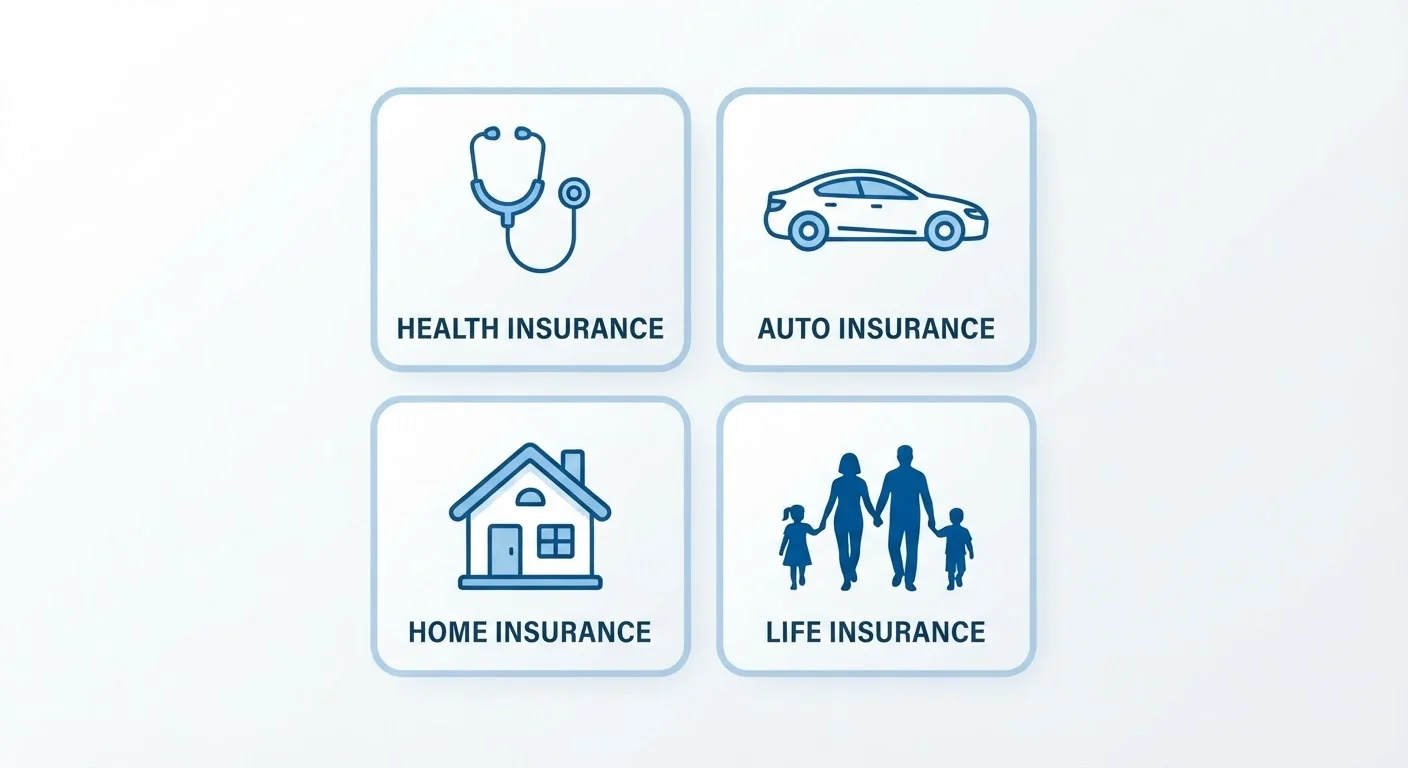
Why These Four Coverage Types Matter
Most Americans carry some combination of health, auto, home, and life insurance — often without a clear picture of what each one actually does. These four coverage types have become the foundation of personal financial protection because they address the four biggest unexpected costs a household can face: medical bills, accident liability, property loss, and loss of income after a death.
Understanding what each policy covers — and just as importantly, what it doesn't cover — is the starting point for making sound decisions about your own protection. This article is general educational information, not personalized insurance or financial advice. Always consult a licensed insurance agent and read your policy documents before making coverage decisions.
If you're brand new to insurance concepts, our starter guide for first-time policyholders walks through foundational terms like premiums, deductibles, and coverage limits.
91%
Americans with some form of health coverage
According to U.S. Census Bureau data, the vast majority of Americans have health insurance through an employer, government program, or private plan.
~$2,300
Average annual homeowners insurance premium
The Insurance Information Institute has reported national average homeowners premiums in this range, though costs vary significantly by state and property.
49 states
States requiring some form of auto liability insurance
All states except New Hampshire mandate minimum auto liability coverage; even NH requires drivers to demonstrate financial responsibility.
Health Insurance: Protecting Against Medical Costs
Health insurance helps pay for medical care — doctor visits, prescriptions, hospital stays, surgeries, and preventive services. Without it, a single emergency room visit or serious diagnosis can generate bills that quickly reach tens of thousands of dollars.
Health plans vary widely in structure. Common types include HMOs (Health Maintenance Organizations), which require you to use a specific network of providers, and PPOs (Preferred Provider Organizations), which offer more flexibility but often at higher cost. Key terms to know: your premium is what you pay each month to keep the plan active; your deductible is what you pay before the insurer starts sharing costs; and your out-of-pocket maximum is the most you'll pay in a given year before the insurer covers 100% of in-network costs.
Health insurance in the U.S. is obtained through employers, the federal or state marketplace, Medicaid, Medicare, or directly through an insurer. Eligibility and cost depend on your income, employment, and household size.
Review Your Health Plan's Network Before Enrolling
Before selecting a health plan, confirm that your preferred doctors, specialists, and hospitals are in the plan's network. Out-of-network care can cost significantly more — or may not be covered at all depending on the plan type. Checking the provider directory each year at open enrollment is a practical habit, since networks can change.
Auto Insurance: Required Coverage and Beyond
Auto insurance is required by law in nearly every state, though the minimum required coverage varies. At its core, liability coverage pays for injuries or property damage you cause to others in an accident. It does not pay for your own vehicle or your own injuries — that requires additional coverage types.
Collision coverage pays to repair or replace your car after an accident, regardless of fault. Comprehensive coverage handles non-collision events like theft, hail, or a tree falling on your car. Most lenders require both if you're financing or leasing a vehicle.
Other common add-ons include uninsured/underinsured motorist coverage (which protects you if the other driver has no or insufficient insurance) and medical payments coverage. For a full breakdown of what appears on your declarations page, see our auto insurance coverage glossary. And when you're ready to read your actual policy, this guide to understanding your car insurance policy explains each section in plain language.
Home Insurance: Covering Property and Liability
Homeowners insurance typically bundles two types of protection: property coverage for your home's structure and belongings, and personal liability coverage if someone is injured on your property. Mortgage lenders almost universally require homeowners insurance as a condition of the loan.
Standard policies generally cover damage from fire, wind, hail, and theft — but not flooding or earthquakes, which require separate policies. Renters face similar risks to their personal property and liability, and renters insurance covers those gaps without insuring the building itself.
When reviewing a home policy, pay close attention to whether your belongings are covered for actual cash value (depreciated value) or replacement cost (what it would cost to buy the item new today). The difference can be significant after a major loss.
Flood and Earthquake Coverage Require Separate Policies
Standard homeowners insurance does not cover flood damage or earthquake damage. These perils require separate policies — typically through the National Flood Insurance Program (NFIP) for flooding, or through a private insurer for earthquakes. If you live in an area prone to either risk, check whether your current policy leaves you exposed.
Life Insurance: Income Replacement for Your Dependents
Life insurance pays a death benefit — a lump sum — to your named beneficiaries when you die. Its primary purpose is to replace lost income so that people who depend on you financially aren't left without support.
The two most common forms are term life, which covers you for a set period (commonly 10, 20, or 30 years) and pays out only if you die within that term, and permanent life (including whole and universal life), which provides lifetime coverage and may build a cash value component over time. Term life tends to be simpler and less expensive for pure income-replacement purposes.
Life insurance decisions are closely tied to your broader financial picture — your debts, dependents, savings, and long-term goals. For context on how insurance fits into your overall financial planning, the Saving & Investing hub covers foundational money concepts worth understanding alongside your coverage decisions. As always, a licensed professional can help you determine appropriate coverage for your specific situation.
This article is for general informational purposes only and does not constitute personalized insurance, financial, or legal advice. Coverage terms, costs, and availability vary by provider and state. Always read your policy documents carefully and consult a licensed insurance agent or financial adviser before making coverage decisions.