
What These Terms Actually Mean
When you buy a property insurance policy — whether for a home, condo, or rental — you're buying coverage against specific causes of loss. In insurance language, those causes are called perils. A peril might be fire, theft, wind, or water damage from a burst pipe. The critical question is: which perils does your policy actually cover?
The answer hinges on whether you have a named-perils policy or an open-perils policy (sometimes called "all-risk" coverage, though that label is a bit misleading).
- Named-perils policies cover losses only when caused by a peril explicitly listed in the policy document. If the cause of your damage isn't on the list, the claim is denied — regardless of how severe the loss is.
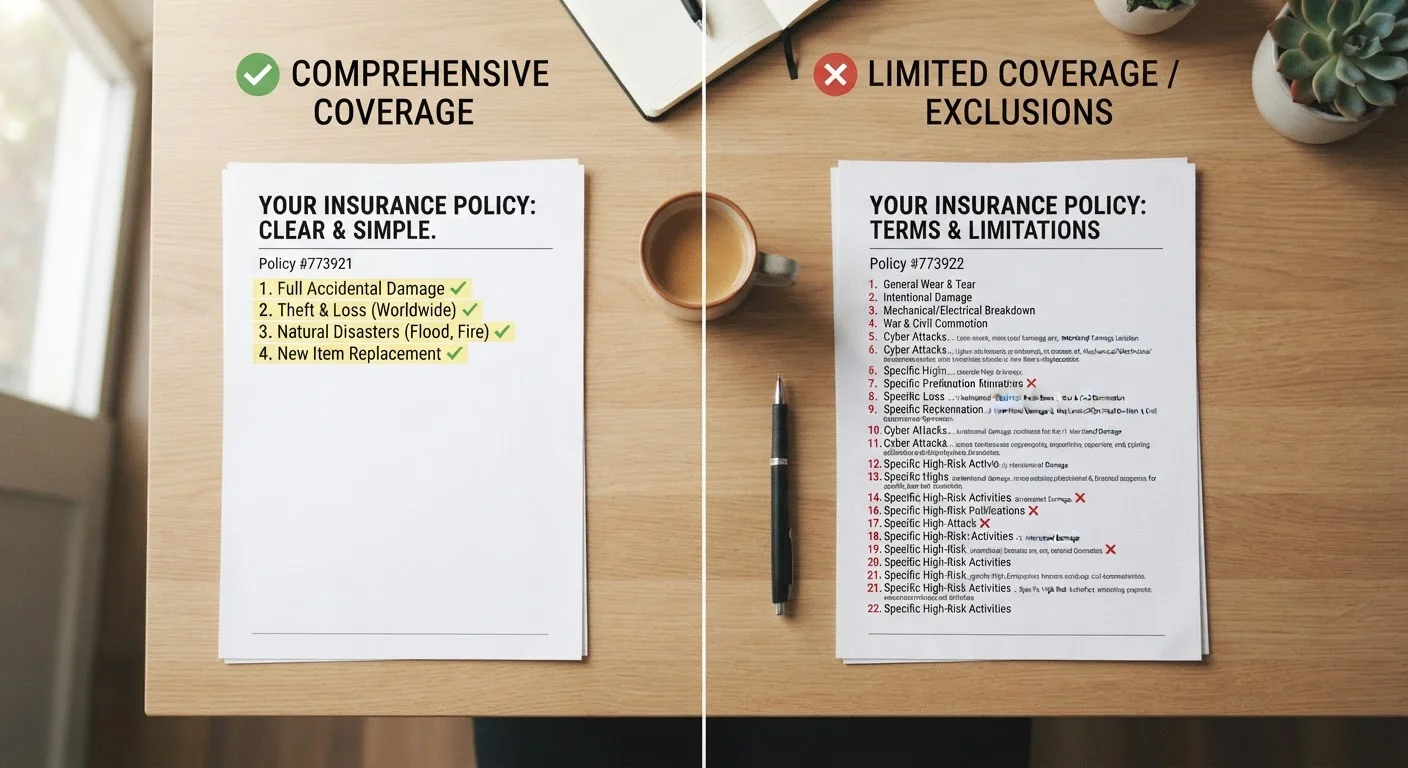
- Open-perils policies work in reverse: they cover losses from any cause except those specifically excluded. You don't have to prove you were hit by a listed peril; the insurer has to prove an exclusion applies to deny the claim.
That structural difference is what makes open-perils coverage generally broader in practice. See our guide to what homeowners insurance covers for more on which perils appear in standard policies.
How Each Type Plays Out in a Real Claim
Consider a scenario: water seeps into your home after an ice dam forms on your roof. You file a claim.
Under a named-perils policy, your adjuster checks whether "ice dam damage" or "weight of ice and snow" appears on your covered-perils list. If it does, you're covered. If it doesn't — even if the situation seems obviously weather-related — the claim may be denied.
Under an open-perils policy, the default assumption is coverage. The insurer must point to a specific exclusion that applies (for example, a "gradual seepage" exclusion) to deny the claim. If no exclusion clearly fits, coverage applies.
This burden-of-proof difference is significant. With named perils, the policyholder essentially has to prove their loss fits a covered category. With open perils, the insurer has to prove an exclusion blocks coverage. That reversal can matter enormously when damage has an ambiguous or unusual cause.
| Named-Perils Coverage | Open-Perils Coverage | |
|---|---|---|
| How coverage is determined | Only listed perils are covered | Everything covered except listed exclusions |
| Burden of proof in a claim | Policyholder proves peril is listed | Insurer proves an exclusion applies |
| Typical premium level | Generally lower | Generally higher |
| Risk of unexpected denial | Higher — unusual causes often not listed | Lower — ambiguous causes default to covered |
| Policy language to look for | "Covered perils include…" | "Direct physical loss unless…" |
| Common policy forms (homeowners) | HO-1, HO-2 | HO-3, HO-5 |
It's worth noting that even open-perils policies routinely exclude flood, earthquake, and normal wear and tear. No policy covers everything. Our article on insurance exclusions and limitations explains how exclusion language works in detail.
Cost, Trade-offs, and When Named Perils Makes Sense
Open-perils coverage typically carries a higher premium than named-perils coverage for comparable property. That cost difference reflects the insurer taking on a wider range of potential losses.
Named-perils policies aren't a bad deal by default. Many standard homeowners policies (commonly referred to as HO-2 forms) use named-perils language for the dwelling itself, and for many policyholders the listed perils — fire, lightning, windstorm, hail, theft, vandalism, and others — cover the risks they're most realistically exposed to. If the premium savings are meaningful and the covered list aligns with your actual risk environment, a named-perils policy may be a reasonable fit.
Always Read Both the Perils List and the Exclusions
Whether your policy is named perils or open perils, the exclusions section is where coverage actually gets limited. A named-perils policy may have a longer perils list than you expect, and an open-perils policy may have more exclusions than the broad label implies. Reading both sections together gives you the most accurate picture of what you're actually protected against.
That said, surprises tend to come from perils no one anticipated. An unusual cause of loss — say, structural damage from the collapse of a neighbor's tree during an ice storm — may be covered under an open-perils policy and denied under a named-perils policy, depending on how the list is written. For a deeper look at gaps that catch policyholders off guard, see coverage gaps people discover after filing a claim.
If your policy has gaps, supplemental coverage types like riders and endorsements can sometimes fill them without requiring a full policy switch.
How to Evaluate Your Own Policy
Start by locating your policy's declarations page and coverage form. Look for language like "we cover losses caused by the following perils" (named perils) versus "we cover direct physical loss unless caused by the following" (open perils). The difference in phrasing tells you a lot.
Then read the exclusions — in both types of policy, exclusions define the real outer edges of your coverage. An open-perils policy with aggressive exclusions can end up narrower than it appears, while a named-perils policy with a generous list may cover more than you'd expect.
Questions worth asking your licensed insurance agent or broker:
- Is my dwelling coverage named perils or open perils?
- What are the most significant exclusions on this policy?
- Are there endorsements available to add coverage for risks the base policy excludes?
If you carry multiple policies, coordination also matters. See how to coordinate multiple coverage types to make sure your policies complement rather than duplicate each other.
This article is for general informational purposes only and does not constitute insurance, legal, or financial advice. Coverage terms, exclusions, and availability vary by insurer, policy form, and state. Always read your actual policy documents and consult a licensed insurance agent or adviser for guidance specific to your situation.