
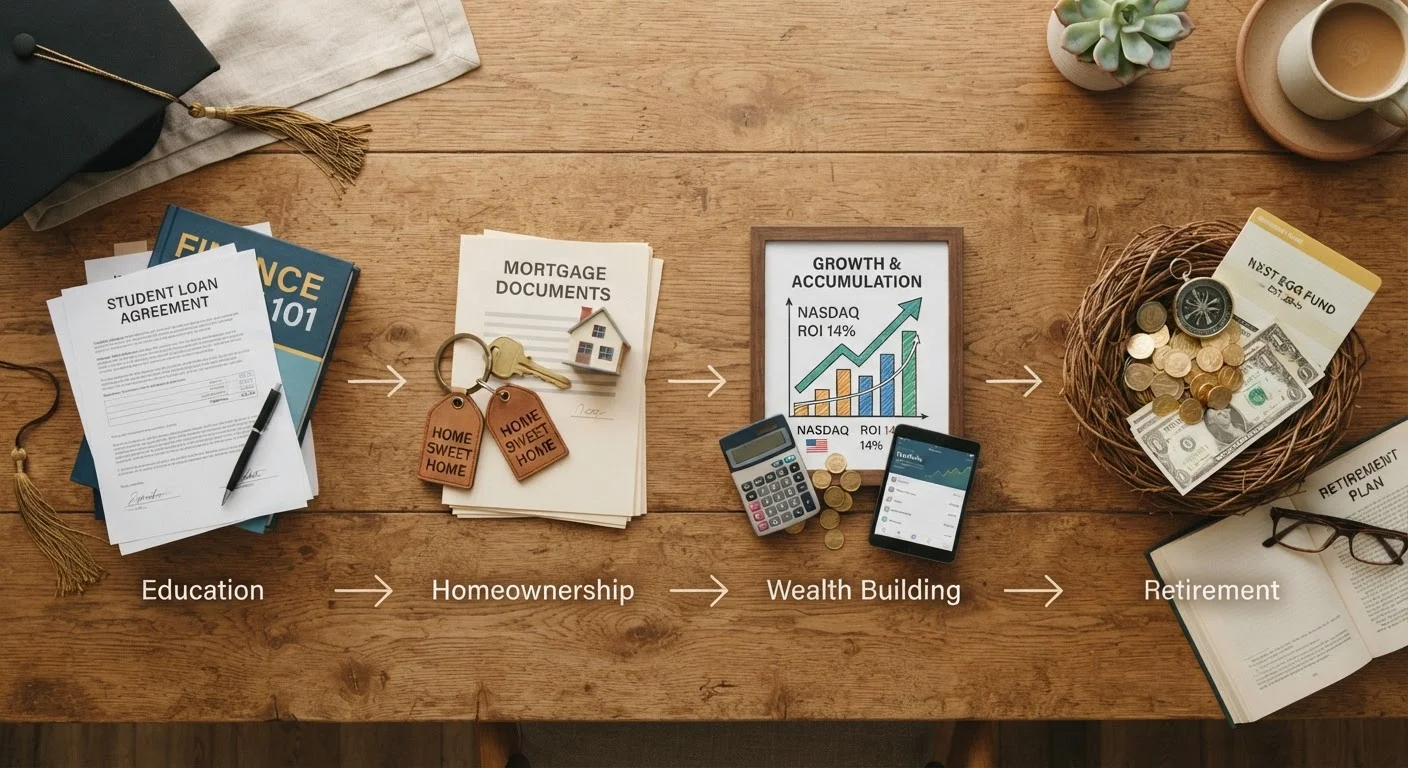
Why Life Stage Changes Everything About Debt
Debt isn't inherently good or bad — its impact depends heavily on when you take it on, why, and how it fits into your broader financial picture. A student loan at 22 and a home equity line at 52 carry very different risk profiles, even if the interest rates are similar. Understanding how your relationship with borrowing should evolve is one of the most practical steps toward long-term financial stability.
Before diving into each stage, it helps to have a working knowledge of core concepts. If terms like APR, credit utilization, or debt-to-income ratio are unfamiliar, see our glossary of key borrower terms for clear definitions. Likewise, how you borrow connects directly to how you save — the two are explored in parallel in our guide to savings goals across life stages.
In your 20s, prioritize building credit before taking on significant debt.
Your credit history is essentially your financial reputation. A thin or damaged credit file in early adulthood leads to higher interest rates on every loan you take for years. Starting with a low-limit credit card used responsibly — and paid in full monthly — costs nothing and pays dividends later.
In your 30s, borrow for assets — not lifestyle — and keep your debt-to-income ratio manageable.
This stage often brings mortgages, growing families, and higher earning potential — but also higher spending temptations. Borrowing to purchase a home can build equity over time; borrowing to fund vacations or luxury goods with high-interest credit typically erodes financial security. Keeping monthly debt payments below 36% of gross income is a widely cited benchmark worth targeting.
In your 40s, aggressively pay down high-interest debt to protect retirement readiness.
Compound interest works for you in savings accounts and retirement funds — and against you in debt balances. Carrying credit card debt into your 40s while attempting to invest is mathematically challenging: a 20% APR on a card almost always outpaces expected investment returns. Eliminating high-interest balances frees cash flow for retirement accounts.
As you approach retirement, avoid taking on new long-term debt obligations.
Fixed income in retirement makes large debt payments much harder to absorb than they were during peak earning years. A 30-year mortgage signed at 58 runs to age 88 — creating a payment obligation that may outlast your earning capacity. Shorter loan terms or no new debt at all is a conservative but often sound approach in this window.
In retirement, treat any remaining debt as a cash-flow risk and plan accordingly.
When income is fixed and largely determined by Social Security, pensions, or withdrawals, even modest debt payments compress your financial flexibility. Carrying a mortgage into retirement is workable for some — but high-interest unsecured debt like credit cards can quickly destabilize a retiree's budget if unexpected expenses arise.
Quick Wins at Any Stage
Regardless of where you are in life, a few actions can immediately improve your borrowing position. These aren't long-term strategies — they're moves you can make today.
Borrowing in Context: What the Data Suggests
American households carry debt at nearly every stage of life, but the composition changes dramatically. Younger households are more likely to carry student and auto debt, while older households tend to hold more mortgage and medical debt.
$59,580
Average US household debt balance
According to Federal Reserve data and Experian's State of Credit reports, average non-mortgage consumer debt per household has remained in this range in recent years.
22%+
Average credit card APR in the US
The Federal Reserve's G.19 consumer credit report tracks average credit card interest rates, which have exceeded 20% APR in recent reporting periods.
36%
Commonly cited safe debt-to-income ceiling
Many financial guidance frameworks and mortgage underwriting standards use 36% as a general threshold for total monthly debt payments relative to gross income.
The key insight isn't that debt is more or less common at certain ages — it's that the purpose and manageability of that debt shifts. Debt used to build an asset (like a home or education) behaves differently over time than debt used to cover recurring expenses. Building a realistic budget is the foundation that makes responsible borrowing possible at any stage.
“Debt is not inherently negative. Used wisely and intentionally, it is a tool — like any tool, its value depends entirely on whether it is the right instrument for the job at hand.”
— Personal Finance Educator Perspective, Representative view held broadly across personal finance education literature
This article is for general informational purposes only and does not constitute personalized financial, tax, or legal advice. Consult a qualified financial professional before making decisions specific to your situation.