
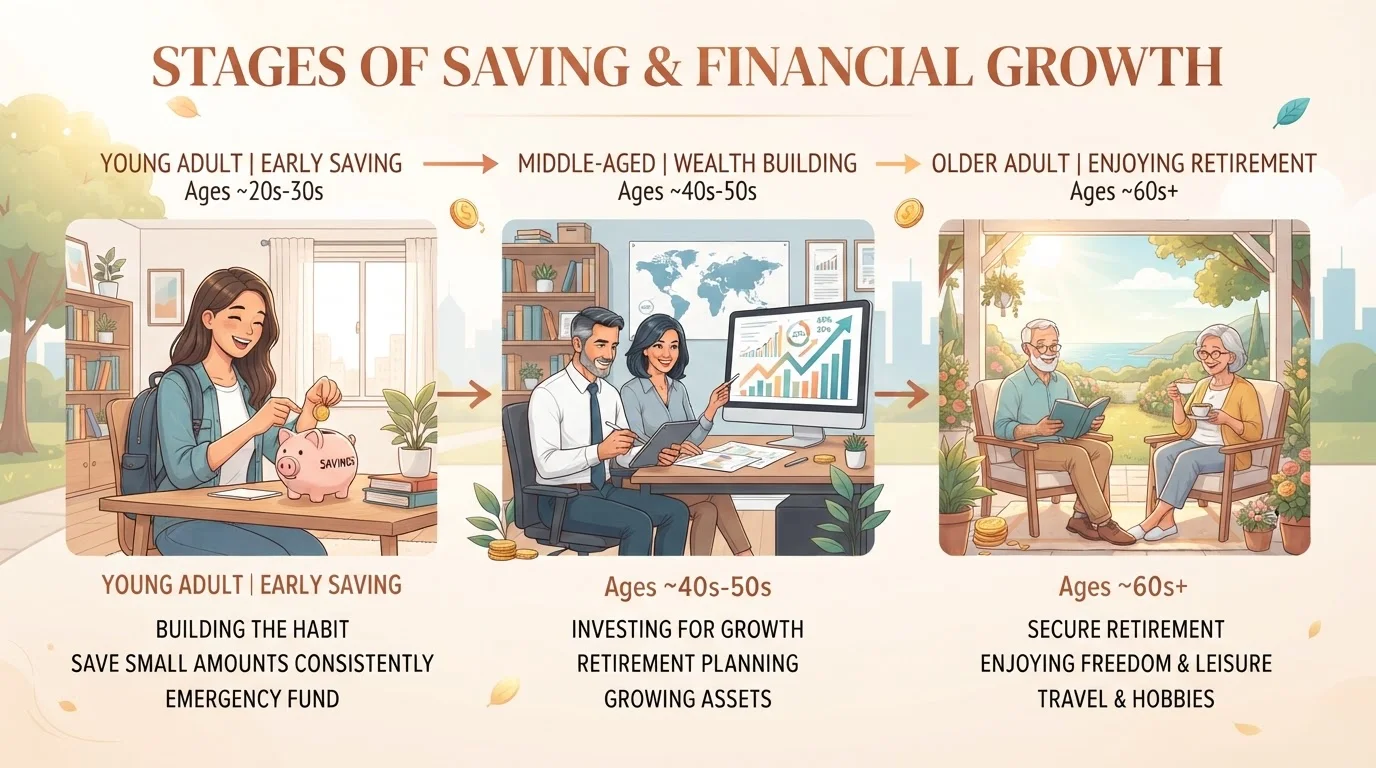
Why Life Stage Matters for Saving
There is no single savings strategy that serves a 24-year-old and a 58-year-old equally well. Income levels, family responsibilities, risk tolerance, and time horizons all shift across decades — and your approach to saving should shift with them.
This guide organizes saving priorities into three broad phases: short-term (typically early adulthood), mid-term (the middle decades), and long-term (pre-retirement and beyond). These phases are not rigid age cutoffs. A 35-year-old starting over after a career change may have short-term priorities that look more like those of a recent graduate. Use the phases as a framework, not a rulebook.
Understanding how debt and saving interact across these phases is also useful. For a complementary perspective, see how borrowing fits into each life stage.
~28%
Americans with no retirement savings
A Federal Reserve survey on economic well-being found roughly one in four non-retired adults had no retirement savings at all.
3–6 months
Recommended emergency fund coverage
Most mainstream financial guidance suggests three to six months of essential expenses as a baseline liquid cash buffer.
10x
Potential long-term compounding gap from delayed saving
Illustrative compounding models consistently show that saving earlier — even with smaller amounts — can yield dramatically larger ending balances than saving more later.
Short-Term Goals: Building the Foundation (Roughly Your 20s)
Early adulthood is typically characterized by lower income, limited savings history, and significant financial firsts — first apartment, first car payment, first full-time job. The foundational goal at this stage is stability before growth.
Emergency Fund First
Before investing or chasing higher returns, building a cash buffer is widely considered the highest-priority step. Most financial guidance suggests three to six months of essential living expenses held in a liquid, accessible account. Learn how emergency funds work and why keeping them separate matters.
Begin Retirement Contributions Early
Even modest contributions to an employer-sponsored retirement plan (such as a 401(k)) or an IRA in your 20s benefit disproportionately from compounding growth over decades. The cost of delayed retirement saving is often underestimated.
Automate even a small fixed transfer to savings from your first paycheck at a new job — before lifestyle inflation sets in. Increasing it annually by even one percentage point is far easier than cutting spending later.
Behavioral research consistently shows that automatic saving removes the decision point that causes most people to delay or skip contributions.
In your 30s and 40s, review your savings allocation annually — not just investment performance. Life changes (a new child, a promotion, a refinanced mortgage) shift what each bucket should hold.
Mid-career finances are rarely static; an allocation set at 32 may be meaningfully mismatched by 38 without a deliberate review.
Keep Short-Term Savings Liquid
Money earmarked for near-term goals — a security deposit, a vehicle, travel — belongs in accessible accounts, not long-term investments where market volatility could erode it when you need it most.
Mid-Term Goals: Growing Wealth While Managing Competing Demands (30s–40s)
The middle decades often bring higher income — but also higher expenses: mortgages, childcare, education costs, and aging-parent care. The challenge is allocating across multiple legitimate priorities simultaneously.
Earmark Savings by Purpose
Keeping a single savings account for everything makes it easy to raid funds meant for one goal to cover another. Many financial planners suggest separate accounts or sub-accounts labeled by goal — home down payment, college fund, vacation — to reduce this risk.
Increase Retirement Contribution Rates as Income Grows
A common guideline is to increase contribution rates whenever income rises, rather than absorbing the entire raise into lifestyle spending. If your employer offers contribution matching, capturing the full match is generally considered a high-priority move before directing funds elsewhere.
Raise Your Savings Rate With Every Raise
When your income increases, direct at least half of the net increase toward savings and retirement before adjusting your lifestyle budget. This approach — sometimes called "split the raise" — makes it easier to grow savings without feeling deprived. Revisiting your budget framework annually helps keep this habit in place.
Balance Growth and Accessibility
Mid-term savings (goals three to ten years out) can tolerate modest risk but not the volatility of an all-equity portfolio. A mix of savings vehicles calibrated to each goal's timeline is worth considering. Review savings account types and how they differ in access and interest for context.
A structured budget framework also helps at this stage. The 50/30/20 rule and other budget frameworks can provide a starting point for dividing income across needs, wants, and savings.
Long-Term Goals: Protecting and Extending What You've Built (50s and Beyond)
As retirement approaches, the saving calculus shifts from accumulation to preservation and distribution planning. Time horizons shorten for most goal categories, which generally argues for reducing exposure to high-volatility assets — though individual circumstances vary significantly.
Sequence of Returns Risk Is Real
A significant market downturn in the first few years of retirement — when you are actively withdrawing — can have a lasting negative impact on portfolio longevity that cannot be recovered by later gains. This is a well-documented planning challenge, not a hypothetical. Anyone within five to ten years of retirement should discuss withdrawal sequencing and asset allocation with a licensed financial adviser.
Maximize Catch-Up Contributions
U.S. tax rules allow workers aged 50 and older to contribute additional amounts to retirement accounts beyond standard annual limits. These catch-up provisions exist specifically to help later-stage savers accelerate accumulation. Consult a licensed financial adviser or tax professional for current limits and eligibility rules.
Shift Focus to Income Sustainability
Rather than asking only "how much will I accumulate?", the core question in this phase becomes "how long will my savings last?" Sequence-of-returns risk — the danger that poor market performance early in retirement can permanently reduce a portfolio — becomes a meaningful planning consideration.
Understanding how compound interest works over time remains relevant here: growth continues in retirement, but the math of withdrawals runs in the opposite direction.
“The goal of retirement planning is not simply to accumulate a large number — it is to convert that number into reliable, sustainable income for as long as you need it.”
— Christine Benz, Director of Personal Finance, Morningstar
Choosing the Right Accounts at Each Stage
The type of account you use matters as much as the amount you save. Broadly:
- High-yield savings accounts and money market accounts suit short-term and emergency goals where liquidity is essential.
- Certificates of deposit (CDs) can work for mid-term goals with a fixed timeline where you won't need early access.
- Tax-advantaged retirement accounts (401(k), IRA, Roth IRA) are generally best suited to long-term goals where the tax treatment compounds the benefit over time.
Each account type carries trade-offs in access, yield, and tax treatment. A detailed breakdown of common savings account types can help you match accounts to goals.
Once you have a plan, automating contributions removes the friction of manual transfers. See a practical walkthrough for automating your savings.
Putting It All Together
Saving across life stages is not a single decision — it is a series of recalibrations made as income, responsibilities, and timelines evolve. The most consistent thread across all stages is the value of intentionality: naming goals, assigning them timelines, and choosing accounts that match.
No article can substitute for personalized guidance. A licensed financial adviser can help you model scenarios specific to your income, obligations, and risk tolerance. For building the budgeting discipline that makes saving possible at any stage, explore practical budgeting strategies and review habits that help people stick to budgets long-term.
Budget Frameworks for Savers
A comparison of popular budgeting approaches — including 50/30/20 and pay-yourself-first — and how each handles the saving allocation differently.
Savings Account Type Comparison
A reference breakdown of high-yield savings, money market accounts, CDs, and standard savings accounts — including how they differ in interest and liquidity.
Savings Automation Walkthrough
Step-by-step guidance on setting up automatic transfers and contributions so your saving system requires less daily willpower.
This article is for general informational and educational purposes only and does not constitute personalized financial, investment, tax, or legal advice. Consult a qualified, licensed financial professional before making decisions specific to your situation.