
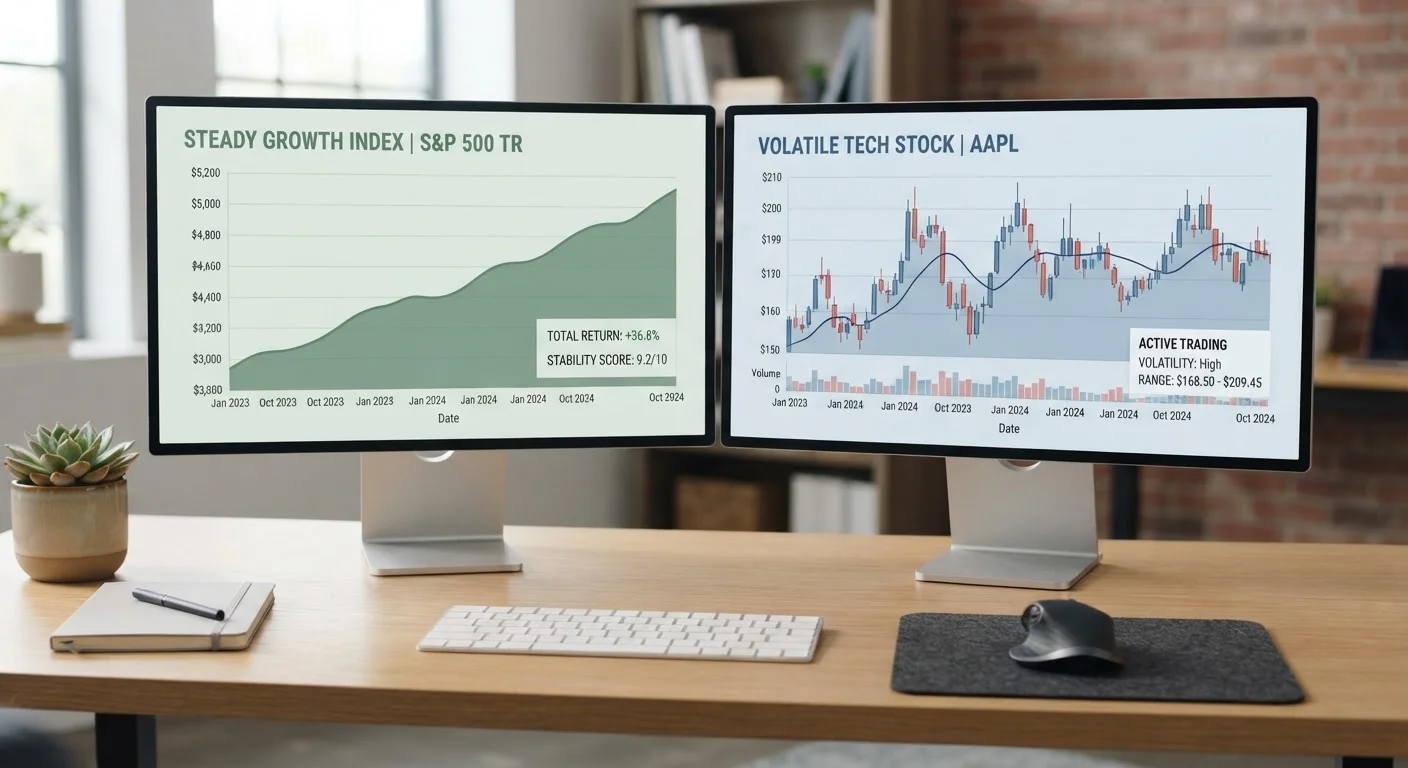
The Core Structural Difference
At their foundation, index funds and actively managed funds differ in how investment decisions are made — not merely in performance or price.
An index fund is built to replicate the composition and performance of a specific market index, such as the S&P 500 or the Bloomberg U.S. Aggregate Bond Index. The fund holds the same securities — in the same proportions — as the index it tracks. There is no manager deciding which stocks to buy or sell based on market outlook. The process is rules-based and largely automated.
An actively managed fund, by contrast, employs a portfolio manager (or a team) who analyzes securities, forms views on valuations and market conditions, and makes ongoing buy and sell decisions. The explicit goal is to outperform a benchmark index rather than simply match it.
This structural distinction drives virtually every other difference between the two: cost, tax efficiency, consistency of approach, and how performance is measured. For a broader look at how spreading assets across fund types relates to risk, see our article on what diversification actually does to portfolio risk.
| Criterion | Index Funds | Actively Managed Funds |
|---|---|---|
| Investment strategy | Tracks a market index passively | Manager makes active buy/sell decisions |
| Typical expense ratio | 0.03%–0.20% | 0.50%–1.00%+ |
| Performance goal | Match benchmark returns | Outperform benchmark |
| Portfolio turnover | Generally low | Often higher |
| Tax efficiency (taxable accounts) | Generally more tax-efficient | Can generate more taxable events |
| Manager dependency | None — rules-based process | High — depends on manager skill |
| Market risk | Full exposure to index volatility | Varies by strategy and mandate |
Cost: The Most Consequential Gap
The fee difference between index and actively managed funds is one of the most well-documented and consequential distinctions in personal investing.
Fund costs are typically expressed as an expense ratio — the annual percentage of assets deducted to cover fund operating expenses. Index funds, because they require minimal active decision-making, generally carry expense ratios well under 0.20%, with many broad-market index funds available at 0.03%–0.10%. Actively managed funds, which must pay for research teams, analyst resources, and manager compensation, often carry expense ratios ranging from 0.50% to over 1.00%.
~0.05%
Typical index fund expense ratio
Many broad-market index funds carry expense ratios at or below 0.10%, with some as low as 0.03%, according to fund industry data.
Over 80%
Active large-cap funds underperforming index over 15 years
S&P Dow Jones Indices' SPIVA reports have repeatedly found that the majority of actively managed U.S. large-cap funds lag their benchmark over 15-year periods, after fees.
~0.66%
Average active equity fund expense ratio
Morningstar's annual fee studies have documented that actively managed equity funds carry average expense ratios significantly higher than their passive counterparts.
That gap may sound small in percentage terms, but compounding amplifies it considerably. On a $50,000 portfolio growing at 6% annually over 30 years, a 1% annual fee difference can translate to tens of thousands of dollars in foregone returns. This is not a projection or guarantee — it's a mathematical illustration of how fee drag works over time.
Actively managed funds also tend to generate more taxable events due to higher portfolio turnover, which can create additional tax considerations for investors holding funds in taxable accounts. Understanding how these costs fit into your overall financial picture is worth discussing with a qualified financial adviser.
Performance: What the Evidence Suggests
The debate over active versus passive management has been studied extensively. The S&P Indices Versus Active (SPIVA) scorecards, published by S&P Dow Jones Indices, track how actively managed funds perform relative to their benchmark indexes over various time horizons. Across multiple editions and time periods, a majority of active funds in most categories have underperformed their benchmark over 10- and 15-year windows, after fees.
This does not mean all active funds underperform — some do beat their benchmarks, sometimes by meaningful margins. The challenge is identifying which funds will outperform in advance, and whether outperformance persists over time. Evidence for consistent, durable outperformance among active managers is limited, and past performance does not guarantee future results.
It's also worth noting that market efficiency plays a role. In highly liquid, well-researched markets like large-cap U.S. equities, it is particularly difficult for active managers to gain a consistent informational edge. In less-efficient corners of the market — smaller companies, emerging markets, certain fixed-income segments — the case for active management is sometimes argued more credibly, though results remain mixed.
If you use a dollar-cost averaging strategy to invest regularly, understanding whether you're applying it to index or active funds matters for how costs accumulate. Our guide on dollar-cost averaging explains the mechanics in detail.
A Note on Market Conditions and Active Management
Proponents of active management often argue it is better positioned during volatile or declining markets, as managers can shift allocations defensively. Research on this claim is mixed — some active funds have navigated downturns more effectively, while others have not. Market timing and defensive positioning introduce their own risks and costs, and there is no reliable evidence that active funds, on average, consistently protect against drawdowns better than index alternatives.
Which Structure Fits Your Situation
Choosing between index funds and actively managed funds is not a universal decision — it depends on your goals, time horizon, cost sensitivity, and how you hold investments (taxable account, IRA, 401(k), etc.).
Index funds are often highlighted as a sound starting point for investors seeking simplicity, cost efficiency, and broad diversification. They require no view on manager skill and deliver market-rate returns before fees by design. For most long-term investors building toward retirement, this alignment with market performance — rather than a bet on outperformance — has historically served well as a structural anchor.
Actively managed funds may appeal to investors who have specific reasons to seek manager discretion: a targeted allocation to a niche asset class, a value-oriented strategy in a less-efficient market, or a desire for a defined risk-management framework. These are legitimate considerations, but they should be weighed against the higher cost and the difficulty of consistently identifying outperforming managers ahead of time.
Many investors use both — holding index funds as a core position while allocating a smaller portion to active strategies in areas where they believe the case is stronger. There is no single correct answer.
If you're also evaluating the account type in which to hold these funds, our comparison of Roth IRA vs. Traditional IRA covers key structural differences worth understanding before you decide.
This article is for general informational and educational purposes only and does not constitute personalized financial, investment, tax, or legal advice. Past performance does not guarantee future results. Consult a qualified financial adviser, accountant, or attorney regarding decisions specific to your situation.