
How Dollar-Cost Averaging Actually Works
The mechanics of dollar-cost averaging are straightforward. Suppose you commit to investing $200 every month in a broad-market index fund. In month one, shares cost $20 each — your $200 buys 10 shares. In month two, the price drops to $16 — your $200 buys 12.5 shares. In month three, prices recover to $25 — your $200 buys 8 shares.
After three months, you've invested $600 and own 30.5 shares. The average price you paid per share works out to roughly $19.67, which is lower than the average of the three prices ($20.33). That's the core arithmetic benefit: because you buy more shares when prices are lower and fewer when they're higher, the average cost per share tends to shade downward over time.
This dynamic works in your favor during volatile or declining markets. Rather than watching a lump-sum investment shrink, you're accumulating more shares at lower prices — shares that benefit when the market eventually recovers. It won't spare your existing holdings from paper losses, but it does mean your ongoing purchases are working harder during down periods.
DCA and Index Funds: A Common Pairing
Dollar-cost averaging is frequently combined with broad-market index funds because index funds offer built-in diversification across many companies. This pairing means each fixed contribution is automatically spread across hundreds or thousands of holdings. For a deeper look at how index funds compare to actively managed alternatives, see our article on index funds vs. actively managed funds.
Why Investors Use It — and What It Doesn't Fix
The primary appeal of DCA is psychological and practical. Market timing — predicting the best moment to invest — is notoriously difficult, even for professional investors. DCA removes that decision entirely. You invest on schedule, and short-term market noise becomes less relevant to your behavior.
This matters because one of the most common investing mistakes is letting emotion override discipline. Investors who try to time markets often buy when confidence is high (near peaks) and sell when fear takes over (near troughs) — the opposite of what builds wealth. A fixed schedule sidesteps that trap.
“The stock market is a device for transferring money from the impatient to the patient.”
— Warren Buffett, Chairman and CEO of Berkshire Hathaway; widely cited investor and business commentator
What DCA cannot do is protect against sustained market declines. If you invest $200 per month into an asset that falls steadily for several years, you will accumulate more shares at progressively lower prices — but those shares will still be worth less than you paid. The strategy requires patience and a long enough time horizon for recovery to be realistic. It also does not address the composition of your portfolio. For that, understanding diversification is a separate but complementary discipline.
Making the Habit Work in Practice
The most reliable way to sustain dollar-cost averaging is to make it automatic. When contributions happen without requiring a deliberate decision each period, they're far less likely to be skipped during stressful stretches — exactly the moments when you most need to stay the course.
Many workplace retirement accounts are already structured this way: each paycheck, a fixed amount flows into the account and is invested, regardless of market conditions. If you're starting to invest with a small income, this kind of automation lowers the barrier significantly — you don't need to be watching markets or making active decisions. Setting up automatic transfers is covered in more detail in our practical savings automation guide.
~57%
U.S. workers with access to a workplace retirement plan
According to the U.S. Bureau of Labor Statistics, roughly 57% of private-sector workers have access to an employer-sponsored retirement plan — most of which use automatic payroll contributions that mirror the DCA approach.
401(k)
Most common DCA vehicle for American workers
The 401(k) is the most widely used vehicle for systematic, recurring investment contributions in the United States, and its structure inherently applies dollar-cost averaging each pay period.
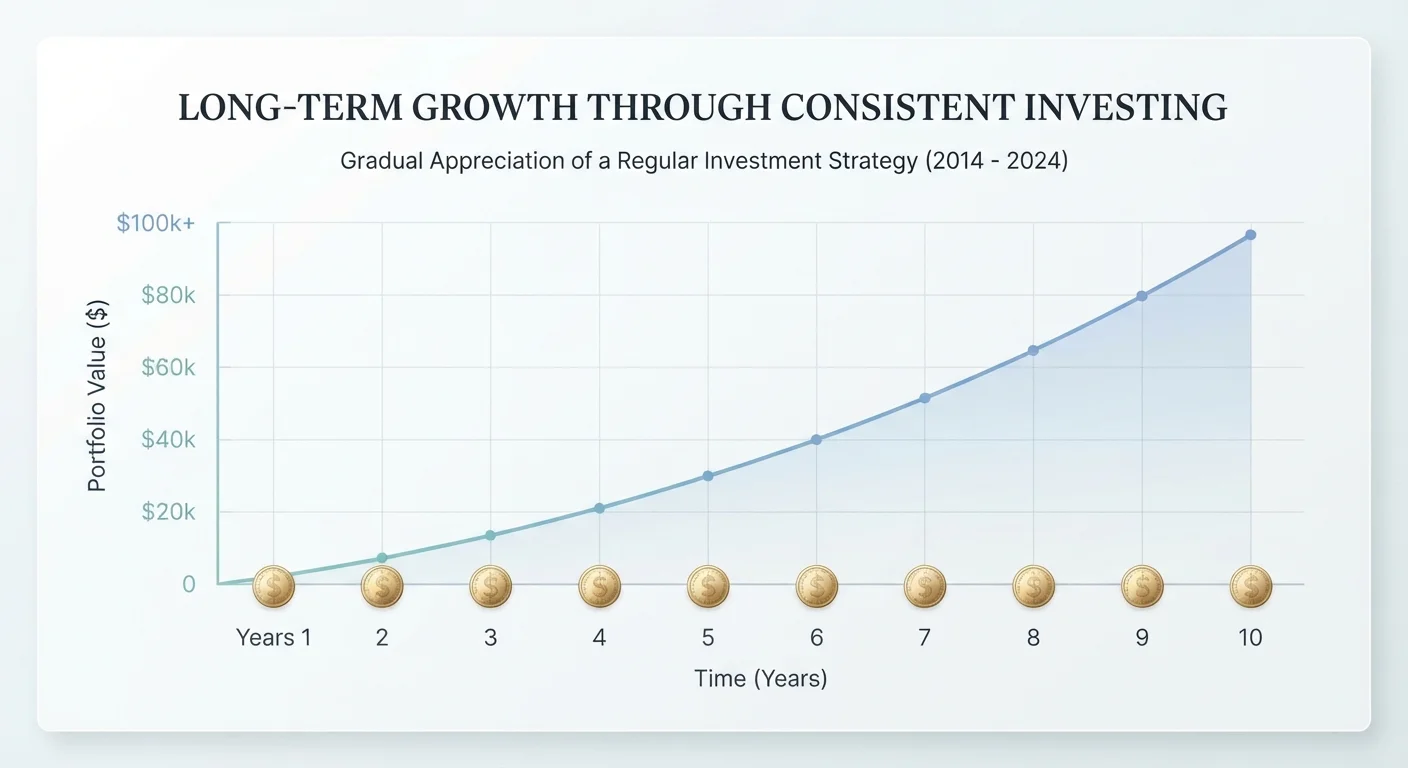
It's also worth understanding how DCA fits into a broader financial picture. The returns from regular investing compound over time — meaning gains themselves generate further gains. Our breakdown of how compound interest builds wealth explains why consistency and time are so powerful together. And if you're concerned about the cost of waiting to get started, delayed saving carries real long-term costs that are easy to underestimate.
This article is for general informational purposes only and does not constitute personalised financial or investment advice. Consult a qualified financial adviser before making decisions about your own investments.