
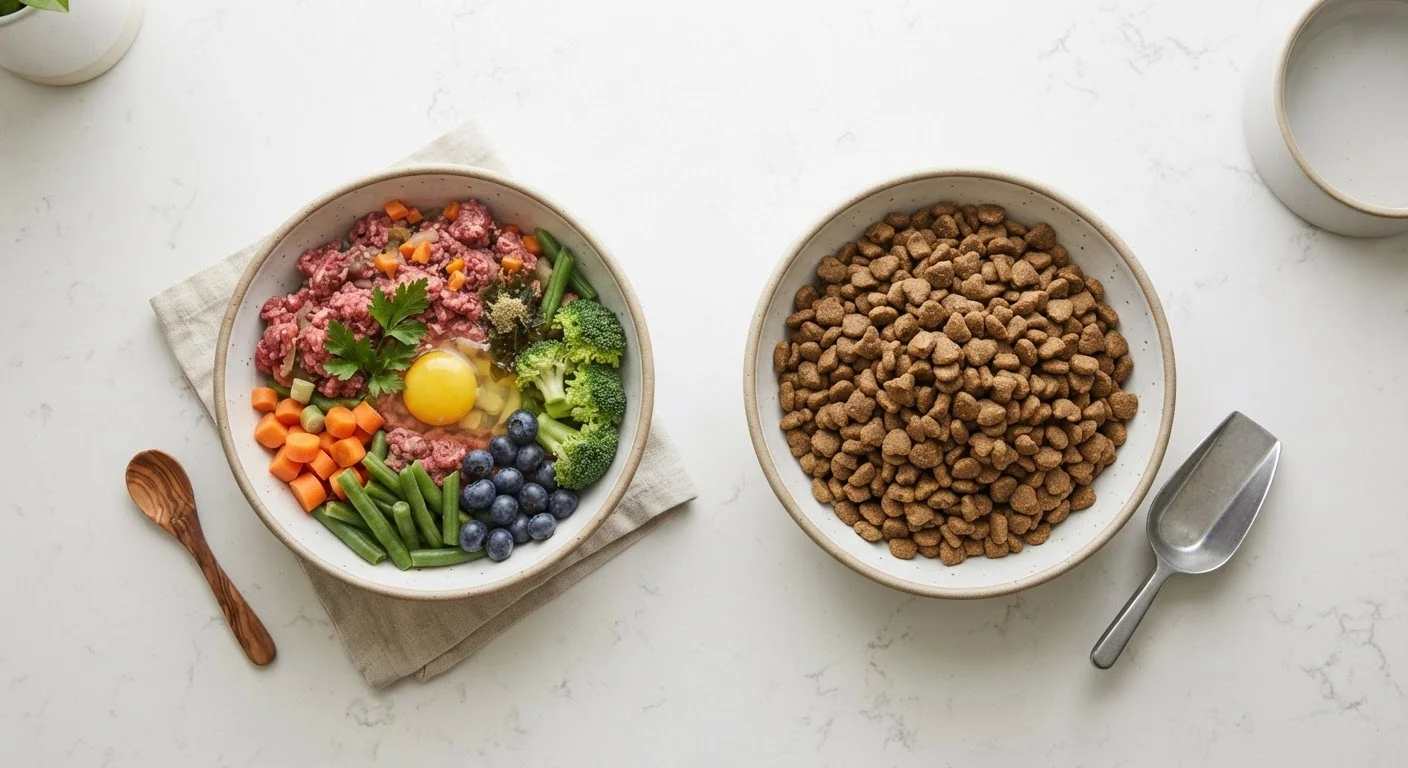
What Each Feeding Approach Actually Involves
The term raw diet typically refers to feeding dogs or cats uncooked animal muscle meat, organ meat, raw meaty bones, and sometimes fruits or vegetables. Two common frameworks are the BARF model (Biologically Appropriate Raw Food) and whole-prey feeding. Proponents argue these diets mirror what a wild ancestor would eat. In practice, raw diets are prepared at home or purchased pre-made from specialty retailers.
Commercial kibble, by contrast, is a highly processed dry food formulated to meet nutritional profiles established by the Association of American Feed Control Officials (AAFCO). Ingredients are cooked at high temperatures, which kills pathogens and extends shelf life. Most veterinary nutritionists consider an AAFCO-compliant kibble a reliable nutritional baseline for healthy pets at various life stages.
Understanding the real differences starts with knowing what each option is — and isn't. For a broader look at what nutritional balance actually requires, see our guide on what a balanced diet means for pets.
| Criterion | Raw Diet | Commercial Kibble |
|---|---|---|
| Nutritional completeness | Varies; often incomplete without expert formulation | Standardized via AAFCO nutrient profiles |
| Food safety risk | Higher — raw meat may harbor Salmonella, Listeria | Lower — heat processing kills most pathogens |
| Scientific evidence base | Limited peer-reviewed long-term studies | Decades of feeding trials and research |
| Convenience | Low — requires sourcing, prep, and storage | High — shelf-stable and easy to portion |
| Ingredient control | High — owner selects every component | Low to moderate — depends on brand formulation |
| Cost | Typically higher, especially for quality sourcing | Wide range; generally more affordable |
| Suitability for vulnerable pets | Not generally recommended | Appropriate with vet-approved formula |
What the Research Actually Shows
Veterinary science has a robust body of research supporting the nutritional adequacy of commercially formulated diets. AAFCO feeding trials — though imperfect — have been used for decades to validate that kibble meets minimum nutritional requirements across life stages.
Research on raw diets is more limited and less consistent. A frequently cited concern is nutritional incompleteness: multiple studies have found that a high percentage of homemade and commercially available raw diets fail to meet AAFCO nutrient profiles, particularly for calcium, phosphorus, and certain trace minerals. A study published in the Journal of Nutritional Science found that the majority of raw recipes evaluated were deficient in at least one essential nutrient.
On the claimed benefits side — shinier coats, better digestion, improved energy — the evidence is largely anecdotal. Controlled, peer-reviewed studies demonstrating these outcomes in companion animals are sparse. That doesn't mean the benefits aren't real for some pets, but it does mean they haven't been scientifically validated at scale.
~60%
Raw pet food samples testing positive for pathogens
FDA surveillance testing has found Salmonella or Listeria in a significant proportion of raw pet food samples tested in multiple studies.
~83%
Homemade raw recipes found nutritionally deficient
Research published in veterinary nutrition journals found that the large majority of evaluated homemade raw diets failed to meet AAFCO nutrient minimums in at least one category.
< 1%
Raw diet studies meeting high evidence standards
A systematic review of raw diet research noted that very few published studies met criteria for robust controlled trial design, limiting what firm conclusions can be drawn.
Food safety is where the science is clearest. The FDA and the CDC have both published data showing that raw pet food is significantly more likely to test positive for Salmonella and Listeria than conventional pet food. These pathogens can colonize a pet's gut asymptomatically and shed into the environment, creating risk for human household members — particularly children, the elderly, and immunocompromised individuals.
For context on how research literacy applies to nutrition claims more broadly, our article on what nutrition research does and doesn't prove offers useful framing.
Practical Considerations for Pet Owners
Beyond the science, day-to-day practicality plays a large role in which approach is sustainable. Kibble wins on convenience, shelf stability, and cost predictability. A raw diet — especially homemade — requires careful sourcing, handling, refrigeration, and regular nutritional review.
If you're interested in raw feeding, the most important step is consulting a board-certified veterinary nutritionist (DACVN) before starting. They can formulate a diet tailored to your pet's species, breed, age, and health status, and flag deficiencies before they become clinical problems. General recipes found online are frequently inadequate without professional adjustment.
Pet owners exploring feeding alternatives should also read up on common pet nutrition myths — many popular beliefs about both raw and processed diets don't hold up under scrutiny.
Freeze-Dried and Lightly Cooked: A Middle Ground?
Some pet owners opt for commercially prepared freeze-dried raw or gently cooked diets as a compromise. These formats reduce — but may not eliminate — pathogen risk compared to fully raw feeding. Nutritional completeness still varies by product, so checking for an AAFCO statement on the label and discussing the option with your veterinarian remains important before making a switch.
For a related comparison within commercial food formats, dry kibble vs. wet food covers practical trade-offs worth understanding before committing to any routine. And for foundational pet care guidance, the Pet Care Basics hub is a reliable starting point.
This article is for general informational and educational purposes only. It is not veterinary advice. Always consult a licensed veterinarian or board-certified veterinary nutritionist before making significant changes to your pet's diet, especially if your pet has existing health conditions.