
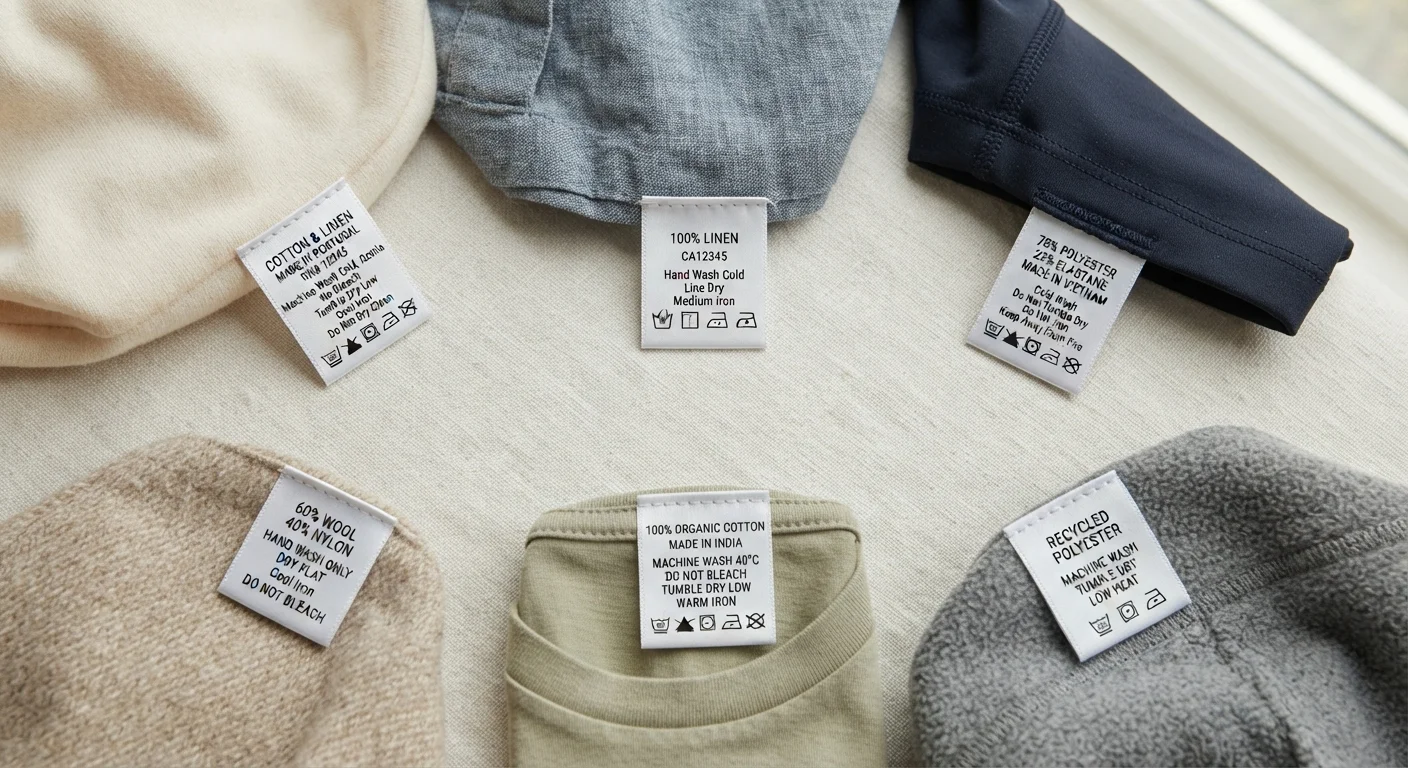
The Five Symbol Families — Your Quick-Reference Map
Every care label sold in the U.S. uses the same five symbol categories, standardized under ASTM D5489. Once you recognize the five shapes, you can decode any label in seconds — no guesswork required.
| Symbol categories on care labels | 5 (Washing, Bleaching, Drying, Ironing, Professional Care) (ASTM D5489 Standard) |
| U.S. care label regulation | Required by FTC Care Labeling Rule (Federal Trade Commission) |
| Universal 'do not' indicator | X drawn through any symbol (GINETEX international standard) |
| Dots inside dryer or iron symbols | Indicate heat level: 1 dot = low, 2 = medium, 3 = high (ASTM D5489 Standard) |
| Lines under the wash tub symbol | 1 line = permanent press; 2 lines = delicate cycle (ASTM D5489 Standard) |
| Triangle symbol | Bleaching instructions (empty = any bleach OK; crossed = no bleach) (GINETEX international standard) |
- Wash tub — Washing instructions. The number inside is the maximum water temperature in Celsius. Lines beneath the tub signal agitation level: one line means permanent press, two lines mean delicate or gentle cycle.
- Triangle — Bleaching. An empty triangle means any bleach is safe. A triangle with two diagonal stripes means non-chlorine bleach only. A crossed-out triangle means skip bleach entirely.
- Square — Drying method. A circle inside the square means tumble dry; dots within that circle indicate heat level. A square with a curved line at the top means line dry. A horizontal line through the center means lay flat to dry.
- Iron — Ironing temperature. Dots inside the iron indicate heat: one dot for low, two for medium, three for high. Steam lines crossed out beneath the iron mean avoid steam.
- Circle — Professional cleaning. A plain circle means dry clean. Letters inside (such as P or F) tell the dry cleaner which solvents are safe to use. A crossed-out circle means do not dry clean.
The one shorthand worth memorizing first: an X through any symbol means do not — universally, across every category.
When Labels Show Text Instead of Symbols
Some older or imported garments use written care instructions rather than symbols — both formats carry the same legal weight under FTC rules. If a garment shows text in another language alongside symbols, the symbols take precedence for the U.S. market. When any instruction is unclear, default to the most cautious option on the label: cooler water, lower heat, and gentler handling.
Common Label Situations — And What to Actually Do
Knowing the symbols is one thing; applying them confidently at laundry time is another. Here are the scenarios that trip people up most often.
Permanent Care Label
A label sewn into a garment that provides legally required care instructions. In the U.S., the FTC mandates that most clothing carry permanent care labels at the time of sale.
ASTM D5489
The American standard that defines the symbols used on U.S. garment care labels, aligned with the international GINETEX system used in most countries.
Delicate / Gentle Cycle
A washing machine setting that uses slower agitation and lower spin speeds to reduce mechanical stress on fragile or structured fabrics.
Tumble Dry
Machine drying in a rotating drum. Dots inside the dryer symbol indicate temperature: one dot for low heat, two for medium, three for high.
Lay Flat to Dry
A drying method where the garment is reshaped and dried horizontally to prevent stretching caused by hanging weight — most common for knitwear.
Dry Clean Only
A care instruction indicating the garment must be cleaned using professional solvent-based methods, not water-based home washing.
"Dry Clean Only" vs. "Dry Clean"
"Dry Clean Only" is a firm instruction — water washing risks shrinking structured garments, dissolving interfacing, or permanently warping shape. "Dry Clean" without "Only" is technically a recommendation, and many such garments tolerate a careful hand wash in cool water. When uncertain, test an inconspicuous area like a seam allowance before washing the full piece.
The Hand Wash Symbol
A tub with a hand inside means gentle, cool-water washing — not a vigorous scrub. Fill a basin, submerge the garment, press (never wring) suds through, and rinse thoroughly. Then dry using whatever remaining label instruction applies: hang, lay flat, or reshape.
No Iron Symbol
An iron with an X through it often appears on heat-sensitive synthetic blends or embellished fabrics. A handheld steamer held a few inches away is usually fine — the instruction targets direct contact heat, not all humidity. Always check for a crossed-out steam icon separately before steaming.
66%
Consumers who rarely or never check care labels
According to a survey by the American Cleaning Institute, roughly two-thirds of consumers admit to skipping care label instructions before laundering.
5
Standardized symbol families on every label
All garment care labels use the same five icon categories established under the ASTM D5489 guidelines adopted in the U.S.
If you find yourself puzzling over another kind of label system, the dress codes guide brings the same plain-language clarity to occasion dressing. And for bedding purchases, understanding bedding label terms like thread count and fill power works out to the same confidence-building exercise as mastering clothing care.
Following care label guidance consistently is one of the simplest ways to extend the life of every garment you own — which translates directly into a wardrobe that holds up season after season.