
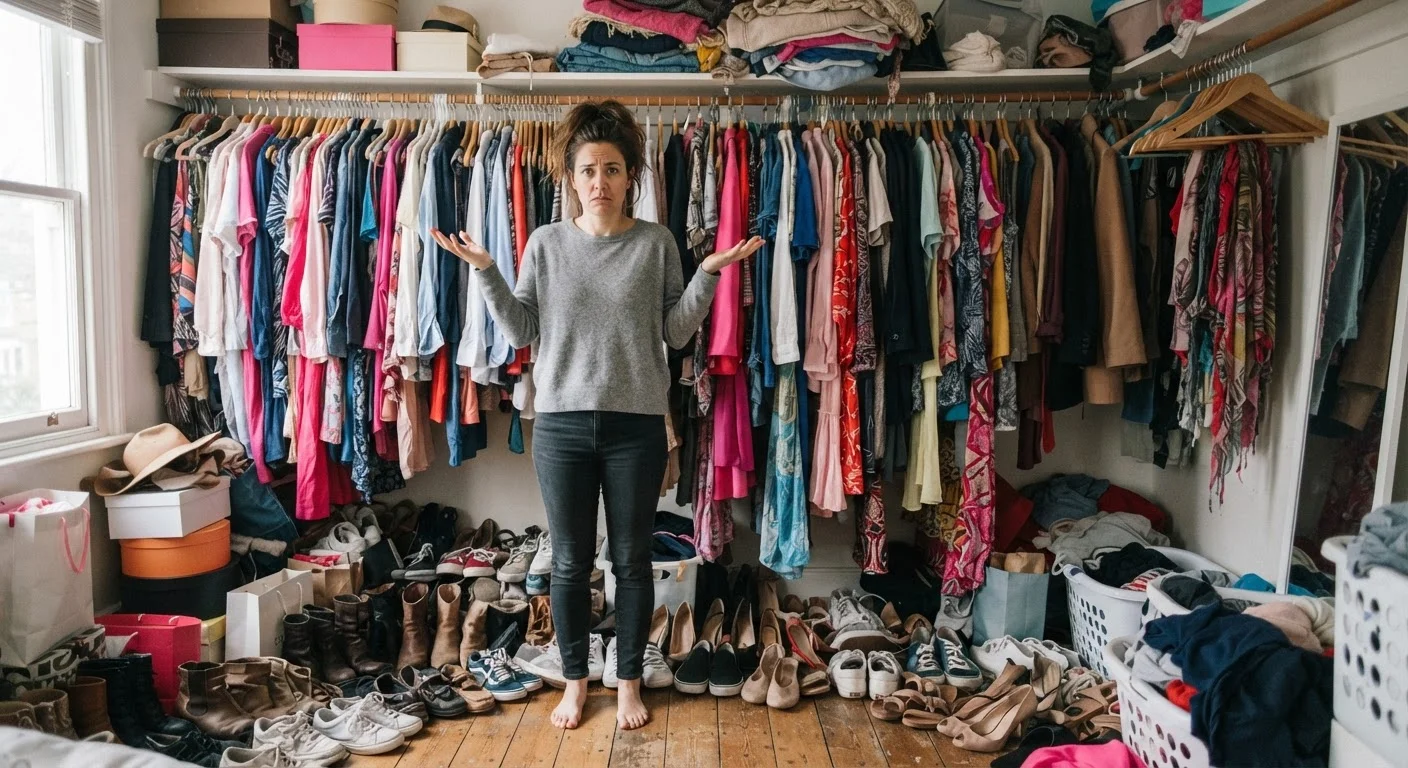
The Overcrowded Closet Paradox
It's one of the most common style frustrations: you open a closet stuffed with clothing and still feel like you have nothing to wear. This isn't a supply problem — it's a cohesion problem. The pieces simply don't connect in ways that produce real outfits for your real life.
Understanding why this happens is the first step toward fixing it. The root cause is almost always a series of small, repeated shopping decisions that made sense individually but created chaos collectively. Each mistake below is easy to make and just as easy to course-correct once you see it clearly.
Volume Is Not the Same as Versatility
Having 80 items in your closet means very little if they don't work together. Wardrobe function comes from cohesion — shared colors, compatible silhouettes, and pieces suited to your real daily life — not from sheer numbers. Before adding anything new, consider whether it connects meaningfully to what you already own.
Common Wardrobe Mistakes — and How to Sidestep Them
The following patterns show up again and again in closets that feel full but function poorly. Recognizing your own tendencies here is more useful than any organizational hack.
Shopping for a fantasy lifestyle rather than your actual one.
Why it happens: Retail environments and social media showcase aspirational looks that feel exciting in the moment, making it easy to buy for a version of your life that rarely — or never — shows up.
Building a closet without a defined color palette.
Why it happens: Shoppers often react to individual pieces that catch their eye, accumulating colors and prints that look great on a rack but refuse to coordinate with anything else at home.
Holding onto items that don't fit the body you have right now.
Why it happens: Clothes tied to a past size, a hoped-for future size, or a sentimental purchase create visual clutter and make mornings harder — they take up physical and mental space without contributing anything wearable.
Buying trend pieces with no connection to your personal style.
Why it happens: Trend cycles move fast, and the social pressure to stay current can push people toward items that reflect the moment rather than their own identity — leaving a closet that feels foreign.
Neglecting the basics that act as outfit glue.
Why it happens: Basics feel boring to shop for, so people gravitate toward statement pieces — but without foundational items like well-fitting solid tops or versatile trousers, those statement pieces have nothing to anchor them.
If several of these feel familiar, you're not alone — and you don't need to overhaul everything at once. A focused step-by-step wardrobe evaluation can help you identify exactly which patterns are costing you the most wearable combinations.
Shifting from More to Better
The goal isn't a smaller closet for its own sake — it's a closet where nearly everything earns its place. Whether you prefer a curated minimalist approach or a fuller, more expressive wardrobe, what matters is intentionality. Our guide to capsule versus full wardrobe approaches can help you figure out which model actually fits how you live.
~20%
Clothes worn regularly from the average closet
Research in consumer behavior and wardrobe studies consistently suggests most people wear roughly a fifth of the clothing they own on a regular basis.
3–5
Neutral base colors in a functional wardrobe palette
Style professionals and wardrobe consultants commonly recommend limiting your foundational neutral palette to three to five tones to maximize outfit combinations.
If you're starting from a genuinely unclear place — unsure of your style identity, your palette, or what a functional base even looks like — building a wardrobe from scratch offers a practical, pressure-free starting point. Style clarity doesn't require spending more; it requires making choices that reflect who you actually are.