
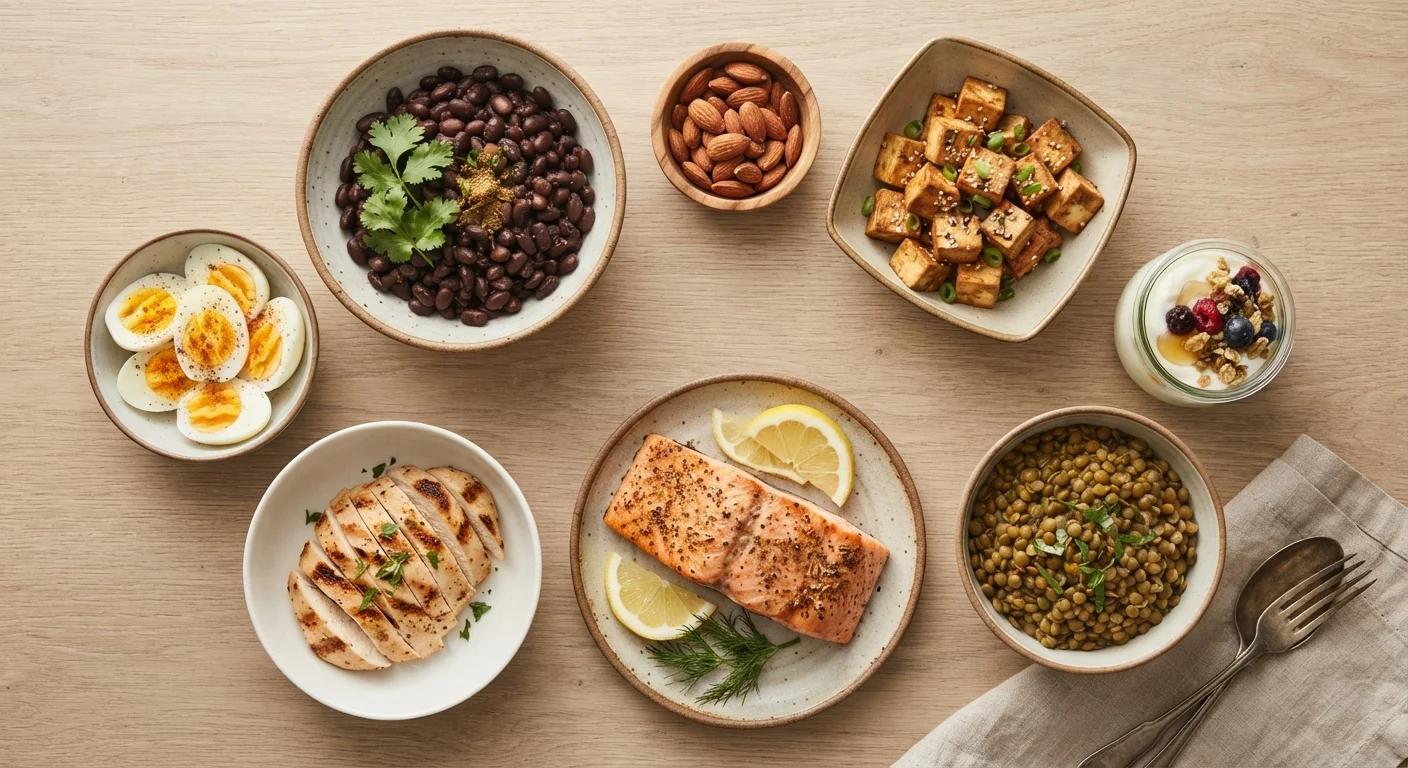
What Makes a Protein Source Worth Knowing About
Protein is made up of amino acids — the building blocks your body uses for muscle repair, immune function, enzyme production, and more. Of the 20 amino acids needed for these processes, nine are essential, meaning the body cannot make them on its own and must obtain them through food.
Two concepts help evaluate any protein source: quantity (how much protein per serving) and quality (how well the amino acid profile matches what the body needs). The PDCAAS and the newer DIAAS are the primary scientific scales used to assess protein quality. Both compare a food's amino acid profile against human requirements and factor in digestibility.
Complete Protein
A food that contains all nine essential amino acids in sufficient quantities. Animal products and some plant foods like soy and quinoa are considered complete proteins.
Essential Amino Acids
The nine amino acids the human body cannot synthesize on its own and must obtain through food. They include leucine, lysine, and tryptophan, among others.
PDCAAS
Protein Digestibility Corrected Amino Acid Score — a method of evaluating protein quality based on both the amino acid composition and digestibility of a food relative to human requirements.
DIAAS
Digestible Indispensable Amino Acid Score — a more precise successor to PDCAAS that measures protein quality at the level of individual amino acid digestibility in the small intestine.
Complementary Proteins
Plant protein sources that, when eaten in combination (e.g., rice and beans), together provide all essential amino acids. Achieving variety throughout the day is generally sufficient.
Legumes
The family of plants that includes beans, lentils, peas, and chickpeas. Legumes are among the most protein-rich plant foods and are also high in dietary fiber.
Understanding these fundamentals helps you evaluate any food — regardless of your dietary pattern. For a broader look at how food choices fit together day to day, see building a balanced plate.
Animal-Based Protein Sources
Animal foods generally score high on protein quality because they contain all nine essential amino acids in proportions close to human needs.
| Protein in chicken breast (3 oz cooked) | ~26 g (USDA FoodData Central) |
| Protein in cooked lentils (1 cup) | ~18 g (USDA FoodData Central) |
| Protein in one large egg | ~6 g (USDA FoodData Central) |
| Protein in firm tofu (½ cup) | ~10–20 g (Varies by brand and water content) |
| Recommended daily protein (general adult) | 0.8 g per kg body weight (Dietary Reference Intakes, National Academies) |
| Protein in Greek yogurt (1 cup) | ~15–20 g (USDA FoodData Central) |
- Meat and poultry — Chicken breast, beef, pork, and turkey provide roughly 20–30 g of protein per 3 oz (85 g) cooked serving, along with iron, zinc, and B vitamins. Preparation method affects saturated fat content more than protein content.
- Fish and seafood — Salmon, tuna, cod, and shrimp are high-protein and offer omega-3 fatty acids. A 3 oz serving of most fish delivers 15–25 g of protein.
- Eggs — One large egg provides about 6 g of protein and is often cited as a reference standard for amino acid completeness.
- Dairy — Greek yogurt (~15–20 g per cup), cottage cheese (~14 g per half cup), and milk (~8 g per cup) are versatile sources that also contribute calcium.
Animal proteins are generally well-absorbed. Their broader nutritional context — including fat type and processing level — is worth considering alongside protein content.
Plant-Based Protein Sources
Plant proteins vary more widely in amino acid profiles. Most are lower in one or more essential amino acids, though this concern is easily addressed through dietary variety over the course of a day — not necessarily within every single meal.
- Legumes — Lentils (~18 g per cooked cup), black beans (~15 g), chickpeas (~15 g), and edamame (~17 g) are among the most protein-dense plant foods. They also provide fiber and a range of micronutrients.
- Soy foods — Tofu (varies by firmness, roughly 8–20 g per half cup), tempeh (~15–16 g per half cup), and edamame are complete proteins — containing all essential amino acids — and score highly on quality scales.
- Whole grains — Quinoa (~8 g per cooked cup) and amaranth are notable for providing complete protein profiles. Other grains like oats and brown rice contribute modest amounts.
- Nuts and seeds — Hemp seeds (~10 g per 3 tbsp), pumpkin seeds, and peanuts provide protein alongside healthy fats, though calorie density is high.
For those exploring plant-forward eating, a practical starting point for plant-based eating covers common nutritional gaps and how to fill them.
Protein Absorption Varies by Food Form
Processing and cooking can influence how well protein is absorbed. For example, cooked legumes are more digestible than raw ones, and fermented soy products like tempeh may have improved bioavailability compared to whole soybeans. This doesn't mean one form is always superior — it's one more variable in the full nutritional picture.
Mixing Sources and Meeting Needs Across Patterns
Protein needs differ by age, body weight, activity level, and health status. General public health guidelines in the U.S. suggest 0.8 g of protein per kilogram of body weight daily for most healthy adults — though research suggests older adults and those who are physically active may benefit from higher intakes. A registered dietitian can help determine what's appropriate for your individual circumstances.
The idea of "complementary proteins" — pairing foods like rice and beans to complete amino acid profiles — is grounded in sound science, though current evidence suggests total daily variety matters more than strict meal-by-meal combining for most people. Whether you eat meat, follow a vegetarian or vegan diet, or fall somewhere in between, a diverse and consistent eating pattern can meet protein needs. Research on eating patterns from around the world offers additional perspective on how varied dietary traditions support long-term health.
This article is for general informational and educational purposes only and is not a substitute for personalized advice from a qualified healthcare professional or registered dietitian.