
How Each Method Works
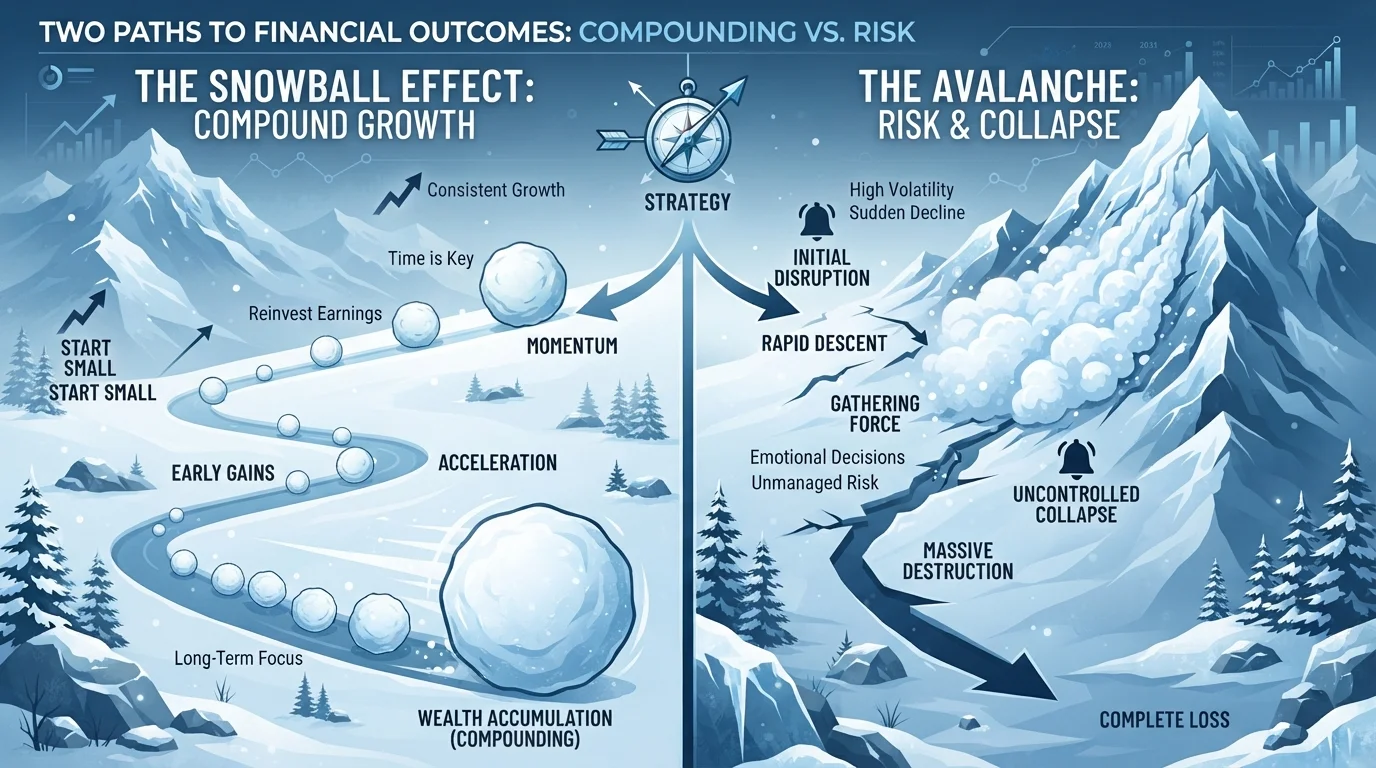
Both the debt snowball and debt avalanche share the same structural foundation: you make minimum payments on every debt, then direct any additional funds toward one target debt at a time. Once that target is eliminated, you "roll" the freed-up payment into the next target — compounding your repayment power over time.
Where the methods diverge is in how they choose that target.
Debt Snowball
With the snowball, you rank your debts by balance from smallest to largest and attack the smallest first, regardless of its interest rate. Each paid-off account frees up cash that gets added to the next minimum payment, creating a growing — snowballing — monthly payment as you progress.
Debt Avalanche
The avalanche ranks debts by annual percentage rate (APR) from highest to lowest. Your extra dollars go to the highest-rate debt first. Because high-rate debt generates the most interest per dollar owed, eliminating it first reduces how much interest accrues on your overall portfolio. Understanding how interest compounds on credit card debt is essential context — compounding means delay is costly.
| Criterion | Debt Snowball | Debt Avalanche |
|---|---|---|
| Payoff order | Smallest balance first | Highest interest rate first |
| Total interest paid | Typically higher | Typically lower |
| Speed to first paid-off account | Faster (smallest balance) | Slower (rate-based targeting) |
| Motivational structure | High — frequent early wins | Lower — wins may come later |
| Mathematical optimality | No | Yes |
| Best when rates are similar | Yes — gap narrows | Less decisive advantage |
| Complexity | Low — simple ranking | Low — simple ranking |
The Real Cost Difference
In mathematical terms, the avalanche almost always wins. When high-rate balances sit untouched while you pay off lower-rate debts, interest compounds daily on those balances, inflating the total amount you repay. The snowball method can cost hundreds or even thousands more in interest over a multi-year payoff, depending on the size of the balances and the spread between interest rates.
However, that cost difference shrinks in two scenarios: when your debts have interest rates that are close together, and when the smallest balance also happens to carry a high rate. In those cases, the practical gap between the two strategies is minor.
~$1,000+
Potential extra interest with snowball vs. avalanche
The dollar difference depends on balance sizes and rate spread; wider gaps between rates produce larger savings from the avalanche approach.
~4 in 10
Americans carrying credit card debt month-to-month
Federal Reserve data consistently shows a significant share of U.S. households revolve a balance, underscoring the practical importance of a structured payoff strategy.
20%+
Average credit card APR in recent years
Federal Reserve data has shown average credit card rates exceeding 20% APR, making high-rate balances expensive to leave unaddressed.
It is worth noting that the best mathematical plan is worthless if it is abandoned. Studies in behavioral economics have consistently found that visible progress increases commitment — a core reason many financial counselors still recommend the snowball for clients who have previously dropped payoff plans. For a broader look at how debt strategy fits different life circumstances, see responsible borrowing across different life stages.
Choosing the Right Strategy — and Knowing the Alternatives
Selecting between snowball and avalanche is less about finding the universally correct answer and more about honest self-assessment. Ask yourself: Have you started debt payoff plans before and quit? If yes, the snowball's early victories may be worth the added interest cost. Do you have a stable monthly budget and the discipline to ignore early wins in favor of long-term savings? If yes, the avalanche is the more efficient path.
Some borrowers use a hybrid approach — targeting the highest-rate debt unless a small balance is within one or two payments of elimination, at which point they clear it quickly before returning to the rate-based order. This is not a formal method, but it reflects the legitimate trade-off between cost and motivation.
The Hybrid Approach: A Middle Path
Some borrowers effectively combine both methods by generally following the avalanche order but making tactical exceptions when a small balance is close to zero. Clearing that account quickly can provide a motivational boost without meaningfully increasing total interest. There is no official name for this approach, and it requires more active management — but for borrowers who find the pure avalanche demotivating, it can be a practical compromise.
It is also worth considering whether a separate strategy — debt consolidation — might be appropriate before choosing a payoff order. Debt consolidation can simplify repayment, but it is not always the right move and carries its own trade-offs. Similarly, understanding the distinction between secured and unsecured debt matters when prioritising which obligations to address first, since the consequences of default differ significantly by debt type.
This article is for general informational purposes only and does not constitute personalised financial or legal advice. Consult a qualified financial professional for guidance tailored to your individual situation.