
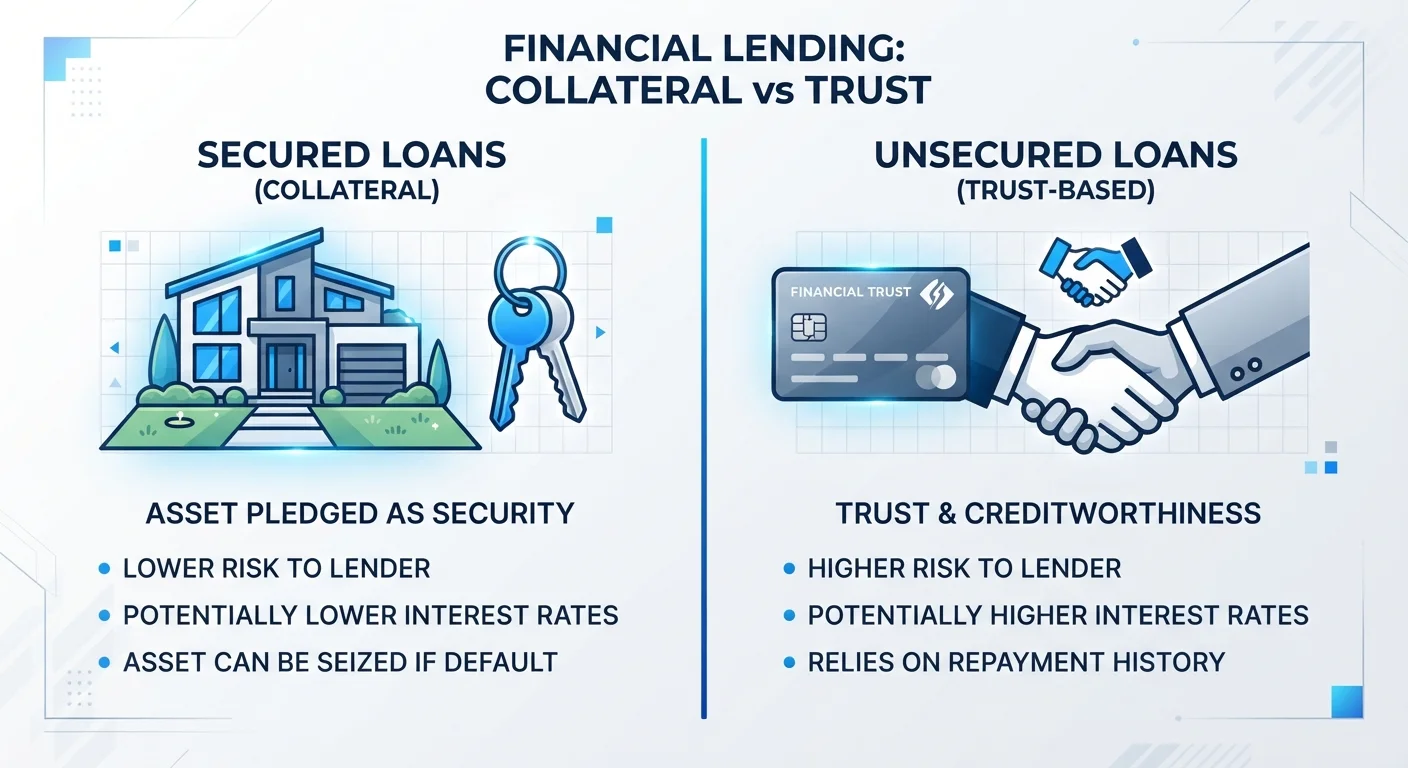
The Core Distinction: Collateral
Every borrowing arrangement comes down to a fundamental question: what happens if the borrower can't repay? Lenders answer that question differently depending on whether the loan is secured or unsecured.
A secured debt is backed by collateral — a specific asset the borrower pledges to the lender. If the borrower defaults, the lender has a legal right to seize and sell that asset to recover what's owed. Common examples include mortgages (secured by the home) and auto loans (secured by the vehicle).
An unsecured debt carries no such pledge. The lender extends credit based on the borrower's creditworthiness — their income, credit history, and debt-to-income ratio. Credit cards, personal loans, and student loans are the most familiar examples. If the borrower defaults, the lender cannot automatically claim a specific asset, though other consequences follow.
For a plain-language breakdown of related terms like APR and charge-off, see the borrower's glossary.
| Criterion | Secured Debt | Unsecured Debt |
|---|---|---|
| Collateral required | Yes — specific asset pledged | No — based on creditworthiness |
| Typical interest rates | Generally lower | Generally higher |
| Common examples | Mortgage, auto loan, HELOC | Credit card, personal loan, student loan |
| Credit requirements | More flexible | Typically stricter |
| Default consequence | Repossession or foreclosure | Collections, lawsuits, wage garnishment |
| Asset at direct risk | Yes — the pledged collateral | No specific asset immediately at risk |
How Collateral Shapes Interest Rates and Approval Odds
The presence or absence of collateral is one of the biggest drivers of loan pricing. Because a secured lender can recover losses by selling the pledged asset, their risk is lower — and that reduced risk is usually passed on to the borrower in the form of a lower interest rate.
Unsecured lenders, by contrast, have no backstop if a borrower stops paying. To compensate for that elevated risk, they typically charge higher interest rates and set stricter qualification standards. A borrower with excellent credit may still qualify for competitive unsecured rates, but the floor is almost always higher than an equivalent secured product.
Approval odds follow the same logic. Secured loans are often accessible to borrowers with limited or damaged credit histories precisely because the collateral limits the lender's downside. Unsecured credit tends to favor borrowers with stronger profiles.
~6%–7%
Average 30-year fixed mortgage rate range
Federal Reserve data shows secured mortgage rates have historically remained significantly below unsecured personal loan rates, reflecting the collateral advantage.
20%+
Typical average credit card APR
The Consumer Financial Protection Bureau has reported average credit card interest rates above 20%, illustrating the premium borrowers pay for unsecured credit.
1 in 10
Americans with debt in collections
Research from the Urban Institute has found a significant share of US adults have debt in collections, underscoring the real-world consequences of default on unsecured obligations.
What Happens When You Can't Pay
The consequences of default differ sharply between the two debt types — and understanding them before you borrow matters.
With secured debt, default gives the lender a clear, legally supported remedy: repossession or foreclosure. Miss enough car payments and the lender can repossess the vehicle. Stop paying the mortgage and the bank can begin foreclosure proceedings on your home. The asset is gone, and if its sale doesn't cover the full balance owed, you may still face a deficiency judgment — a legal ruling requiring you to pay the remaining amount.
With unsecured debt, there is no specific asset to seize immediately. However, lenders are not without recourse. They can report the default to credit bureaus, sell the debt to a collection agency, or sue you in court. A court judgment could result in wage garnishment or bank account levies, depending on state law. The path to consequences is longer, but it still exists.
In either case, missed payments damage your credit score. Once you're managing debt repayment, frameworks like the debt snowball vs. debt avalanche can help you build a structured plan.
Bankruptcy Treats These Debts Differently
In a bankruptcy proceeding, secured and unsecured debts are handled under separate rules. Secured creditors generally have priority claim to the collateral, while unsecured debts may be dischargeable depending on the type of bankruptcy filed. Bankruptcy law is complex and highly situation-specific — anyone considering this path should consult a licensed bankruptcy attorney.
Choosing the Right Type of Debt for Your Situation
Neither secured nor unsecured debt is inherently better — the right choice depends on your financial goals, credit profile, and risk tolerance.
If you're financing a large, specific purchase like a home or vehicle, secured debt is typically the standard path and often the most cost-effective. If you need flexible funds for a major expense and don't want to pledge property, an unsecured personal loan or credit card may serve you better — though at a higher cost. For a side-by-side look at those two options, see personal loan vs. credit card for large expenses.
It's also worth thinking about how debt fits your broader financial picture. The role of borrowing shifts across different stages of life, and what makes sense in your 30s may look very different closer to retirement. See how responsible borrowing across life stages varies from decade to decade.
If you're already carrying multiple debts across both types, consolidation may be worth exploring. Debt consolidation can simplify repayment, but it involves real trade-offs worth understanding before committing.
This article is for general informational and educational purposes only. It is not personalized financial, legal, or investment advice. Consult a qualified financial professional before making decisions about your own borrowing or debt management.