
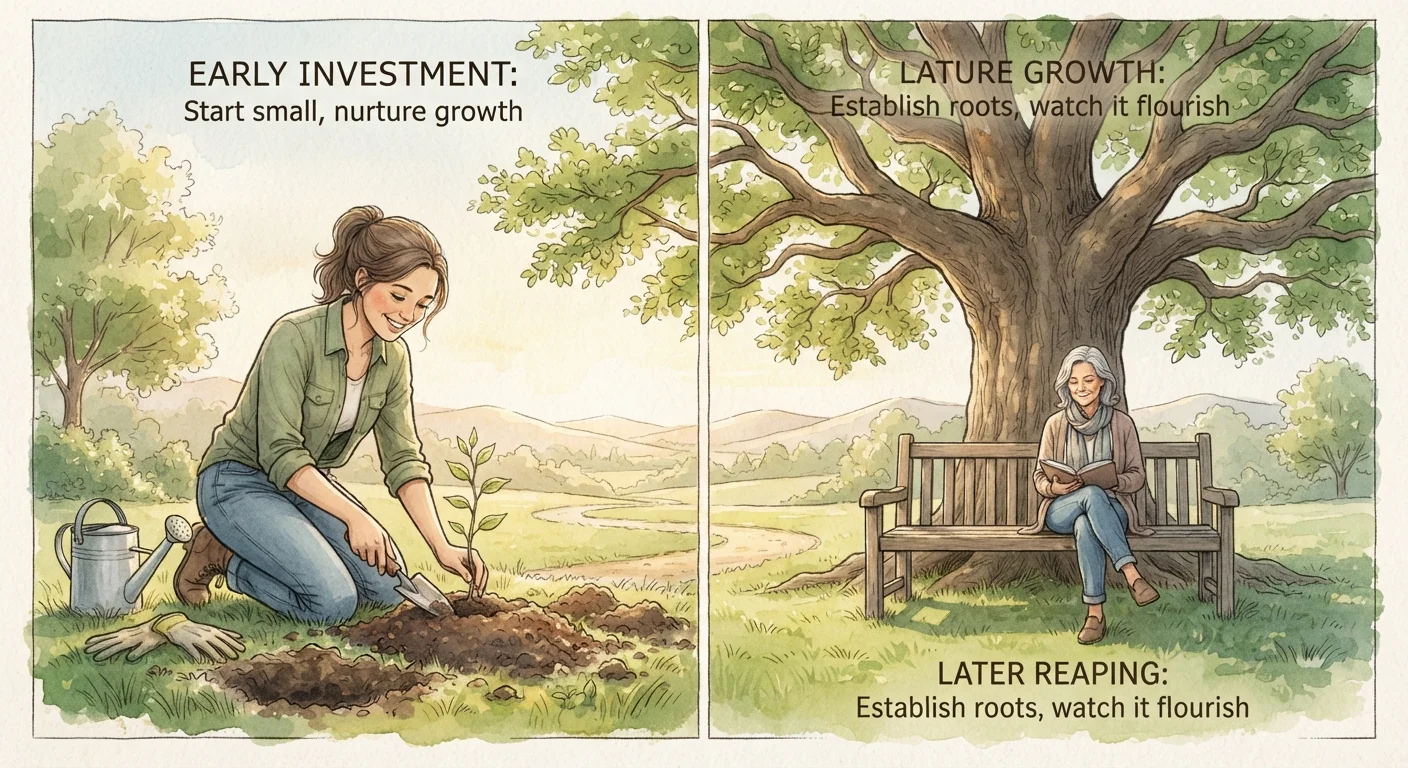
The Real Price of Putting It Off
Most people understand, in a general sense, that saving for retirement early is a good idea. Fewer appreciate how costly the delay actually is. The mechanism at work is compound growth — the process by which returns generate their own returns over time. The longer that cycle runs, the larger the effect. Interrupt it early, and you lose not just the contributions you didn't make, but all the growth those contributions would have produced.
Consider a simple illustration: a person who begins saving at 25 versus one who starts at 35, assuming identical contribution amounts and the same hypothetical average annual return. After decades, the earlier saver can end up with roughly twice as much — not because they saved twice as hard, but because their money had ten extra years to compound. The numbers vary based on real-world factors, but the directional truth holds: time is the most powerful variable in long-term saving, and it can't be recovered once spent.
This article examines the most common mistakes that lead people to delay — and what to do instead. Understanding these patterns is the first step toward acting on them. For a broader view of how saving priorities shift across your working years, see Savings Goals Across Life Stages.
This article is for general informational and educational purposes only and does not constitute personalized financial or investment advice. Consult a qualified financial professional for guidance specific to your situation.
Common Mistakes That Delay Retirement Saving
The following mistakes appear repeatedly among people who arrive at midlife with less saved than they'd hoped. Recognizing them is easier than avoiding them — but both matter.
Assuming there will be a better time to start saving later.
Why it happens: Competing financial pressures — rent, student loans, childcare — make retirement feel like a distant and deferrable priority when money is tight.
Underestimating how much the delay compounds over time.
Why it happens: Human intuition tends to think about growth linearly, not exponentially — making it hard to feel the true weight of missing a decade of compounding.
Waiting until debt is fully paid off before contributing to retirement accounts.
Why it happens: Paying off debt feels tangible and satisfying. Saving for retirement feels abstract. This can lead to an all-or-nothing mindset that prioritizes debt elimination at the complete expense of saving.
Treating retirement saving as optional until income increases.
Why it happens: Lower earners often assume retirement saving is a luxury reserved for those with surplus income, when in fact the habit of saving matters more than the initial amount.
Cashing out retirement accounts when changing jobs.
Why it happens: When leaving an employer, an account balance can feel like a windfall — especially when immediate financial needs are present. The long-term cost of early withdrawal, including taxes and penalties, is often underweighted.
~$0.30
Cost of every dollar not saved at 25 vs. 35
Illustrative modeling using a 7% hypothetical average annual return shows a dollar saved at 25 grows to roughly twice what the same dollar saved at 35 would become by age 65.
56%
Workers with access to a workplace retirement plan
According to the U.S. Bureau of Labor Statistics, roughly 56% of private-sector workers have access to a defined contribution retirement plan through their employer.
10 years
Average delay before workers begin saving
Research from the Employee Benefit Research Institute suggests many workers do not begin contributing to retirement accounts until their mid-to-late 30s, well after the most compounding-rich years.
Building Habits That Make Starting Easier
The most consistent finding in behavioral finance research is that people save more when saving is automatic and effortless. Waiting for a "right moment" to begin — a raise, a paid-off debt, a cleaner budget — usually means waiting indefinitely. Structuring contributions to happen without a decision each month sidesteps that trap entirely.
The Cost of Waiting Cannot Be Recovered
Time lost to delayed saving cannot be made up simply by contributing more later. Higher contributions in later years can narrow the gap, but rarely close it entirely — because those later dollars have far fewer years to compound. The most effective action is always to start now, at whatever level is currently possible, and increase contributions as circumstances allow.
One practical approach is the pay-yourself-first model: directing a portion of each paycheck to a retirement account before it touches your checking balance. Even a small, consistent percentage matters more than a larger amount contributed sporadically. For a step-by-step look at setting this up, Automating Your Savings covers the mechanics in detail.
Pairing automation with a workable budget framework also helps. The 50/30/20 rule and similar frameworks offer structured ways to allocate income so that saving isn't treated as an afterthought. And if market timing feels like a barrier, dollar-cost averaging is a strategy many long-term investors use to contribute consistently regardless of market conditions — reducing the temptation to wait for a "better" moment that may never come.