
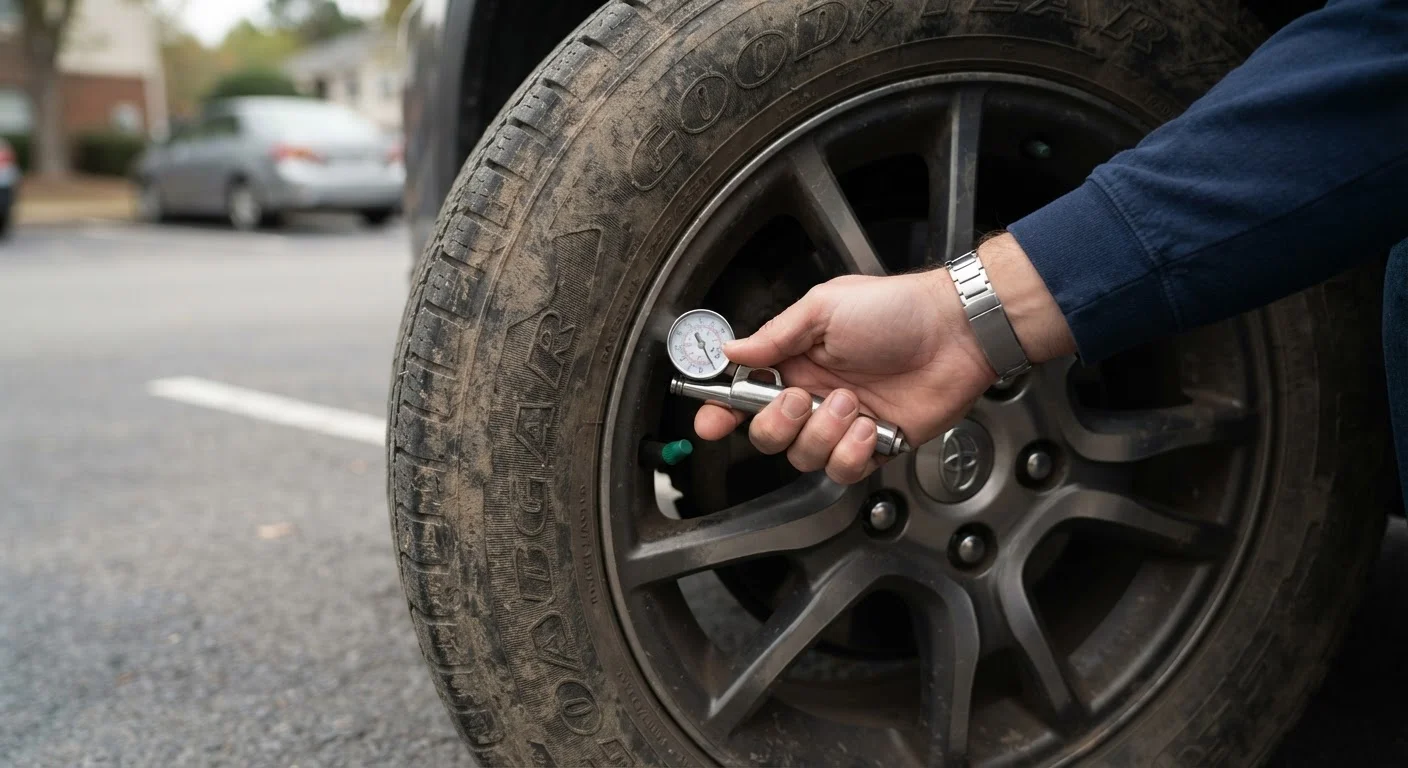
Why These Two Numbers Define Tire Safety
Tires are your vehicle's only contact with the road - four patches of rubber, each roughly the size of a hand. Tire pressure and tread depth are the two measurements that determine how well those patches grip, steer, and stop. Get either number wrong and braking distances increase, hydroplaning risk rises, and blowout likelihood goes up. The good news: you can check both in about five minutes with tools you likely already own.
If your dashboard TPMS light has come on recently, this guide pairs well with our deeper explainer on what that warning light is really telling you - because a simple pressure refill isn't always the whole answer.
Check Pressure Monthly, Not Just When the Light Comes On
TPMS sensors are required on all U.S. passenger vehicles made after 2007, but they typically alert only when pressure drops 25% or more below the recommendation - meaning a tire can be meaningfully underinflated without triggering the light. A monthly manual check with a gauge gives you a much earlier warning and helps catch slow leaks before they become roadside emergencies.
What You Need Before You Start
No special mechanical knowledge is required, but having the right items on hand makes the process accurate and efficient.
What you will need
Tire Pressure Gauge
Measures the air pressure inside each tire in PSI so you can compare it against your vehicle's specification.
Penny
Used for a quick tread depth check - insert it head-down into the tread groove to gauge whether depth has reached the legal minimum.
Quarter
A more conservative tread depth test than the penny - signals when tread is approaching the threshold where wet-road performance declines.
Air Compressor or Pump
Needed to inflate any tire that reads below the recommended PSI.
Step-by-Step: Checking Pressure and Tread Depth
Follow the steps below in order. Checking cold tires - meaning the car hasn't been driven for at least three hours - gives the most accurate pressure reading, because driving heats air inside the tire and temporarily inflates the reading.
Find your vehicle's recommended PSI
Open the driver's door and look for a sticker on the door jamb. It lists the recommended tire pressure in PSI for both front and rear tires. Write this number down - front and rear recommendations sometimes differ.
Remove the valve cap and seat the gauge
Locate the valve stem on the wheel - a small rubber or metal protrusion. Unscrew the cap counterclockwise and set it somewhere safe. Press the gauge firmly and squarely onto the valve stem until the hissing stops. Read the displayed PSI.
Record and compare all four tires
Repeat the measurement on each tire, including the spare if your vehicle has a full-size spare. Note each reading and compare it to the recommended PSI from Step 1. Inflate any tire that falls more than 2-3 PSI below the recommendation, and release air (using the small pin inside the valve stem) from any tire significantly overinflated.
Run the penny tread depth test
Hold a penny with Lincoln's head pointing down and insert it into the tread groove at multiple points across the tire's width. If you can see the top of Lincoln's head at any point, tread depth is at or below 2/32 of an inch - the legal minimum in most U.S. states. That tire should be replaced promptly.
Run the quarter test for an earlier warning
Repeat the coin test using a quarter with Washington's head pointing down. If the top of Washington's head is visible, tread depth is at or below 4/32 of an inch. The tire is still legal, but wet-road stopping distances are beginning to increase. Plan for replacement soon, particularly if you drive in rain or snow.
Sidewall Damage Overrides Both Readings
Even a tire with correct pressure and adequate tread can be dangerous if the sidewall shows bulges, cracks, or embedded objects. Inspect the sidewall visually each time you check pressure. A bulge in the sidewall indicates internal structural damage and the tire should be evaluated by a qualified technician before the vehicle is driven further.
Both tire pressure and tread depth are part of a broader set of maintenance items that drivers routinely overlook. For a full checklist of tasks worth scheduling, see our guide on routine maintenance tasks most drivers forget.
Understanding the Readings and When to Act
Once you have your numbers, here is how to interpret them:
Tire Pressure (PSI)
Your vehicle's recommended PSI is printed on a sticker inside the driver's door jamb - not on the tire itself. The number molded into the tire sidewall is the maximum safe pressure, not the target. Most passenger vehicles fall between 30 and 35 PSI. If your reading is more than 5 PSI below the recommendation, inflate before driving. Overinflation is also a problem: tires inflated too hard wear unevenly down the center and have less road contact. Keep in mind that pressure drops approximately 1 PSI for every 10°F drop in ambient temperature, so cold-weather season often triggers the TPMS light even when nothing is actually wrong with the tire.
Tread Depth
New tires typically start at 10/32 to 11/32 of an inch. U.S. law in most states sets the minimum safe tread at 2/32 of an inch, but safety experts generally recommend replacing tires before they reach 4/32 - especially in wet conditions, where deeper tread channels water away from the contact patch more effectively. If Lincoln's head is fully visible on the penny test, you are legally at or near the limit. If Washington's head is fully visible on the quarter test, you are approaching the point where wet-road grip begins to degrade noticeably.
Uneven tread wear across a single tire can also signal alignment or inflation issues rather than simple age. If one edge is significantly more worn than the other, consult a qualified mechanic. You can also learn more about related dashboard signals - including what a TPMS alert actually indicates - in our guide to dashboard warning lights and what they mean.