
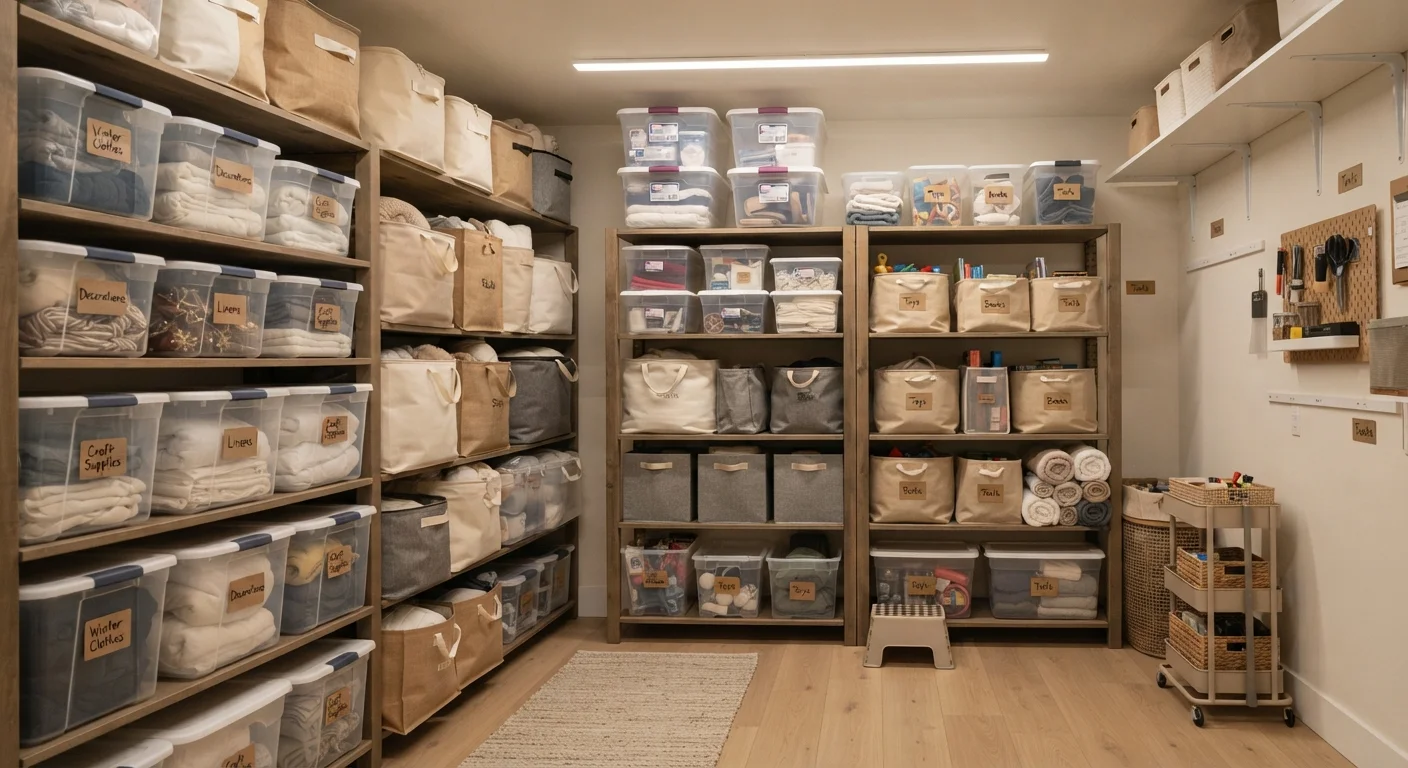
Why Storage Container Type Actually Matters
Most people inherit a mix of storage containers over time — plastic totes from one move, fabric cubes from a closet project, maybe a few wicker baskets. But when you're intentionally outfitting a home for long-term organization, the distinction between hard-sided and soft-sided containers has real consequences for what you can store, where, and how safely.
This isn't a minor stylistic choice. The structural properties of each container type determine whether your holiday ornaments survive three years in the attic, or whether your off-season sweaters fit under a low-clearance bed frame. A room-by-room storage audit is a useful first step before committing to either type — knowing your actual gaps helps you match container to context rather than buying by habit.
| Criterion | Hard-Sided Containers | Soft-Sided Containers |
|---|---|---|
| Structural protection | High — resists crushing and impact | Low — walls flex and compress |
| Moisture and pest resistance | Good to excellent (sealed lids) | Minimal without special lining |
| Stackability | Excellent — flat lids support weight | Limited — soft tops compress unevenly |
| Fits irregular spaces | Poor — fixed dimensions | Good — conforms to tight spaces |
| Storage when empty | Bulky — same footprint as when full | Compact — folds or compresses flat |
| Weight when loaded | Heavier (container adds weight) | Lighter (minimal container weight) |
| Typical best location | Garage, basement, attic | Closet, bedroom, living area |
| Cost range | Moderate to high | Low to moderate |
Hard-Sided Containers: Strengths and Limitations
Hard-sided containers — typically made from polypropylene or other rigid plastics — offer structural integrity that soft options simply can't match. They stack reliably, they don't collapse under weight, and they create a meaningful barrier against moisture, insects, and rodents. This makes them the practical default for garages, basements, and attics where the environment is less controlled.
The downsides are equally real. Rigid containers occupy fixed volume whether full or empty, meaning an off-season bin still claims the same shelf space in July that it does in December. They're also heavier when loaded, which matters if you're moving them solo or storing them overhead. Lids vary in seal quality — a snap-on lid behaves very differently from a gasket-sealed one when humidity is a concern.
~50%
Volume reduction possible with compressed soft bags
Compressible fabric storage bags can reduce the occupied volume of soft goods like sweaters and linens by roughly half when tightly packed, according to general product testing observations.
3–5x
Weight difference: loaded hard bin vs. fabric bin
A fully loaded large plastic storage bin commonly weighs three to five times more than a comparable fabric container holding the same contents, due to the container shell weight alone.
One underappreciated drawback: hard containers with opaque walls obscure contents, leading to "mystery bins" that get reopened unnecessarily. Clear-sided options solve this, but they're typically more expensive and can discolor over time with UV exposure.
Soft-Sided Containers: Where Flexibility Pays Off
Soft-sided storage — fabric cubes, canvas bins, zippered under-bed bags, and collapsible organizers — earns its place in living areas and closets where accessibility and aesthetics matter. Fabric containers can be squeezed into spaces that rigid bins can't reach: the narrow shelf above a closet rod, the tapered space under a platform bed, or the gap beside a water heater.
Compressibility is the defining advantage for seasonal clothing and linens. A soft bag of sweaters can be compressed to half its volume when packed tightly; a rigid bin cannot. When the season ends and the bin is empty, that soft bag folds to almost nothing. This makes soft-sided options genuinely practical for apartments and smaller homes where storage space is itself at a premium.
The trade-offs are structural. Fabric bins that aren't stored on a firm surface can sag, lose shape, and make stacking unreliable. They offer minimal protection from moisture or pests — a concern in humid climates or older homes. If you're thinking about long-term wardrobe planning alongside storage decisions, the capsule vs. full wardrobe comparison offers context for how much clothing storage you might actually need.
Matching Container Type to Storage Context
The most practical approach treats hard-sided and soft-sided containers as complementary tools rather than competing options. A few guiding principles:
- Garage and basement storage: Default to hard-sided. Pest pressure, humidity, and heavy items all favor rigid, sealable bins.
- Closet shelving: Soft fabric cubes work well here — they're lightweight, accessible, and can be labeled without looking institutional.
- Under-bed storage: Flat, soft-sided bags with zip closures maximize the usable depth of low clearance spaces.
- Archival storage (documents, photos, keepsakes): Hard-sided, ideally with a gasket seal, to reduce humidity and physical damage risk over years.
- Frequently accessed items: Soft bins near the point of use; hard bins for items accessed once or twice a year.
A Note on Label and Visibility Strategy
Regardless of container type, a consistent labeling system dramatically reduces the time spent re-opening bins to find items. Hard-sided opaque containers particularly benefit from exterior labels or color-coding. For soft bins, exterior pockets or sewn-on tag loops make labeling easier without tape adhesive issues. Visibility into contents — whether through a clear panel or a detailed label — is one of the highest-value investments in any storage system.
For households doing a larger organization effort — especially when thinking about buying storage containers in bulk — mapping out container needs by room and access frequency before purchasing prevents the common mistake of buying one type uniformly and regretting it in half the rooms.