
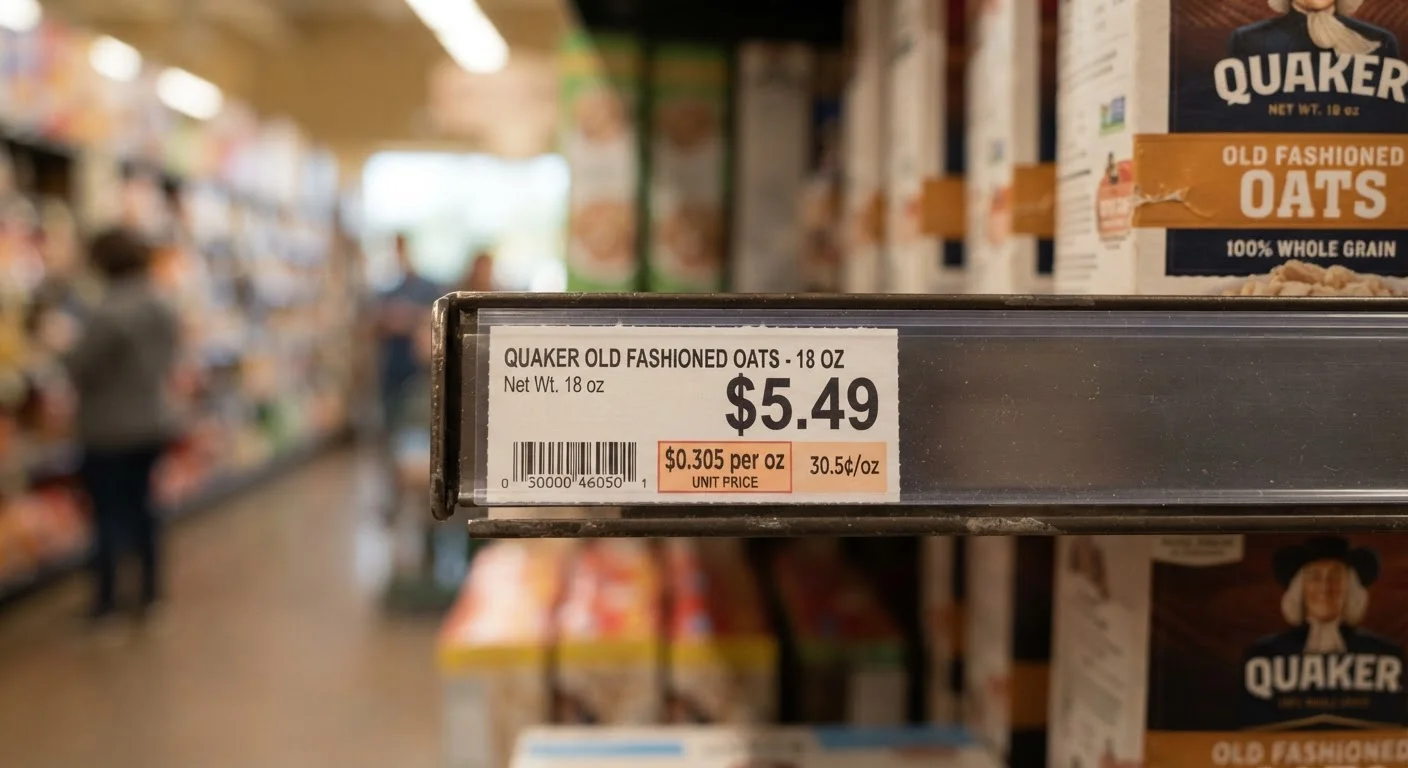
The Number Hiding on Every Shelf Tag
Most shoppers look at two things on a shelf tag: the product name and the total price. That's understandable — they're the biggest, boldest pieces of information. But there's a third number that usually sits in a corner in smaller print, and it's often the most useful figure in the aisle.
The unit price converts a product's total cost into a standard measurement — cost per ounce, per sheet, per count — so that you can compare two products of different sizes on the same terms. Without it, deciding whether a 15-oz can at $1.89 is a better deal than a 28-oz can at $3.49 requires mental arithmetic most of us skip. With it, a glance tells you which one costs less per ounce.
This isn't a budgeting trick requiring spreadsheets or coupons. It's a simple reading habit that takes about two seconds per product once you know what to look for. And it works across grocery staples, cleaning supplies, personal care products, and more.
~30+
U.S. states with some form of unit pricing regulation
Many states mandate unit pricing for grocery and general merchandise retailers, though specific coverage rules vary considerably by jurisdiction.
~$1,500
Estimated annual food waste per U.S. household
According to USDA research, American households discard a significant share of purchased food — a factor that affects the real value of bulk or large-size purchases.
How to Read — and Calculate — a Unit Price
Shelf tags vary by retailer, but the unit price is usually displayed in a smaller font somewhere near the item's name or price bar. Look for language like "$0.22/oz" or "$0.05/ct" — the abbreviation after the slash tells you the unit of measurement being used.
When the unit price isn't shown, or when you want to verify it, the math is straightforward:
- Find the total price (e.g., $3.84)
- Find the total quantity in the unit shown (e.g., 32 oz)
- Divide: $3.84 ÷ 32 = $0.12 per oz
Do the same for a competing product, and whichever number is smaller is the lower-cost option per unit. This works whether you're comparing package sizes of the same product or a store brand against a name brand.
Keep Your Phone's Calculator Handy
When a shelf tag doesn't display a unit price — or displays it in a different unit than a competing product — a quick calculation on your phone resolves the comparison in seconds. Divide the total price by the total quantity shown on the package. This works for any product and any unit of measure.
One caution: make sure the unit of measurement matches. Some shelf tags display cost per ounce while a nearby product uses cost per pound. Convert to the same unit before comparing — 16 oz equals 1 lb, so multiply or divide accordingly.
When the "Deal" Isn't Actually a Deal
Unit pricing exposes one of grocery retail's quiet realities: bigger isn't always cheaper. A bulk-size container of laundry detergent might carry a higher unit price than a mid-size bottle on promotion. A "value pack" of snacks might cost more per ounce than the standard size sitting next to it.
Sale tags add another layer of complexity. A yellow sale sticker highlights the new total price prominently, but it doesn't always tell you whether the unit price has actually dropped to a competitive level. Checking the unit price on sale items takes the same two seconds — and occasionally reveals that a "sale" item is still more expensive per unit than an unsale alternative.
For a broader look at how retail pricing cycles work, understanding when retailers actually discount can help you separate genuine markdowns from routine shelf pricing.
Putting Unit Prices Into a Consistent Shopping Habit
The most effective use of unit pricing isn't a one-time effort — it's a comparison reflex that becomes automatic over time. A few practical approaches:
- Compare before you grab. Pause for a moment at the shelf before reaching for a familiar product. Check the unit price of the size you usually buy and the size next to it.
- Use your phone. If the shelf tag doesn't display a unit price, the division takes about five seconds with a calculator app.
- Watch for unit inconsistency. Retailers occasionally switch between units (ounces vs. pounds, count vs. weight) in ways that obscure comparisons. Normalize everything to one unit before deciding.
Unit pricing pairs well with other deliberate shopping habits. Going into the store with a list, for example, gives you a framework for applying unit comparisons only to the items you actually intend to buy — rather than being pulled into comparisons on impulse items. Unplanned grocery trips tend to cost more for exactly this reason.
For households buying in quantity, it's also worth reading about when bulk buying genuinely makes sense — because a low unit price on a perishable item that goes to waste isn't actually a saving.
If you're working within tighter budget constraints, making the most of a tight shopping budget covers a broader set of strategies that work alongside unit price awareness.