
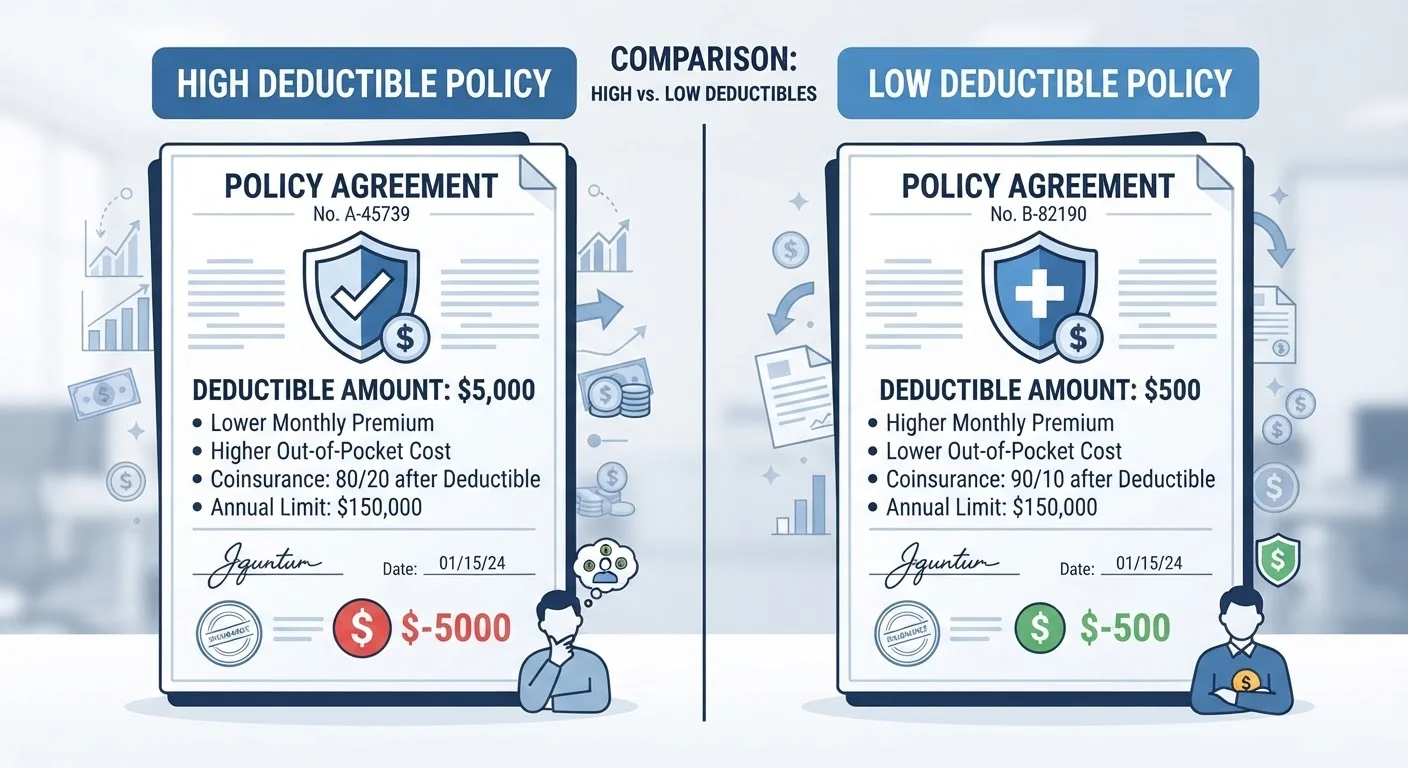
The Real Job a Deductible Does
Most people think of a deductible as a formality — just a number buried in the policy. In practice, it's one of the most consequential decisions in any insurance contract. Your deductible determines the point at which insurance actually becomes useful to you after a loss.
Insurance is designed to protect against financial shocks too large to absorb on your own. A deductible draws a line: small losses stay with you; large losses get shared with your insurer. That line has a direct effect on what you pay in premiums and what you receive when something goes wrong.
For a broader look at how deductibles interact with other cost-sharing features, the guide to deductibles, copays, and coinsurance breaks down all three in one place.
$1,763
Average annual health insurance deductible for single coverage
According to KFF's 2023 Employer Health Benefits Survey, the average deductible for single coverage in employer-sponsored plans was approximately $1,763.
46%
Adults who could not cover a $500 emergency expense from savings
A Bankrate survey found that roughly 46% of U.S. adults would struggle to cover a $500 unexpected expense without borrowing — a figure that underscores the real-world risk of high deductibles.
1–5%
Typical range for percentage-based homeowners deductibles
Percentage deductibles for wind, hurricane, or hail perils commonly range from 1% to 5% of a home's insured value, according to the Insurance Information Institute.
Per-Incident vs. Annual Deductibles
How your deductible resets matters as much as how large it is. Understanding the structure helps you estimate your real exposure over a full year.
Per-Incident Deductibles
Auto and homeowners policies typically apply a deductible each time you file a claim. Back your car into a pole in March and file another claim in October? You pay your deductible twice. This structure means multiple events in a single year can stack up quickly.
Annual Deductibles
Health insurance deductibles work differently — they accumulate across all covered services within a plan year. Once your total out-of-pocket spending on covered services reaches the deductible threshold, your insurer begins sharing costs. That's why a January hospitalization can shift your entire year's cost structure. To understand what happens after you meet your deductible, the article on out-of-pocket maximum vs. deductible explains how the next spending cap works.
Family vs. Individual Deductibles in Health Plans
Many health plans carry two deductible thresholds: one for each individual covered and a higher combined family deductible. Once any single family member meets the individual threshold, coverage kicks in for that person — even if the family threshold hasn't been reached. Understanding which threshold applies to each family member can significantly affect your planning for healthcare costs.
How Deductibles Affect Auto and Home Coverage
In auto insurance, your deductible applies separately to collision and comprehensive coverage. If you carry a $500 collision deductible and a $250 comprehensive deductible, a hailstorm and a fender-bender in the same month means different out-of-pocket costs for each event. Our plain-language auto policy breakdown explains how these coverages and their deductibles fit together.
Homeowners policies introduce an additional wrinkle: percentage-based deductibles. Rather than a flat amount, these are calculated as a percentage — often 1–5% — of your home's insured value. On a $350,000 home with a 2% hurricane deductible, you'd be responsible for $7,000 before coverage applies. This can come as a surprise to homeowners who assumed a flat deductible covered every scenario.
The type of coverage on your policy also shapes how much you actually receive after meeting your deductible. Actual cash value vs. replacement cost coverage is worth understanding alongside your deductible choice.
Choosing a Deductible You Can Actually Use
A deductible only protects you if you can pay it when the time comes. Selecting a high deductible to reduce your premium creates a gap if the savings aren't stored somewhere accessible. The premium savings from a higher deductible are real — but so is the risk of being unable to cover the deductible after an unexpected loss.
A practical approach: treat your deductible amount as the minimum target for a dedicated emergency fund. If your auto deductible is $1,000 and your homeowners deductible is $2,500, having at least $3,500 set aside means a bad month doesn't leave a claim in limbo.
Match Your Deductible to Your Emergency Fund
Before selecting a deductible based on premium savings alone, add up the total deductibles across all your active policies. That combined figure represents the worst-case out-of-pocket scenario in a single bad year. Keeping that amount in an accessible savings account ensures you can actually use the coverage you're paying for.
One more factor worth considering: when a loss amount barely clears your deductible, filing may not be the right move. Claims history can influence future premiums. For more on that calculation, see when filing a claim actually raises your premiums.
This article provides general insurance education and is not personalized insurance, financial, or legal advice. Coverage terms, deductible structures, and regulations vary by provider and state. Always read your actual policy documents and consult a licensed insurance agent for guidance specific to your situation.