
Why the Ingredient List Is Only Part of the Story
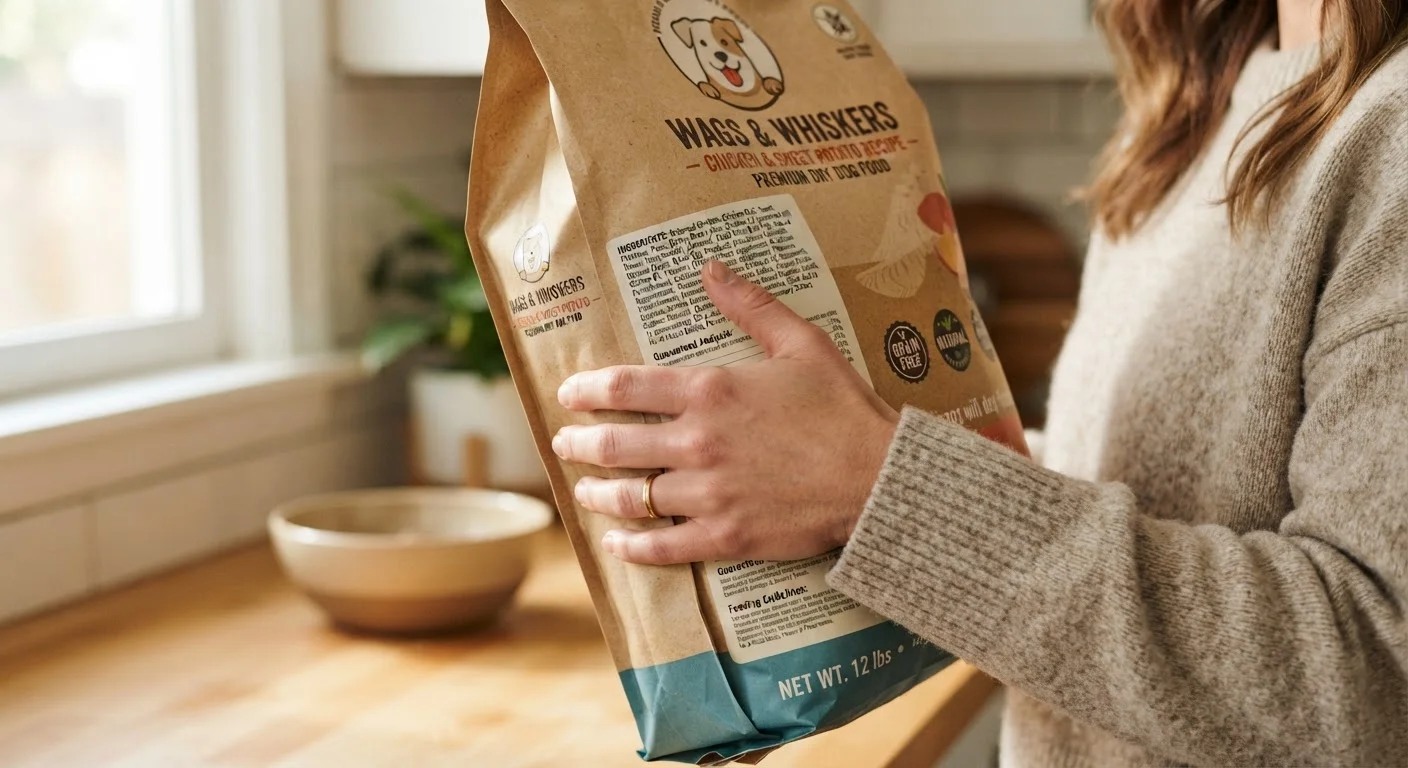
When you flip a bag of pet food over, the ingredient list is usually the first place your eyes land. It's intuitive — you want to know what's in there. But the list works differently than many pet owners expect, and misreading it can lead to conclusions that don't reflect a food's actual nutritional value.
Ingredients are listed in descending order by weight before processing. That means a raw, water-rich ingredient like fresh chicken (which is roughly 70% water) may sit at the top of the list, even though it contributes less protein by dry weight than, say, chicken meal listed third or fourth. This doesn't make fresh chicken a bad ingredient — it's simply how the labeling system works.
For context on how ingredient lists compare to those on human food packaging, the nutrition label decoded guide offers a useful parallel for understanding how panel data is structured and what it can and can't tell you.
Labels Are Regulated, But Not All Claims Equally
AAFCO defines specific terms like 'by-product,' 'meal,' and 'complete and balanced,' which gives those words legal meaning. However, terms like 'premium,' 'holistic,' or 'natural' have limited or no regulatory definitions in the U.S. They may reflect genuine quality, or they may primarily be marketing language — the label itself won't tell you which.
The ingredient list and the guaranteed analysis panel work together. Neither tells the complete story alone. A high-quality ingredient list paired with a guaranteed analysis that shows adequate protein, fat, and fiber levels gives you a more complete view of what you're feeding your pet.
Decoding Common Terms: Meal, By-Products, and More
Some of the most misunderstood words on a pet food label have specific, regulated definitions under AAFCO. Knowing what they actually mean removes a lot of unnecessary anxiety.
- Chicken meal — This is rendered (cooked down and dried) chicken flesh. Because the moisture has been removed, it's actually a concentrated protein source. 'Meal' listed as the second or third ingredient can represent a substantial protein contribution.
- By-products — AAFCO defines poultry by-products as the clean parts of slaughtered birds, such as organs (liver, kidneys, lungs), not including feathers or intestinal contents. Organ meats are nutrient-dense. The regulatory definition exists precisely to prevent truly indigestible material from being included.
- Natural flavors — These are derived from animal or plant sources and used in small quantities to improve palatability. They're not nutritional contributors but are generally recognized as safe.
- Preservatives (mixed tocopherols, rosemary extract) — These are naturally derived antioxidants used to prevent fat from going rancid. Synthetic preservatives like BHA and BHT are also used in some foods and are considered safe at approved levels by the FDA.
Scan for Ingredient Splitting Before Judging a List
If you see multiple forms of the same ingredient listed separately — like 'wheat flour,' 'wheat bran,' and 'wheat germ' — add them together mentally. Their combined weight might place that ingredient higher on the list than any single form suggests. This doesn't automatically make the food poor quality, but it gives you a more accurate read of the formula.
Scanning an ingredient list for repeated forms of the same base ingredient — such as 'ground corn,' 'corn gluten meal,' and 'corn syrup' — is a useful habit. This practice, called ingredient splitting, can make a single ingredient appear less dominant than it actually is in the total formula.
The Guaranteed Analysis: What the Numbers Mean
Below or beside the ingredient list, you'll find the guaranteed analysis panel. This shows the minimum percentages of crude protein and crude fat, and the maximum percentages of crude fiber and moisture. These figures aren't exact nutrient amounts — they're guarantees that the product won't fall below (or exceed) stated thresholds.
80%+
Moisture content in typical wet pet foods
Because wet foods are mostly water, their label percentages for protein and fat are naturally lower and require dry-matter conversion for accurate comparison with kibble.
40+
Nutrients covered by AAFCO dog and cat profiles
AAFCO's nutrient profiles specify minimum (and sometimes maximum) levels for proteins, fats, vitamins, and minerals that a 'complete and balanced' food must meet.
Crude protein is the term that trips up the most readers. It's calculated by measuring nitrogen content in the food and multiplying by a standard conversion factor — it's a chemical proxy, not a direct count of digestible protein. A food with high crude protein from a well-digestible source is nutritionally different from one hitting the same number through less digestible ingredients, even if the label figures look identical.
Moisture content matters especially when comparing wet and dry foods. A wet food showing 10% crude protein and a dry food showing 30% may actually deliver similar protein levels on a dry-matter basis once water is removed from the equation. Understanding this helps you make fair comparisons across food formats. For a deeper look at how food format affects nutritional profiles, see our guide on dry kibble vs. wet food.
What 'Complete and Balanced' Actually Requires
Of all the claims on a pet food label, 'complete and balanced' is arguably the most meaningful — and the most regulated. To use this phrase, a manufacturer must show the food meets AAFCO's nutrient profiles for a stated life stage (adult maintenance, growth, all life stages, etc.), either through formulation or through feeding trials.
Foods that haven't met these standards must be labeled 'for supplemental feeding only' or carry similar language indicating they shouldn't be used as a sole diet. If a food you're considering doesn't include a life-stage statement at all, that's worth noting.
The life-stage claim also matters in practice. A food formulated for 'all life stages' meets the higher nutrient requirements of growth and reproduction — appropriate for puppies or kittens, but potentially more calorie-dense than an adult or senior pet needs.
Pet food science continues to evolve, and debates about different feeding approaches are common. For a research-grounded overview of how commercial pet food compares to alternative diets, the raw diet vs. commercial kibble article covers what veterinary nutritionists currently say about both approaches.
This article is for general informational purposes only and is not a substitute for advice from a licensed veterinarian or veterinary nutritionist. Always consult a qualified professional before making significant changes to your pet's diet.