
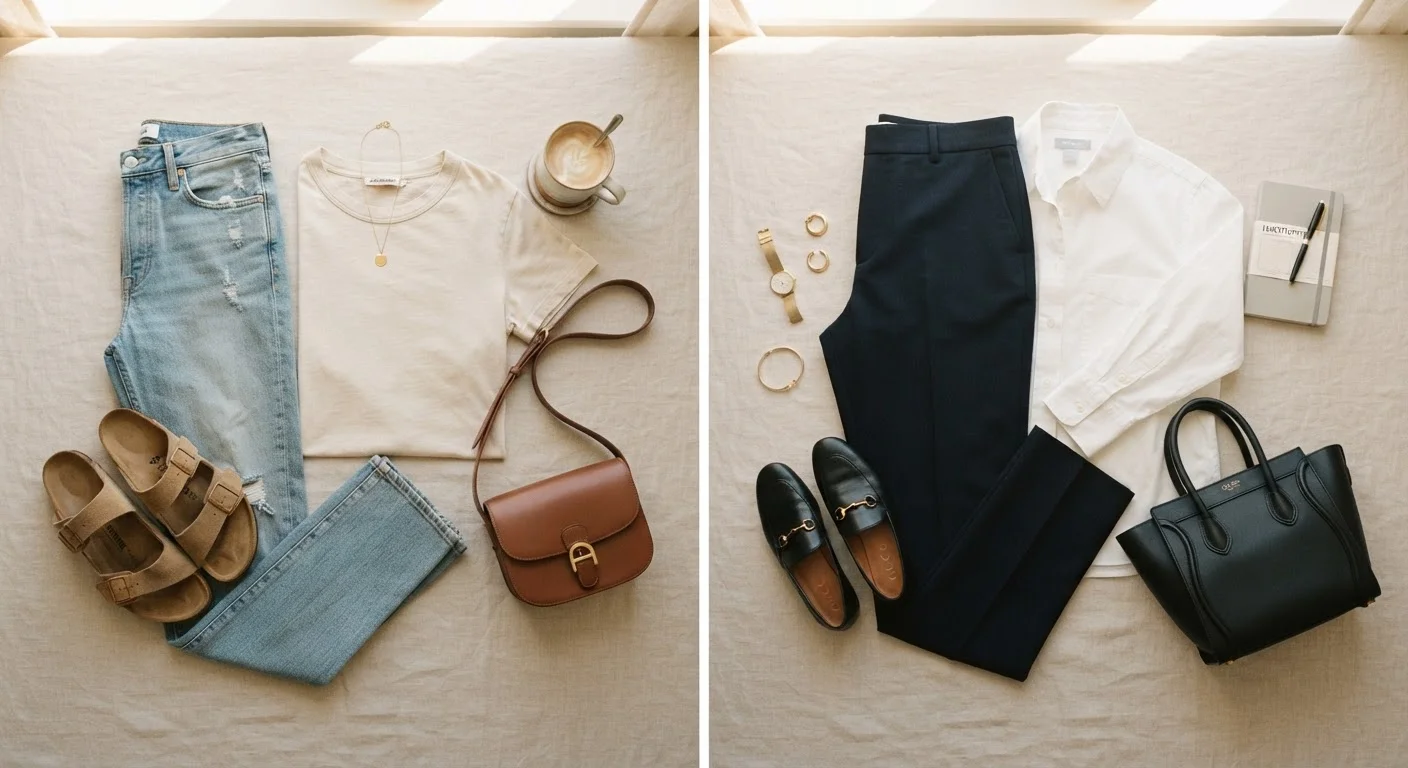
What We Actually Mean by Casual and Polished
In everyday American life, "casual" and "polished" get used loosely — often as stand-ins for comfort and effort, respectively. But neither word is a fixed destination. Casual dressing typically emphasizes relaxed silhouettes, soft or durable fabrics, and minimal construction details: think well-worn jeans, knit tops, sneakers, and outerwear built for movement. Polished dressing leans toward intentional fit, structured pieces, and finishes that read as considered — tailored trousers, button-front shirts, leather-soled footwear, or clean layering.
What matters is that both are context-dependent. A pressed Oxford shirt is polished at a job interview and overdressed at a weekend farmers market. Understanding that the spectrum is relative — not absolute — is the first step toward dressing with real confidence. For a deeper look at how specific dress code labels map to this spectrum, see our guide to decoding dress codes.
Casual vs. Polished: How They Compare Across Key Dimensions
The table below breaks down how each approach performs across the dimensions that matter most to everyday dressers. Neither column is the winner — the right answer depends on your day.
| Casual Dressing | Polished Dressing | |
|---|---|---|
| Physical comfort | High — relaxed fit and soft fabrics | Moderate — depends on construction |
| Versatility across contexts | Limited in formal or professional settings | Strong across most everyday and formal contexts |
| Getting-dressed effort | Low — fewer decisions required | Moderate — fit and coordination matter more |
| Perceived intentionality | Varies widely with execution | Consistently reads as considered and prepared |
| Cost to build | Generally lower entry point | Can range widely; quality construction costs more |
| Longevity of pieces | Depends heavily on fabric quality | Structured pieces often last longer with care |
| Ease of seasonal transition | High — many casual pieces layer naturally | Moderate — tailored layers require more planning |
One pattern emerges clearly: polished dressing often wins on perception and versatility in formal contexts, while casual dressing wins on accessibility and physical ease. The smartest wardrobe strategy borrows strengths from both.
The Case for Staying Casual — Done Right
Casual dressing gets a bad reputation when it slides into thoughtlessness — mismatched proportions, worn-out fabrics, or clothing that visibly telegraphs "I didn't think about this." But intentional casual dressing is one of the most practical choices an everyday American can make.
The key levers are fit and fabric quality. A well-fitted cotton crewneck in a clean color reads dramatically more put-together than an oversized, pilled one — even though both are technically casual. Similarly, dark, unwashed denim in a straight or slim cut crosses into smart-casual territory with very little effort. Footwear is the fastest upgrade: swapping athletic sneakers for a clean leather or canvas low-top changes the register of an entire outfit.
The Fit Rule Always Applies
Whether you're going casual or polished, fit is the single most powerful variable you control. Clothes that fit your actual body — not an aspirational or remembered size — always look more intentional. If something you love doesn't fit well off the rack, basic tailoring alterations (hemming trousers, taking in a side seam) are often more affordable than people assume and dramatically change how a piece reads.
Casual dressing also supports the kind of physical mobility most Americans need day-to-day — commuting, caring for kids, running errands, or heading to the gym. When your clothes work with your body rather than against it, confidence tends to follow naturally. Explore how occasion dressing fits into a cohesive personal style without fragmenting your wardrobe.
The Case for Polished Dressing in Everyday Life
Polished dressing carries real social utility — not because formality signals superiority, but because it communicates intentionality. In professional settings, client-facing roles, or social occasions where first impressions carry weight, a more structured look can reduce the cognitive load of being perceived as prepared and competent.
The misconception is that polished requires discomfort or expense. Modern tailoring has moved toward softer constructions: unlined blazers, stretch-woven trousers, and knit dress shirts that hold their shape without restricting movement. These pieces do the work of looking put-together without asking you to suffer for it.
Polished everyday dressing also tends to be highly versatile across contexts. A well-fitted pair of dark trousers and a clean, tucked-in top can move from a morning meeting to an after-work dinner with minimal adjustment. That kind of outfit ROI is worth the slightly higher effort of getting dressed. If your workplace has no defined dress code, our article on dressing when there's no office dress code offers a practical framework.
Avoid Polished Dressing That Limits Your Day
If a more formal outfit makes you physically self-conscious, restricts your movement, or requires you to think about it all day, it's working against you — not for you. Polished dressing is only an asset when it becomes second nature. Start by incorporating one or two structured pieces into an otherwise casual outfit rather than overhauling your entire approach at once.
Building a Wardrobe That Moves Fluidly Between Both
The most functional everyday wardrobe isn't exclusively casual or polished — it's spectrum-aware. That means stocking pieces that can shift register depending on how they're styled. A few principles make this easier:
- Invest in versatile mid-register pieces. Chinos, dark jeans, simple dresses, and neutral knitwear sit comfortably between both ends and respond to styling cues in either direction.
- Use layering as a dial. Adding a blazer or structured jacket to a casual base outfit moves it toward polished. Removing it — or swapping dress shoes for clean sneakers — brings it back down. See our guide on dressing well across seasons without a wardrobe overhaul for layering strategies that also work across climates.
- Pay attention to color coherence. A palette of coordinating neutrals and a few accent tones makes mixing casual and polished pieces feel intentional rather than accidental. Our breakdown of neutral colors in everyday dressing explores what a neutral-first approach does — and doesn't — accomplish.
The goal isn't a perfectly curated capsule wardrobe. It's a collection of clothes you actually wear, that actually fit, and that give you enough range to show up confidently wherever your day takes you. For an end-to-end framework, The Complete Everyday Style Playbook for American Adults covers closet fundamentals through real-life dressing situations.