
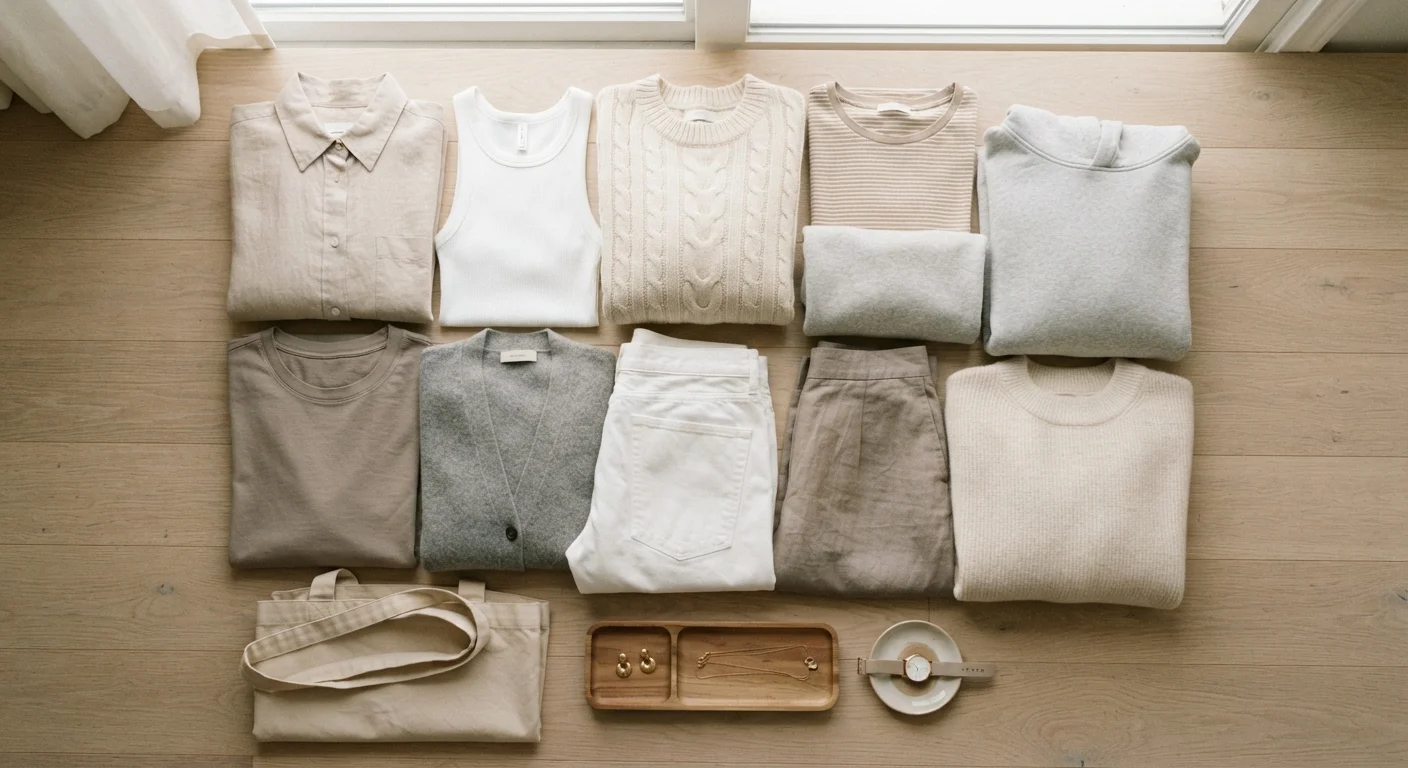
Why Americans Gravitate Toward Neutrals
Walk into most American closets and you'll find a familiar landscape: rows of navy, grey, black, white, and beige. This isn't accidental. Neutral wardrobes emerge from a combination of practical reasoning, cultural messaging, and sheer convenience. When getting dressed in the morning already competes with a full schedule, a closet that practically dresses itself holds serious appeal.
Retailers have reinforced this tendency for decades, often marketing neutral basics as the "foundation" every wardrobe needs. Fashion advice columns consistently recommend building from a neutral core outward. The result is that many people arrive at a nearly monochrome closet not through deliberate curation, but through accumulated defaults.
Understanding whether that default is actually serving you — or just easy — is the first step toward dressing with more intention. For a broader look at how dressing choices connect to your daily life, the Complete Everyday Style Playbook for American Adults covers the full picture.
The Real Advantages of a Neutral Wardrobe
There's a reason neutral dressing has staying power — it solves real problems that color-heavy wardrobes can create.
Effortless mix-and-match across the entire closet
When every item shares a tonal family, almost any combination works — reducing the mental load of getting dressed to nearly zero.
Works across a wide range of occasions and settings
A grey blazer or white button-down can move from a casual Friday to a professional meeting with minimal adjustment, offering genuine versatility.
Resists seasonal trend cycles more effectively
Neutral pieces rarely feel dated the way bold trend colors do, meaning items tend to stay wearable and relevant for longer.
Easier to maintain visual cohesion in photos and public settings
Neutral tones tend to photograph cleanly and don't clash with varied environments, which matters for anyone with a public-facing job or social presence.
Reduces decision fatigue significantly
Studies on cognitive load suggest that reducing trivial daily decisions frees mental energy for higher-stakes choices — a closet that largely coordinates itself is a genuine time saver.
~60%
Americans report wearing neutral tones most often
Consumer survey data from apparel research firms consistently shows that black, white, grey, and beige dominate everyday American wardrobe choices across all age groups.
35%
Reduction in morning decision time with a cohesive palette
Wardrobe consultants and productivity researchers frequently cite simplified color palettes as one of the most practical ways to reduce daily decision fatigue.
Beyond the logistics, neutrals tend to have longer perceived lifespans. A well-made beige trench or charcoal crewneck doesn't read as last season the way a bold trend color might. For anyone who wants their wardrobe to transition smoothly across seasons, neutrals are natural allies.
Where Neutral-Only Dressing Falls Short
The downsides of an all-neutral wardrobe are real, even if they're less immediately obvious than the benefits.
Suppresses personal style and self-expression
Clothing is one of the most accessible forms of self-presentation, and an entirely neutral wardrobe can flatten the visual signals you send about your personality and mood.
Can make outfits feel interchangeable and monotonous
When everything coordinates seamlessly, individual outfits can start to blur together — making getting dressed feel functional rather than enjoyable.
Misses the mood-lifting potential of color
Color psychology research, while still developing, consistently points to the role that certain hues play in influencing energy, confidence, and emotional state throughout the day.
Requires texture and fit to carry all visual interest
Without color as a tool, every dimension of an outfit must work harder — a poorly fitted neutral piece has nowhere to hide, whereas a great color can distract from minor imperfections.
May reflect avoidance rather than intentional choice
Many people land in neutral wardrobes not from a clear style philosophy but from uncertainty about color — which means the wardrobe reflects hesitation rather than confidence.
When Neutrals Become a Style Rut
There's a meaningful difference between choosing neutrals because they genuinely reflect your aesthetic and defaulting to them because color feels risky or overwhelming. If you've ever stood in front of a full closet feeling like you have nothing to wear, a lack of color variety may be contributing — not just a lack of clothes. Periodically auditing your wardrobe for intentionality (not just quantity) is worth the effort.
There's also an emotional dimension worth naming. Research in color psychology suggests that the colors we wear can influence how we feel throughout the day — though individual responses vary widely and this is far from a prescriptive science. Choosing color deliberately, rather than avoiding it by default, gives you one more tool for showing up how you want to.
Building a Neutral Base That Doesn't Feel Bland
The goal isn't to abandon neutrals — it's to use them intentionally. A strong neutral foundation functions like a sentence structure: it creates the framework that makes everything else legible. The key is treating neutrals as a starting point, not an ending point.
Texture is your first upgrade. A cream cable-knit sweater and a white poplin shirt are technically the same color family, but they read completely differently on the body. Mixing matte and shine, smooth and nubby, structured and draped within a neutral palette adds dimension without adding complexity.
From there, consider what wardrobe staples earn their keep in your actual life — the pieces that move fluidly from coffee to meetings to casual dinners. Neutrals that work hard across contexts are genuinely worth the closet space.
If color feels intimidating, building a personal color palette doesn't mean throwing out your grey tees. It means identifying two or three hues that genuinely energize you and adding them in manageable ways — a scarf, a bag, one statement piece per outfit.
And if you're navigating the question of how dressed-up or dressed-down your everyday look should be, understanding the casual-to-polished spectrum can help you find a register that feels natural rather than performative.