
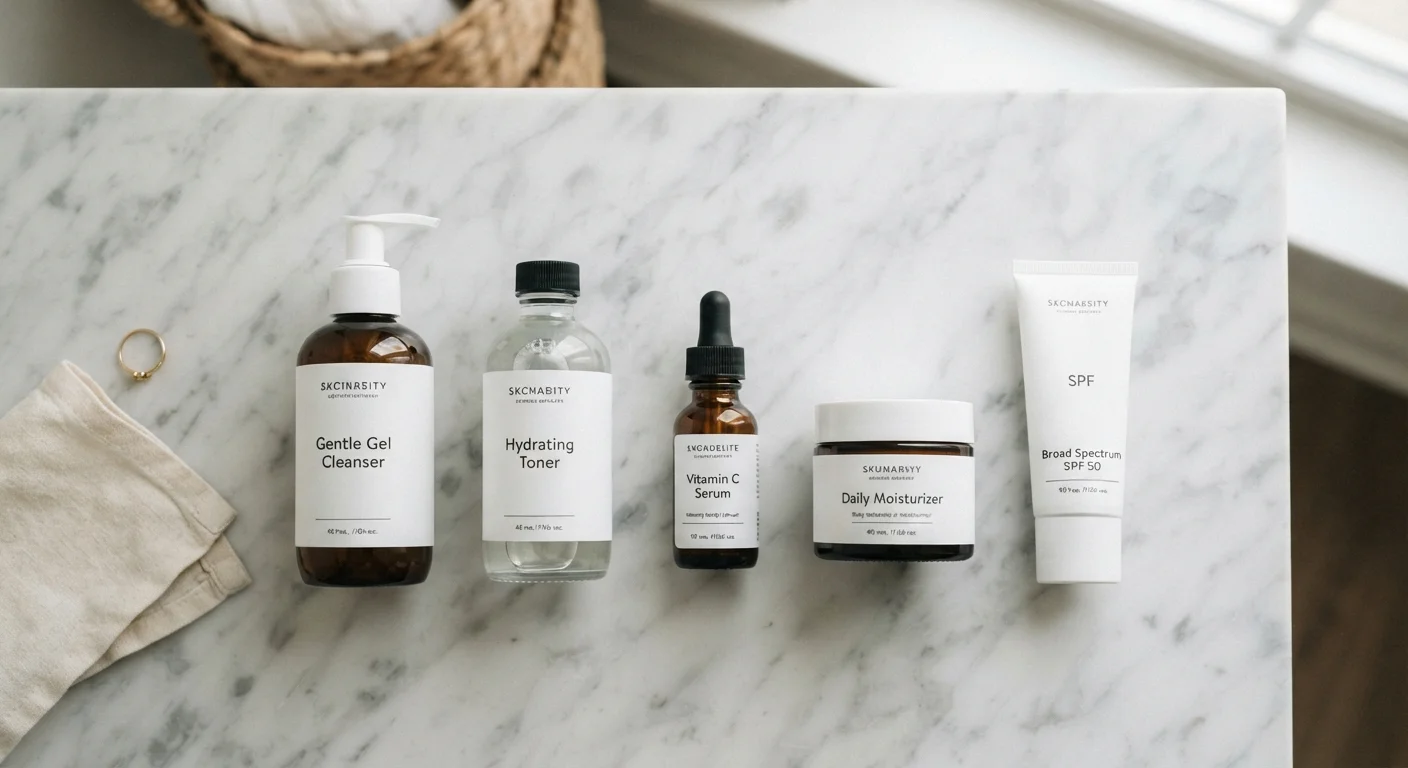
Why Concern-Based Routines Work Better Than Generic Ones
Most skincare advice starts with skin type — oily, dry, combination — but a skin concern tells you what a routine actually needs to do. Dryness calls for barrier support. Acne calls for targeted ingredient choices. Dullness calls for gentle exfoliation and circulation support. These goals require different tools, and mixing them up is exactly how routines stall.
Before building or adjusting your routine, get grounded in your skin type first. Our guide to understanding skin types explains how type and concern often overlap — and where they diverge. Once you have both pieces of the picture, selecting ingredients becomes far less overwhelming.
| Key concern: Dryness | Prioritize barrier repair with humectants + emollients |
| Key concern: Acne | Salicylic acid or benzoyl peroxide + lightweight moisturizer + SPF |
| Key concern: Dullness | AHA exfoliation + vitamin C + consistent SPF |
| Key concern: Hyperpigmentation | Niacinamide, vitamin C, and strict daily sun protection |
| Golden rule | Introduce one new active at a time; wait 2–3 weeks before adding another |
| Minimum effective routine | Cleanser, moisturizer, SPF (AM) + targeted treatment (PM) |
Dryness: Rebuilding the Moisture Barrier
Dry skin lacks sufficient lipids in the outermost layer, leaving it prone to tightness, flaking, and sensitivity. The goal isn't just adding water — it's keeping it in.
- Cleanse gently. Foaming cleansers that strip the skin worsen dryness. Cream or oil-based formulas preserve natural oils.
- Layer humectants, then seal. Humectants like hyaluronic acid pull moisture into the skin; follow immediately with an occlusive or emollient moisturizer to lock it in.
- Avoid over-exfoliating. Physical scrubs can micro-tear already compromised skin. If exfoliation is needed, a low-concentration lactic acid used once or twice a week is generally gentler.
- At night, go richer. Skin loses more moisture while you sleep. A thicker moisturizer or a facial oil over your regular moisturizer supports overnight repair. See what a nighttime routine actually does for your skin to understand the repair window.
Acne: Targeting Breakouts Without Overdoing It
Acne has multiple triggers — excess sebum, bacteria, clogged pores, inflammation — and the most effective routines address more than one. Ironically, over-treating acne is one of the most common mistakes: stripping the skin triggers more oil production, creating a frustrating cycle.
- Use a gentle, non-comedogenic cleanser twice daily. Harsh soaps disrupt the pH balance and can worsen inflammation.
- Introduce actives gradually. Salicylic acid (a beta-hydroxy acid) is oil-soluble and penetrates pores to clear congestion. Benzoyl peroxide reduces acne-causing bacteria. Using both simultaneously can cause excessive dryness — alternate them if needed.
- Don't skip moisturizer. Even oily, acne-prone skin needs hydration. Lightweight, gel-based formulas work well.
- Sunscreen is non-negotiable. Post-breakout marks darken with UV exposure. A daily SPF 30 or higher prevents this from worsening. Our morning routine guide walks through how to layer SPF correctly.
A Note on Prescription Acne Treatments
Some forms of acne — cystic breakouts, widespread inflammation, or cases that don't respond to over-the-counter products — may benefit from a dermatologist's evaluation. Prescription options like topical retinoids or oral medications exist, but they require medical guidance. If OTC routines haven't made a dent after several consistent weeks, a professional consultation is a reasonable next step.
Dullness and Hyperpigmentation: Brightening From the Inside Out
A dull complexion is often a buildup problem: dead cells accumulating faster than they shed, or melanin deposits left behind from old breakouts or sun exposure. Both are addressable, but patience is essential — most brightening ingredients take several weeks to show visible results.
- Exfoliate consistently. AHAs like glycolic acid or mandelic acid accelerate cell turnover. Start with once or twice a week to gauge tolerance.
- Reach for niacinamide. This form of vitamin B3 helps fade hyperpigmentation and supports an even tone without the irritation potential of some other actives. It's also compatible with most other ingredients — a rare quality.
- Vitamin C in the morning. A vitamin C serum in your AM routine offers antioxidant protection and brightening support. It works best under SPF. For a deeper look at how these actives interact, see our ingredient reference guide.
- SPF daily, non-negotiably. Without UV protection, hyperpigmentation will continue to deepen regardless of what else you use.
Humectant
An ingredient that draws water from the environment or deeper skin layers into the outermost skin layer. Common examples include hyaluronic acid and glycerin.
Occlusive
An ingredient that forms a physical barrier on the skin's surface to prevent moisture from evaporating. Petrolatum and certain plant waxes are common occlusives.
AHA (Alpha-Hydroxy Acid)
A class of water-soluble exfoliating acids — including glycolic, lactic, and mandelic acid — that dissolve the bonds between dead skin cells to encourage shedding and cell turnover.
BHA (Beta-Hydroxy Acid)
An oil-soluble exfoliating acid, most commonly salicylic acid, that penetrates into pores to clear congestion. Particularly useful for acne-prone or oily skin.
Niacinamide
A form of vitamin B3 used topically to help even skin tone, reduce the appearance of enlarged pores, and support the skin barrier. Known for being well-tolerated and compatible with most other ingredients.
Hyperpigmentation
Patches of skin that appear darker than the surrounding area due to excess melanin production. Common causes include sun exposure, post-acne marks, and hormonal changes.
Non-comedogenic
A term used to describe products formulated to avoid clogging pores. Commonly applied to moisturizers, sunscreens, and foundations intended for acne-prone skin.
Emollient
An ingredient that softens and smooths the skin by filling in gaps between skin cells. Emollients like ceramides and fatty acids help restore a compromised skin barrier.
Keeping It Manageable: Routine Principles That Apply to Every Concern
No matter your concern, a few principles hold across the board. Introduce new actives one at a time — waiting two to three weeks before adding something else — so you can tell what's helping and what's causing irritation. Patch test unfamiliar products on a small area first.
Understand that serums and moisturizers serve genuinely different purposes: this breakdown of serums vs. moisturizers clarifies when each earns its place. And remember: a shorter, consistent routine outperforms a complex, irregular one almost every time. If your shelf is overwhelming you, a look at what's truly essential vs. extra can help you edit confidently.
This article is for general informational purposes only and does not constitute medical or dermatological advice. If you have persistent, severe, or worsening skin conditions, consult a licensed dermatologist or qualified healthcare professional.